This week, some of the stories on our show inspired college student art — including a vivid image of a bear smashing a clarinet. Also, a Hare Krishna community in West Virginia serves vegetarian food made in three sacred kitchens. And, COVID-19 exposed the contempt society has for marginalized people. One author says, these folks are anything but passive.
WVPB Reporters Look Back On 2025 ‘Favorite Stories’
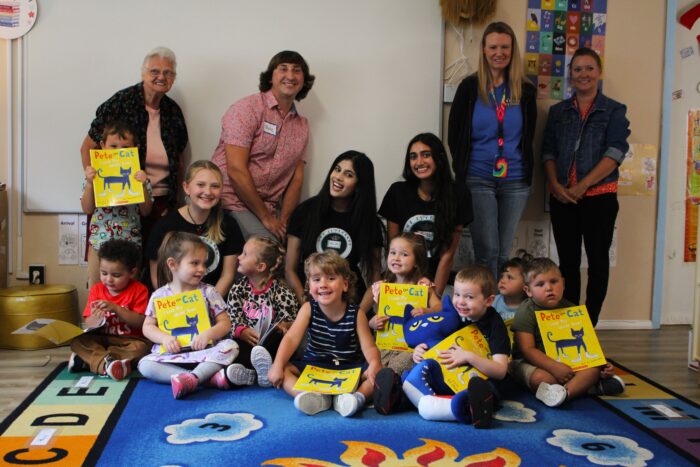
The Webster Head Start classroom in Grafton poses with volunteers from the LiTEArary Society who came to read and donate copies of "Pete the Cat: I Love My White Shoes" Sept. 4, 2025.Chris Schulz/West Virginia Public Broadcasting
Share this Article
Throughout the course of the year, West Virginia Public Broadcasting reporters and producers may create hundreds of stories. There are news “spots” that run less than a minute, “super spots” that go under two minutes. Then there are features and interviews. They all serve a purpose when they are broadcast – to inform or to educate on what’s happening in our state. And every one of them is important.
But some are favorites. We remember the story behind the story.
Below are some of those stories that we were proud to tell in 2025. We’re all looking forward to seeing the stories we get to bring our listeners and readers in 2026.
Randy Yohe, Huntington bureau chief/reporter
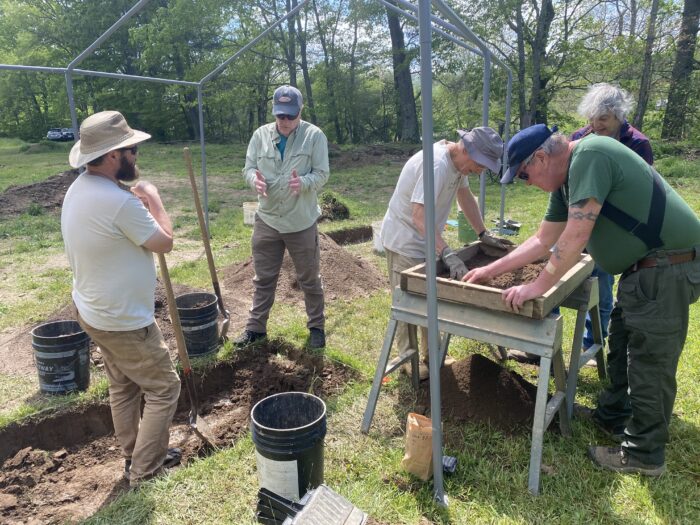
Volunteers work with archeologists to sift for Fort Warwick artifacts.
Photo Credit: Randy Yohe/West Virginia Public Broadcasting
These two stories are special to me because my wife Vickie was with me on both. She loves archeology, so a dig at Fort Warwick was an exciting pleasure for her. We both love Fasnacht, this was our third, and we made paper mache masks this time to really participate in the festivities. They both have fun sound and compelling interviews. Besides, she’s a heck of an editor!
But my favorite stories for the year are a bit different. I love conducting interviews with people and finding out more than just a soundbite. So, when I got the opportunity to interview Fresh Air‘s Terry Gross, considered one of the best interviewers of all time, I jumped at the chance.
My second favorite story really got me out of the office. I produced a story of a coral reef nursery in the Florida Keys, combining my love of scuba diving and storytelling.
Liz McCormick, director of digital/Eastern Panhandle bureau chief
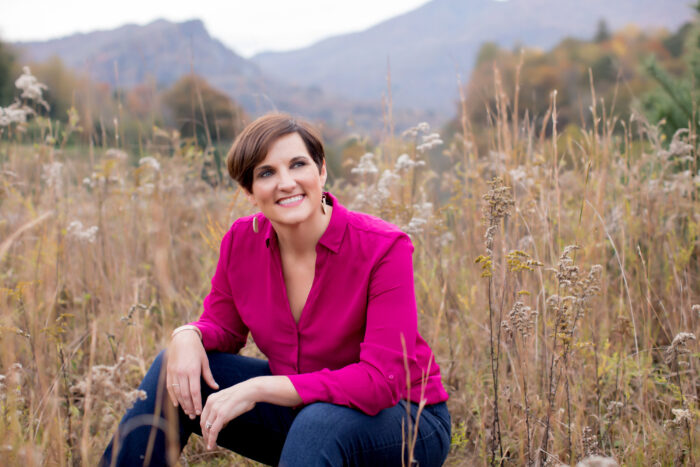
Appalachian author Annette Saunooke Clapsaddle.
Courtesy Photo
For our 2025 Favorites, I’m sharing my interview with Appalachian author Annette Saunooke Clapsaddle. While I’m no longer a reporter for WVPB – becoming our director of digital in spring 2022 – I am always happy to don my reporter cap every now and again and help out my colleagues in the newsroom. In particular, every fall, I have the privilege of conducting an interview with the Shepherd University Appalachian Heritage Writer-in-Residence.
Clapsaddle is a North Carolina native and is an enrolled citizen of the Eastern Band of Cherokee Indians and the author of the 2020 novel Even As We Breathe.
Even As We Breathe was a finalist for the Weatherford Award and the first novel published by an enrolled citizen of the Eastern Band of Cherokee. It is also the 2025 One Book, One West Virginia Common Read.
We sat down to discuss her background, her debut novel and the importance of reclaiming Cherokee identity through literature.
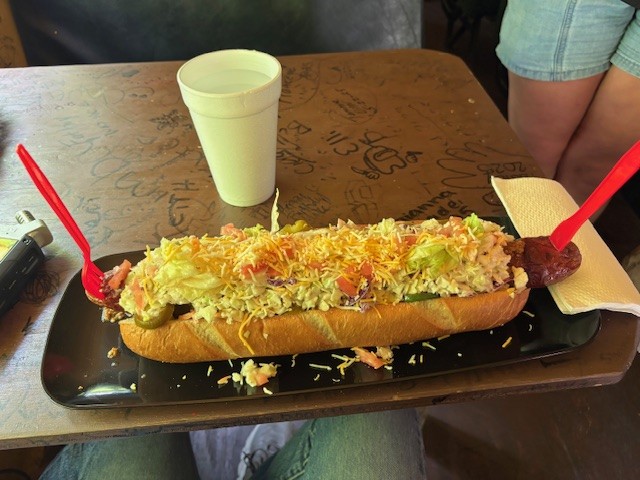
The Homewrecker is a signature food challenge at Hillbilly Hotdogs in LeSage.
Photo Credit: Bill Lynch/West Virginia Public Broadcasting
My family has accused me of sometimes thinking with my stomach and I don’t deny it. I like to eat, but what I like about West Virginia food stories is that they’re never just about the food. Two of my favorite stories this year were about potato chips and hotdogs, very normal, everyday foods that almost everybody eats.
What made them different is that along with the calories, I got some real local flavor. With Hillbilly Hotdog, we not only heard about how a couple’s romance built an authentic Appalachian hotdog destination, but we learned how a celebrity chef helped restore the hotdog restaurant’s signature dog: The Homewrecker.
From Mister Bee’s Chips, we got a look inside the state’s only potato chip factory and got some reactions from the WVPB staff about the brand new Mothman chips.
Software developer Jeff Atwood addresses community leaders in Mercer County at the launch event for a program he hopes will combat generational poverty.
Photo Credit: Maria Young/West Virginia Public Broadcasting
Certainly not an upbeat story, but it shows the abrupt and chaotic nature of the funding cuts and how the organizers, reeling from the news, still managed to pull off a star-studded show this state should be proud of.
This is a favorite in part because it just represents the joy of giving, the gratification of knowing that you’ve helped to make the world a better place. I love the uniqueness of the program, which offers a potentially life-altering situation for hundreds of people. It’s also a favorite for the sheer hope it brings to a region that has long struggled with both poverty and addiction.
Elementary and secondary student-me is completely envious of the students in Pocahontas County who get to take part in this unique and creative approach to learning. Adult-me is wowed by the working mom who had an idea and pulled out all the stops to launch this incredibly impactful program.
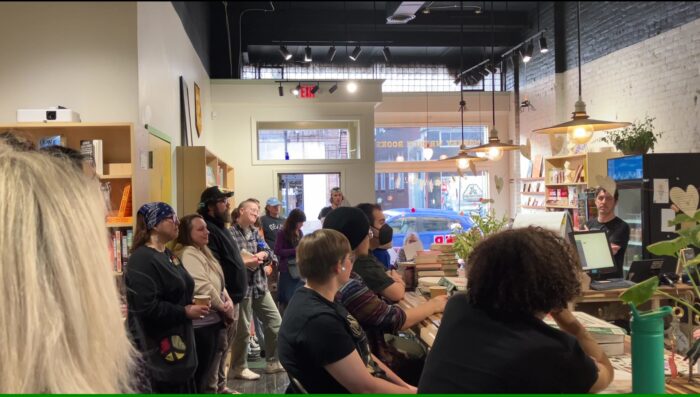
Volunteers and advocates gather at Monkey Wrench Books in downtown Morgantown March 16, 2025 to coordinate outreach efforts ahead of the April 29 local election.
Photo Credit: Chris Schulz/West Virginia Public Broadcasting
This first one is kind of a brag because it was featured as part of the national “Here To Help” series on All Things Considered. But it really is a reminder of the amazing things people are capable of when they commit to an idea and draw on their community for support in pursuing that idea. Rania Zuri is an impressive person at a very young age. To see her uplifting other young women and children with her LiTEArary Society is worth national attention and makes me hopeful for our future.
This next story was a technical and professional achievement as I went out into the field to shoot a feature story for The Legislature Today on my own. We are blessed to have a world class production team here at WVPB, but sometimes as a reporter you just have to learn to go it alone a little bit. Producing for television is still new to me, and then having the story also come together for radio was very satisfying. The subject matter of homelessness is one that surges back into public consciousness particularly every winter, and it was fascinating to see such spirited public discussion on the issue.
Finally, another story that has become ongoing. I was able to get out to beautiful Tucker County this summer to report on the nascent local opposition to a secretive microgrid project seeking environmental approval. The story has since become a case study both in the acceleration of data infrastructure in West Virginia and the country more broadly, but also in community organizing.
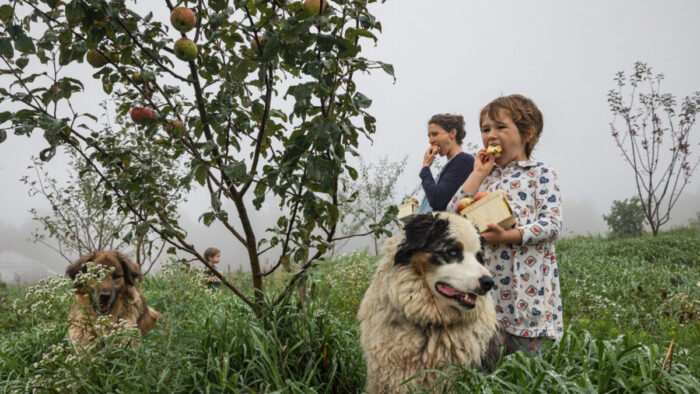
Ben, Hana, Rosie and Henry Yoder in Meyersdale, Pennsylvania.
Photo courtesy of Michael Snyder
I haven’t reported on a lot of stories myself, but I help produce weekly episodes ofInside Appalachia, so I get to listen to a lot of stories about what’s happening in Appalachia.
One story I am proud of is my first radio story. It was an interview with Michael Snyder, a photographer and filmmaker who grew up in the Allegheny Mountains on the border of Maryland and West Virginia. His work has been featured in National Geographic, The Guardian and The Washington Post. After living away from Appalachia for over a decade, Snyder moved back to document what changed and what stayed the same.
I started listening to Inside Appalachia when I was an AmeriCorps member in southeast Ohio. I remember being so impressed by the collection of stories and the depth of Appalachian culture that I was not familiar with. To be hired as an associate producer for the podcast I listened to often was pretty surreal and truly an honor. I am so lucky to work with everyone on the Inside Appalachia team and the wonderful people at West Virginia Public Broadcasting.
In front of what Morrisey estimated were a couple hundred people at the Meadowbrook Mall, Morrisey explained why he believes personal income tax cuts are important to the state.
This year's budget proposal calls for a 10% reduction in state income tax. One budget expert says there are too many uncertainties to make permanent cuts now.
Gov. Patrick Morrisey has made his case for a 10% state income tax cut – but not everyone is convinced that’s the way to go. Assistant News Director Maria Young spoke with Kelly Allen, executive director of the West Virginia Center on Budget and Policy, to learn more.