


Aluminum Plates For Deep Space Win W.Va. 'Coolest' Contest
Aluminum plates that helped keep astronauts on the Artemis II rocket safe won the first ever Coolest Thing Made In West Virginia competition.
Continue Reading Take Me to More NewsAlert (09/29/2026): Our Parkersburg TV transmitter is still undergoing maintenance and remains temporarily inoperative. We apologize for the inconvenience.
All our programming is available via our TV livestreams on our website and WVPB Passport. Thank you for your patience!




To Educate, Inform, and Inspire by Telling West Virginia's Story
Mountain Readers Week will be held Oct. 5-9, 2026! Celebrate and foster a love of reading in children across West Virginia.
Nominate an exceptional West Virginia K-12 teacher today!

On Demand

On Demand
Stream original productions from WVPB

Watch locally produced documentaries & more.

On Demand

On Demand






West Virginia Morning

Inside Appalachia

West Virginia Week

Mountain Stage

Us & Them

The Legislature Today

The Legislature This Week

Send us your comments and questions.

Stream our board meetings.

Check out the latest WVPB news.

Sign up for our newsletter and get weekly updates.

Meet the WVPB staff.

WV Educational Broadcasting Commission, the WVPB Foundation, and the Friends of WVPB.

Come work with us!

Read our annual report and learn how we educate, inform and inspire with your support.

Sponsor impactful and engaging media and entertainment.

Use your IRA to make a gift to WVPB.

Become a member with your gift of $1,000 or more.

Make WVPB part of your legacy.

Manage your membership account.

Learn how you can Protect and Sustain West Virginia Public Broadcasting.
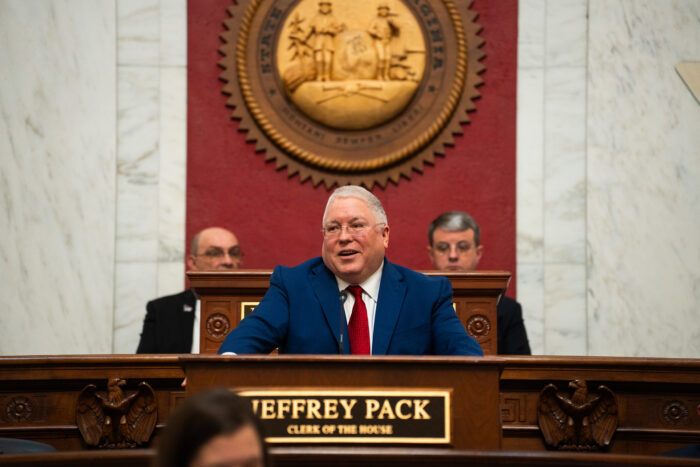
Gov. Patrick Morrisey encouraged attendees at an event in Bridgeport Tuesday to reach out to their legislators and support a tax cut.
In front of what Morrisey estimated were a couple hundred people at the Meadowbrook Mall, Morrisey explained why he believes personal income tax cuts are important to the state.
Before promoting the idea of tax relief, the governor promoted recent private sector investments in the state.
“Since October, we’ve announced over $6.5 billion of private sector investment into West Virginia, with the projected job total for the next few years, 7,000 new jobs,” he said. “That’s pretty good, but it’s not enough, right? We have to continue the momentum we’re making.”
Morrisey also noted there is significant investment in the northern part of the state in the energy sector.
“You know that there’s going to be a new gas plant that’s coming in, right?” he said. “You’ve heard about that? Well, they’re going to be a couple in this area, and that alone is going to cause a need in this part of the state for over 3,200 new workers.”
He said he thinks economic development alone isn’t enough. He noted surrounding states are currently working to lower their taxes.
“You have to invest in the people, and having a 10% across the board income tax, there’s no better way in order to be more competitive with other states, and that’s why I’m up here today,” Morrisey said. “We have to compete. We have to be staying on pace with the other states in order to make this happen.”
He also focused on affordability and inflation.
“I think the best way to address affordability is an income tax cut, and that’s what we’re pushing to do now,” he said. “I will tell you, there’s some that don’t like this, right? It’s an election year. There are people that just want to spend, spend, spend.”
In the governor’s proposed budget, he included a 5% tax cut but has challenged the West Virginia Legislature to come up with an additional 5%.
In a recent interview for The Legislature Today, House Finance Committee Chairman, Del. Vernon Criss, R-Wood, and House Finance Minority Chairman Del. John Williams, D-Monongalia, questioned whether that makes sense. They noted it only provides about $60 a year to the average West Virginian while requiring cuts in services many people depend on.
Observers outside of the government are also wary of the proposal. Kelly Allen, executive director of the West Virginia Center on Budget and Policy, recently told West Virginia Public Broadcasting she thought the proposal was “shocking.”
Add WVPB as a preferred source on Google to see more from our team

They love West Virginia, but love alone may not be enough to keep them here. In the second of two Us & Them episodes, Trey Kay talks with young West Virginians who say they may need to leave in search of careers, community and a place where they can imagine their futures. Their decisions reveal what the Mountain State risks losing when young people cannot see a place for themselves at home.
Continue Reading Take Me to More NewsWest Virginia will apply to host the country's future United States Space Academy.
Continue Reading Take Me to More NewsThe Campaign Finance Reporting System (CFRS) through the West Virginia Secretary of State’s office is available to the public online.
Continue Reading Take Me to More NewsLast week, we aired the first part of an interview with a WVSU professor about what is AI. In the second part of that interview, we explore the best way to use AI to get what you want – while avoiding fabricated or false answers that seem real.
Continue Reading Take Me to More News