LISTEN: The Critton Hollow String Band Has The Mountain Stage Song Of The Week
On this week's premiere broadcast of Mountain Stag...
Continue Reading Take Me to More News




Find videos, resources and activities for teaching civic education in WV classrooms.

Nominate an exceptional West Virginia teacher today!

On Demand

On Demand

Watch locally produced documentaries & more.

On Demand

On Demand






West Virginia Morning

Inside Appalachia
West Virginia Week
Mountain Stage
Us & Them

The Legislature Today

Send us your comments and questions.

Stream our board meetings.

Check out the latest WVPB news.

Sign up for our newsletter and get weekly updates.

Meet the WVPB staff.

WV Educational Broadcasting Authority, the WVPB Foundation, and the Friends of WVPB.

Come work with us!

Sponsor impactful and engaging media and entertainment.

Use your IRA to make a gift to WVPB.

Become a member with your gift of $1,000 or more.

Make WVPB part of your legacy.

Manage your membership account.

Learn how you can Protect and Sustain West Virginia Public Broadcasting.
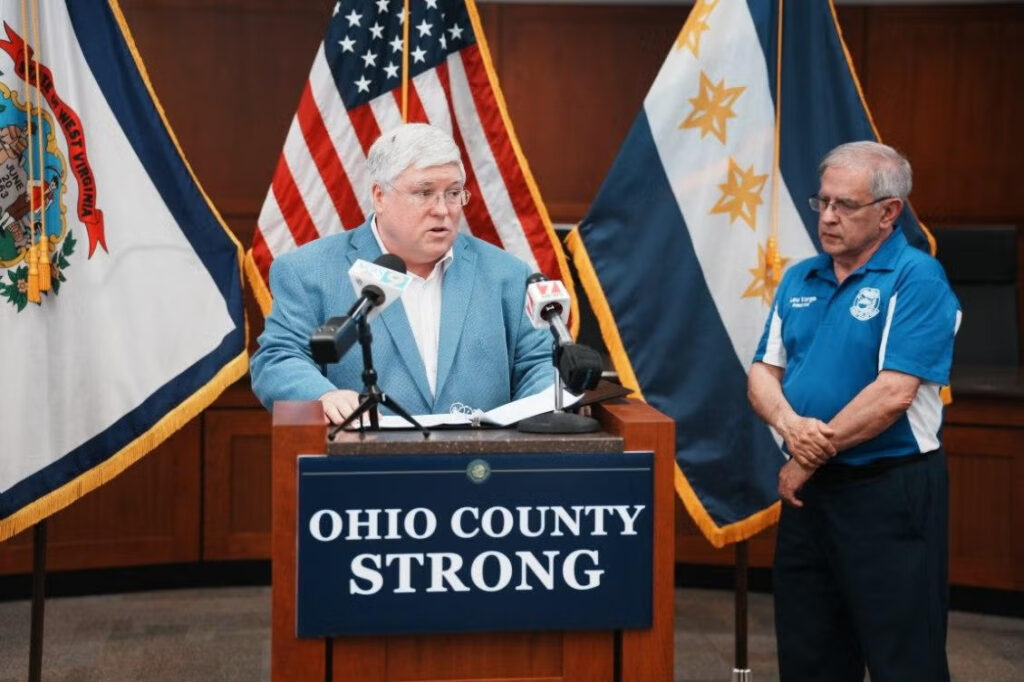
As new federal aid heads to areas of West Virginia affected by severe flooding last month, Gov. Patrick Morrisey said he is pursuing additional avenues for public assistance funding.
Morrisey held a press conference in Wheeling Thursday to provide updates about flood recovery efforts following the devastating flash flooding that struck Marion and Ohio counties.
On Tuesday, President Donald Trump formally declared the floods a major disaster, opening the region to federal aid. Disaster declarations can be requested by governors, but first require approval from the president to receive certain forms of aid through the Federal Emergency Management Agency (FEMA).
Through the declaration, Trump said on the social media platform Truth Social that he granted the state $11.7 million in federal disaster aid. Morrisey had issued a disaster declaration over the flooding June 20.
Morrisey said his administration has followed up with “additional requests and amendments” to secure more public assistance for local flood recovery efforts.
“I’m really optimistic about the future of this area and West Virginia,” Morrisey said. “People have come together in a way that you really haven’t seen before.”
Morrisey urged residents to continue to submit individual assistance damage surveys to FEMA, which help the agency understand and address local impacts of the flooding. He also encouraged residents affected by the flooding to review and consider applying for FEMA’s individual assistance program, which can be accessed through the agency’s website.

Devastating flooding began June 14 in Ohio County and June 15 in Marion County, in some areas ripping apart buildings and roadways. While no deaths were reported in Marion County, the severe storm caused the deaths of nine residents near Wheeling.
“We know that the last few months have been particularly challenging up in this area. I still grieve the nine deaths that we’ve had,” Morrisey said. “I’ve had a chance to talk to a number of people who are family members of those who passed away. It’s not something that people are going to get over very easily.”
The June floods were not the first severe weather event to hit the state this year. In February, flash flooding in southern West Virginia and eastern Kentucky claimed 27 lives — among them three West Virginia residents.
In April 2024, severe flash flooding caused structural damage across West Virginia, both along the Kanawha River and within the Northern Panhandle. In August 2024, Tropical Storm Debby claimed one life in West Virginia’s Eastern Panhandle, and sent the rest of the state into a state of preparedness.
Some state officials have argued the state could more proactively address weather-related risks through increased funding for flood recovery.
Last month, Democratic members of the West Virginia House of Delegates shared a post to the newsletter platform Substack criticizing a lack of funding for the state’s Flood Resiliency Trust Fund, which was created in 2023 to fund flood recovery efforts.
Efforts to add money to the fund or implement a statewide flood resiliency plan have repeatedly failed, the caucus said June 22.
A slain West Virginia Guard member was laid to rest Tuesday, with full military honors.
Continue Reading Take Me to More NewsCommunities are bracing for a sharp drop in temperature as blizzard alerts have been issued.
Continue Reading Take Me to More NewsThere are 15,101 students experiencing homelessness in the state, according to a report given to the Joint Committee on Children and Families during December interim meetings. These are students outside of foster care. Of those, 86% are living with others, 5.4% are staying in shelters, 4.3% are in hotels and motels, and 4.3% are unsheltered. The committee discussed a number of bills Monday they plan to introduce when the regular session begins in January. The hope is to create clearer pathways for children to find permanent stability.
Continue Reading Take Me to More NewsIt’s common at Christmastime for churches and businesses to set up angel trees, decorated with paper ornaments holding a child’s name and wish list. Trees set up this year for the children of Iaeger, West Virginia, reflect the long-term damage done by the February floods that devastated McDowell County.
Continue Reading Take Me to More News