This week, in author Willie Carver, Jr.’s new book, he reconsiders a negative childhood experience with a neighborhood girl who might have just been looking for a friend. Also, a southwestern Virginia community rang the alarm after more and more of its children were diagnosed with cancer. A local journalist is trying to unravel the cause. And, the city of Asheville has a new crusading reporter. He’s a puppet.
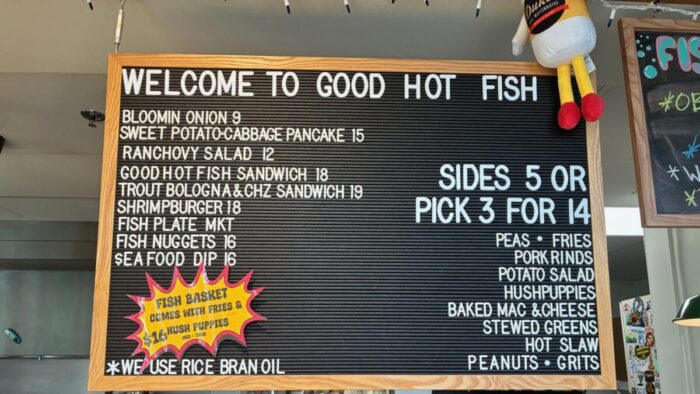
Tucked away at the edge of downtown Asheville, North Carolina, is one of the city’s culinary gems. Good Hot Fish is a small restaurant that started as a pop-up.
Now it’s got a permanent spot next to Burial Beer Company. Drop in and you’ll find the taste and vibes of an old-fashioned fish fry, with dishes like trout bologna alongside standards like stewed greens, baked mac’n’cheese and hush puppies. That’s not to mention the fried fish – whether it’s trout, catfish, cod, or something else, the fish is flaky and flavorful.
Good Hot Fish is run by Ashleigh Shanti. Shanti was a semi-finalist for the 2020 James Beard Award for “Rising Star Chef of the Year,” and she competed on the TV show “Top Chef” in 2022. In 2025, Shanti won a James Beard Foundation Media Award for her cookbook, “Our South: Black Food Through My Lens.”
Recently, Inside Appalachia host Mason Adams stopped in at Good Hot Fish for a catfish sandwich with a side of hot slaw, and a conversation with Shanti.
The conversation below has been lightly edited for clarity.
Adams: When I hear “Affrilachian,” I tend to think about poetry — Frank X Walker, Nikki Giovanni and that poetry movement. Some people have described your food as “Affrilachian.” What does that mean to you? And how would you describe your food?
Shanti: I did not hear the term “Affrilachian” until it was used to describe my food actually. I’ve since learned that Dr. Frank X Walker coined that term to dispel a lot of the myths that exist in the area of southern Appalachia — that it is this largely white region of uneducated people that are barefoot and hillbilly and all of those stereotypical kind of comedic things that people have tied to this area. And while some of them are true, we are certainly so much more than that. And I think when Dr. Walker coined that term, he was speaking not just to the Black influence here in art and poetry, but also in everything that we do: our lifestyles, the food here, the music. It just encompasses an entire lifestyle, and it also speaks to the erasure that we’ve seen of Black culture in this region, and that is why I believe that term is so important, and that’s why I’m proud to hear people describe my cuisine as that.
Adams: I’ve spent a lot of my life around the Roanoke, Virginia region, which is an old railroad town that’s got a significantly higher Black population than a lot of other Appalachian cities. It’s about 30%. When I went to Good Hot Fish the first time, it kind of reminded me of the fish fries that I’ve tasted in Black communities. National Night Out was where I was introduced, and now when I see fish fries advertised, I try to swing by. It feels like you’ve captured the epitome of that in a restaurant. How did you learn to cook this amazing food?
Shanti: Well, actually, I was not born and raised in this region. I have maternal ties to this area, so I did grow up visiting areas like Hillsville, Virginia, and the southwestern parts of Virginia certainly had an impact on me growing up, and just really diving into the food ways and realizing how different they were than other parts of the South. But I grew up in coastal Virginia, in Virginia Beach, which I think certainly informs my love for seafood now, and also a lot of that nostalgia that I was experiencing and experienced when I went home, and the first thing I wanted to do was eat at a good old-school fish fry. That was something that I realized didn’t exist around me living in Asheville, and it was something that I really wanted, and I felt like the community of Asheville really needed that as well, because the Black fish fry is so much more than just food; it is a source of community. And post-pandemic, I really was craving that, and so I’m really thankful that there was such an amazing response from the community when I started doing these pop-ups.
Adams: Can you talk a little bit about how you accumulated this skill? I’m interested in family members that maybe planted the seeds, and some of the major figures that influenced you along the way.
Shanti: My only real jobs have actually been in kitchens, starting back when I was a teenager at 17 years old, working at seafood shacks along the coast because I wanted to hang out with my friends on the beach as much as possible during the summers, and that seemed to be the best way to do it, while also fulfilling my parents’ desire of me having a job as a teenager. I was always surrounded by seafood growing up on the coast, and I don’t think I realized how much it impacted me until I didn’t have access to that anymore, and that’s something that we face here. Being in a mountain region, I feel very fortunate to have the relationships that I have with the fisherfolk along the coast of North and South Carolina, because they inform a lot of the things that we feed our guests, and they inform our menus. I grew up eating that way and working in restaurants where we cooked that way. If it was coming fresh out of the water, then that is what we were going to be preparing that day. Post that time as a teen, working in a lot of those gritty, old school, family-owned restaurants, I got bit with the bug where I realized that I did want to make a living out of working in kitchens. I didn’t really see that as an example, but that is where my heartbeat was. And so, I started working in professional kitchens and realized that it wasn’t just my grandmother that was cooking seasonally and going to farmers markets and growing herbs and foraging and doing all those things and learning that I could tie a lot of the foodways of my upbringing to professional kitchen spaces. Also just wanting to have fun in the kitchen and wanting to see glimpses of my childhood and the things that made me happy growing up, and apply that to a professional kitchen setting, and have it be chef-driven, and have it be supportive of the small makers and farmers around me. I think that was a big part of what inspired the concept of Good Hot Fish.
Adams: Your food is so good you could really cook anywhere in the country, and we’re lucky to have you here in Appalachia. What brought you to Asheville in particular?
Shanti: I spent a great deal of time searching and doing the whole “find myself” thing that I think a lot of creatives do in their professions. I was not in a particular kitchen. I wasn’t a chef or a cook anywhere. And I realized that I wanted to tell my own stories, and I knew that I needed a platform where I could do that, because I had no idea how I was going to do that. I spent about seven months stodging. I was between jobs, and I started all throughout the South. I even went to the MAD Symposium in Copenhagen and did quite a bit of traveling and received many job offers. I worked at Michelin star restaurants, worked under James Beard chefs, and saw a lot of really cool things, and got a lot of amazing job offers, but none of them really spoke to me, and I knew that none of those job offers were going to allow me to tell the stories that I wanted to tell in the kitchen. Through mutual friends, I had a chance interview with Chef John Fleer, whom, at the time was the chef of Rhubarb and The Rhu, and he was opening a concept that highlighted Black food ways, and specifically Affrilachian foodways. That restaurant was called Benne on Eagle, and he wanted to talk about what it would look like for me to be part of that concept and maybe head the food program there. We had many meetings, worked together, conceptualized some menus, and a lot of the things that he was feeling and talking about when it came to this concept were very much so the things that I was also wanting to execute in the kitchen. And so, we traded notes, and it was a very serendipitous happenstance. I feel really proud of the work that I did at Benne on Eagle and feel like I was really able to express myself as a chef and have a connection to this community that, to me, was largely new and welcomed me with open arms. And I really still meditate on that time as one of the peaks in my career, and what really gave me the confidence to do what I do now.
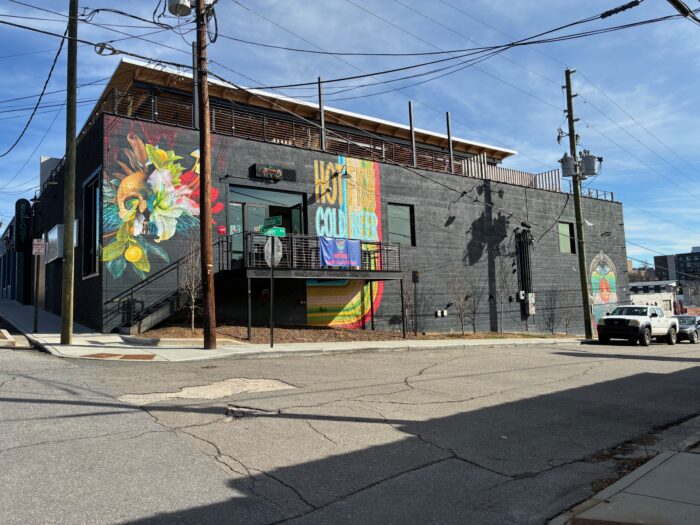
The exterior of Good Hot Fish.
Photo Credit: Mason Adams/West Virginia Public Broadcasting
Adams: What led you to leave that nest and launch your own restaurant here with Good Hot Fish?
Shanti: Well, I mean, gosh, that was almost six years ago now. And I mean, I think just even the work that I’ve done since that time kind of speaks to the why. I’ve been in the spaces of food TV. I’ve written a cookbook that’s won a James Beard Award, I’ve opened a restaurant that started out as a pop-up, and we’ve gotten the recognition of Michelin Guide. I’m essentially just on the trajectory that I’ve always wanted to be on as a chef. I know a lot of chefs say that they want to open their own restaurant, but for me, it was so much more than that. I feel like I’m actualizing a lot of those goals. And I think Benne on Eagle served its purpose for me and served me for the right time in my life. Just like anything, there’s times where it’s time to move on and move forward and accomplish the next goal, and I’m ready to continue to do that.
Adams: I wanted to ask about the Good Hot Fish space. It feels airy and open. The Jet magazines are always cool to look at, and there’s just so much interesting decor. How did you conceptualize and lay out the design in that space? What vibes were you looking to bring?
Shanti: Well, it’s very tiny, so I’m glad you’re saying it feels airy and open. I was really just hearkening back to the days of my youth and my childhood and the things that made me happy, and just thinking of the summers with my cousins. I’m an only child, so my cousins are like my siblings. And just thinking of summers with them and going to the fish fry shop. I was always the only girl. So it’s like the boys would go and get their hair cut, and afterwards we would go to some hole in the wall seafood shack, and there’d be old records on the wall. All of those fun things I think of, like turning to page 26 of my parents Jet magazines and trying to find “Beauty of the Week.” So they’re plastered all over the bathroom walls. So all of the things that really make me happy, and also the things that are undeniably Black and speak to Black culture were really important to me too. Especially in this city, and being one of the few Black-owned businesses, I think it’s really important to highlight our culture here. Yeah, I’m glad that the space makes people happy, and the images, they certainly make me happy, and I’m glad that people enjoy them as well. And I also have to give credit to my wife, Meaghan, that worked day and night to get that space together, and she’s largely a big part of why it looks the way that it does. She executed all of that, and the hand-painted signs are hers as well. We’re really very proud of that. It really, truly feels like a family business.
Adams: I did not grow up reading Jet magazine, but I have memories of looking at it in the aisle of the grocery store as we were checking out growing up, so that it feels safe and warm, like home. It brings up those memories for me. Well, it seems like you’ve, you’ve evolved throughout your career, and you never linger one place too long. What are you working on the next few years? Where’s your mind going at the moment?
Shanti: I mean, I feel I have found my place, and I found my voice, and I feel really good about the roots that we’ve put down here in Asheville. I don’t plan on going very far. I love the idea of seeing more than one or two Good Hot Fishes in the South. As hard as it was to write my first cookbook, I love a challenge, and maybe there’s another one in my future.
Add WVPB as a preferred source on Google to see more from our team
This week, having a very specific talent can lead to a dream job. It’s how cartoonist John Rose got his foot in the door to draw the comic strip Snuffy Smith. Also, there are dos and don’ts for treating poison ivy. And, a young, old-time musician wants to save her family’s lost ballads.
Shepherdstown chef Mary Ellen Diaz, head chef of restaurant Alma Bea in Shepherdstown, is a finalist for the 2026 James Beard Award for Best Chef in the Southeast.
On this West Virginia Week, the state budget is headed to Gov. Patrick Morrisey, a statewide public camping ban bill moves forward, and Inside Appalachia visits Good Hot Fish.
This week, when an award-winning Asheville chef decided to launch a restaurant, she returned to a rich community tradition. Also, the popularity of weaving waxes and wanes. At the moment, it’s having a renaissance. And, during Lent, Yugoslavian fish stew is a local favorite in Charleston, West Virginia.