


Aluminum Plates For Deep Space Win W.Va. 'Coolest' Contest
Aluminum plates that helped keep astronauts on the Artemis II rocket safe won the first ever Coolest Thing Made In West Virginia competition.
Continue Reading Take Me to More NewsAlert (09/29/2026): Our Parkersburg TV transmitter is still undergoing maintenance and remains temporarily inoperative. We apologize for the inconvenience.
All our programming is available via our TV livestreams on our website and WVPB Passport. Thank you for your patience!




To Educate, Inform, and Inspire by Telling West Virginia's Story

Mountain Readers Week will be held Oct. 5-9, 2026! Celebrate and foster a love of reading in children across West Virginia.
Nominate an exceptional West Virginia K-12 teacher today!

On Demand

On Demand

Stream original productions from WVPB

Watch locally produced documentaries & more.

On Demand
On Demand





West Virginia Morning

Inside Appalachia

West Virginia Week
Mountain Stage
Us & Them
The Legislature Today
The Legislature This Week

Send us your comments and questions.

Stream our board meetings.

Check out the latest WVPB news.

Sign up for our newsletter and get weekly updates.

Meet the WVPB staff.

WV Educational Broadcasting Commission, the WVPB Foundation, and the Friends of WVPB.

Come work with us!

Read our annual report and learn how we educate, inform and inspire with your support.

Sponsor impactful and engaging media and entertainment.

Use your IRA to make a gift to WVPB.

Become a member with your gift of $1,000 or more.

Make WVPB part of your legacy.

Manage your membership account.

Learn how you can Protect and Sustain West Virginia Public Broadcasting.

Appalachian Power submitted its plan for the next 10 years to state regulators, and changes could be coming to its coal plants.
Appalachian Power filed its integrated resource plan last week with the West Virginia Public Service Commission.
The company mapped out six scenarios for its Mountaineer, Mitchell and Amos plants.
Only Mountaineer would stay in operation through 2035 in all scenarios, and it may be converted from coal to 100% natural gas.
In some scenarios, Amos would retire completely by 2035 or be partially converted to gas.
The Mitchell plant also would partially retire or partially convert from coal to gas.
The scenarios contemplate a delay in U.S. Environmental Protection Agency power plant rules that are currently under review by the Trump administration.

Karen Wissing, a spokeswoman for Appalachian Power, says if those rules are delayed, “maintaining coal operations at all three plants would be the most cost-effective option for our customers.”
“However,” she added, “if the EPA rules are not modified from their current form, conversion to natural gas generation would become a more cost-effective option.”
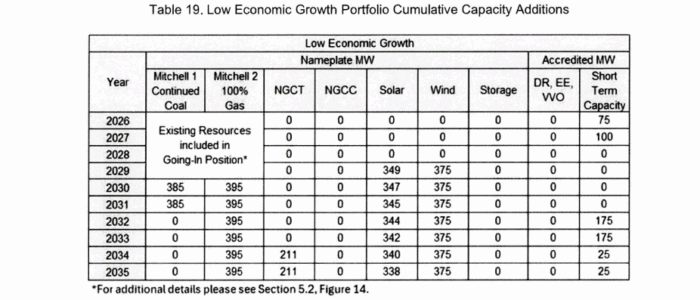
The company’s plan also outlines scenarios for both high economic growth or low economic growth.
A low-growth scenario would lead to the retirement of all coal generation by 2032.
The planning document outlined options for replacing the plants with wind, solar and combined-cycle natural gas.
The Amos and Mountaineer plants provide power to Appalachian Power customers in southwest Virginia.
Virginia’s Clean Economy Act sets targets for emissions reductions in electricity generation, something West Virginia lacks.
Of the three plants, Mountaineer had the highest capacity factor this year through July of 64%.
Amos had a capacity factor of 34% and Mitchell 25%. The average in the PJM region is about 40%. The West Virginia PSC and the legislature would prefer the plants operate closer to 69%.
An expert witness testified to the PSC over the summer that the three plants lost $81 million in the 12 months ending in February. The company has said it burned coal at a loss to manage an excess supply at the plants for worker safety.
It also has said that breaking coal contracts would have cost electricity customers more.
The PSC’s Consumer Advocate Division has asked the commission to revisit the coal plant losses. The PSC denied Appalachian Power’s application to increase customer rates but did not disallow the cost recovery for the uneconomic operation of the plants.
Add WVPB as a preferred source on Google to see more from our team

Local leaders continue to promote the state's aviation industry as the country continues to face a shortage of specialized workers including mechanics, technicians and air traffic controllers.
Continue Reading Take Me to More NewsA U.S. Energy official visited the West Virginia University campus Tuesday, to promote an effort to increase the number of graduates with expertise in mining, minerals and associated supply chain technologies.
Continue Reading Take Me to More NewsMany farmers in our region raise sheep for meat, but not so much for wool. There’s not a great market for it with textile companies overseas, but researchers at Virginia Tech have teamed up with farmers, to figure out how to use wool to insulate houses, potentially creating a new market.
Continue Reading Take Me to More NewsMonday's action officially reinstates the first Trump Administration’s 2020 Title IX rule that includes “the interpretation of ‘sex’ to mean the objective, immutable characteristic of being born male or female.”
Continue Reading Take Me to More News