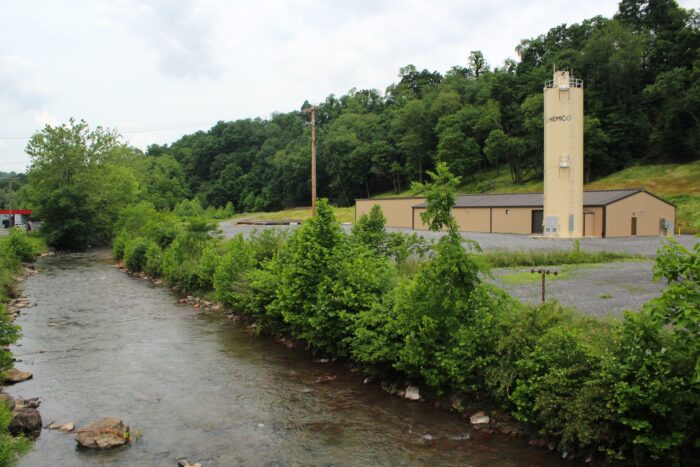
After two years of operation, the Richard Mine Treatment Plant continues to mitigate acid mine drainage into Deckers Creek, a tributary of the Monongahela River. On Monday, the West Virginia Department of Environmental Protection’s (WVDEP) Office of Abandoned Mine Lands and Reclamation (AML) hosted a showcase event to display the successes of the facility’s restoration efforts.
Since opening in April 2024, the treatment plant has removed metals common in mine drainage like iron and aluminum from the water. The acidified water is also treated to raise its pH level back to neutral.
“It’s a practical solution to a problem that has affected this watershed for generations,” said Travis Parsons, AML deputy director. “What’s especially rewarding is seeing the results in the stream itself. Water quality has improved, fish populations are rebounding, and species that were previously absent have returned. Those are tangible signs that the restoration work is making a real difference for the watershed and the community.”
The plant has increased the stream’s flow rate and restored fish population and aquatic life in lower sections of Deckers Creek, according to studies from West Virginia University’s (WVU) West Virginia Water Research Institute. Several new species of fish like Rainbow Trout and Johnny Darters have been spotted in the waters.
The facility is the result of a public-private partnership including the WVDEP, the U.S. Department of Agriculture and Northeast Natural Energy.
Brian Hurley, executive director for the nonprofit Friends of Deckers Creek, told West Virginia Public Broadcasting in 2024 that in the past, the waterway was in “horrible shape” with bright orange and bright red stains from metals.
“The changes we’ve seen in the lower miles of Deckers Creek since the Richard Mine Treatment Plant came online have been remarkable,” Hurley said Monday. “Friends of Deckers Creek has spent decades working to restore this watershed, and this project shows what’s possible when agencies, community groups, researchers and private partners work together toward a common goal.”
The WVDEP plans to install automated AMD treatment systems across the state.
Add WVPB as a preferred source on Google to see more from our team