


The Old Louisville Demon Leaper’s Mischief In One Of America’s Largest Victorian Neighborhoods
In the late 1800s, tales of a creature that bounds between rooftops emerged in Old Louisville — The Demon Leaper.
Continue Reading Take Me to More NewsAlert (09/29/2026): Our Parkersburg TV transmitter is still undergoing maintenance and remains temporarily inoperative. We apologize for the inconvenience.
All our programming is available via our TV livestreams on our website and WVPB Passport. Thank you for your patience!




To Educate, Inform, and Inspire by Telling West Virginia's Story
Mountain Readers 2026 has concluded! Please fill out our volunteer post-survey.

Nominate an exceptional West Virginia K-12 teacher today!

On Demand

On Demand

Stream original productions from WVPB

Watch locally produced documentaries & more.

On Demand

On Demand






West Virginia Morning

Inside Appalachia

West Virginia Week

Mountain Stage

Us & Them

The Legislature Today

The Legislature This Week

Send us your comments and questions.

Stream our board meetings.

Check out the latest WVPB news.

Sign up for our newsletter and get weekly updates.

Meet the WVPB staff.

WV Educational Broadcasting Commission, the WVPB Foundation, and the Friends of WVPB.

Come work with us!

Read our annual report and learn how we educate, inform and inspire with your support.

Sponsor impactful and engaging media and entertainment.

Use your IRA to make a gift to WVPB.

Become a member with your gift of $1,000 or more.

Make WVPB part of your legacy.

Manage your membership account.

Learn how you can Protect and Sustain West Virginia Public Broadcasting.
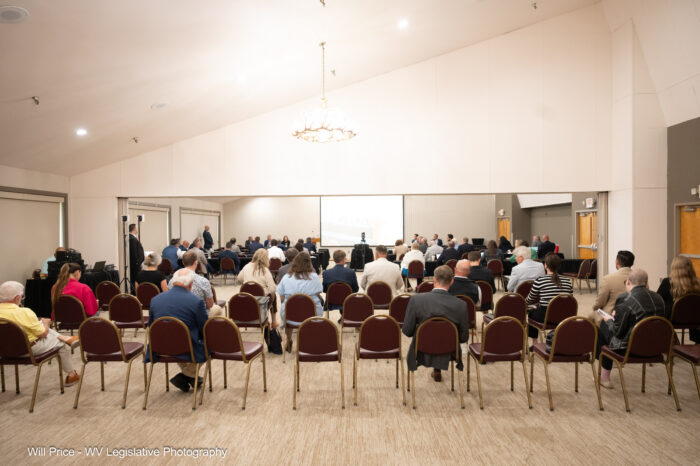
Some lawmakers appear unconvinced about the need for two large transmission line projects proposed to cut across the state.
Lawmakers on the Joint Standing Committee on the Judiciary grilled a panel of energy industry representatives during an interim meeting at Canaan Valley State Park Monday.
Legislators like Del. Bill Ridenour, R-Jefferson, repeatedly questioned the cost to local ratepayers of two transmission line projects proposed to cut across West Virginia.
“I don’t understand why West Virginia should be paying for a Virginia decision relative to their data centers,” he said. “They’ve decided that they want to go with coal or with solar and wind, and they’re going to stick us with paying for the transmission lines.”
Ridenhour and others’ comments mirror public comments recently submitted to the Public Service Commission (PSC) regarding one of the two transmission line projects, the MidAtlantic Resiliency Link (MARL). The 107.5-mile-long line from Pennsylvania to Virginia would cross Monongalia, Preston, Mineral and Hampshire counties.
“The PSC has seen about 40 letters of protest for every single letter of support for the MARL line,” Del. Rick Hillenbrand, R–Hampshire, said.
The second transmission line proposal – Valley Link Transmission – has not finalized a route yet but has been approved by regional grid operator PJM to construct 260 miles of 765-kilovolt (kV) transmission line and two substations between Putnam County and Frederick County, Maryland.
Members of the committee expressed interest in exploring what the legislature can do to protect ratepayers from paying for the cost of major infrastructure projects.
Add WVPB as a preferred source on Google to see more from our team

Secretary of State Kris Warner has announced that 66,855 ballots have been cast across the state in absentee voting and the first four days of early voting.
Continue Reading Take Me to More NewsNearly $1.4 million in funds from the state's Rural Health Transformation Program will be used to help replace a mobile cancer screening unit that serves rural communities.
Continue Reading Take Me to More NewsOn this West Virginia Week, our voter's guide is out, and it has all the information you need to know about the upcoming general election in the state. Also, another lawsuit targets the state's public school funding formula. And, a million dollar giant troll is making its way to the woods of West Virginia.
Continue Reading Take Me to More NewsPeople can drop off medications that are no longer being used at more than 65 National Prescription Drug Take Back Day locations across the state.
Continue Reading Take Me to More News