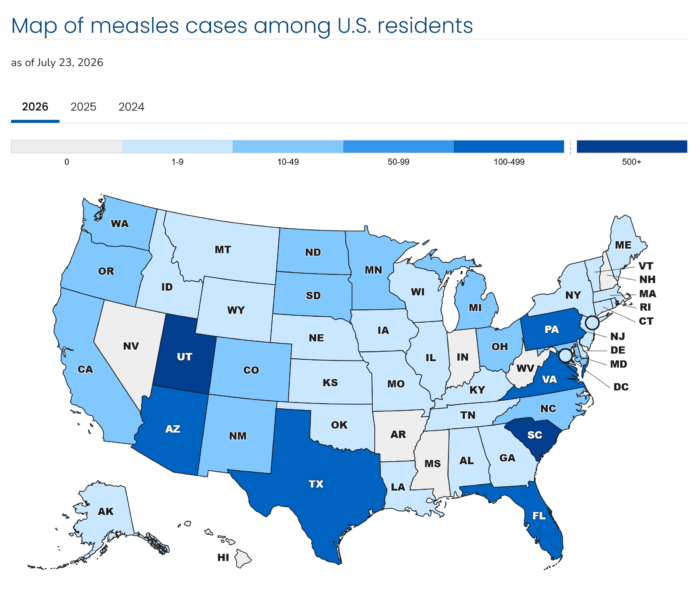
The West Virginia Department of Health has confirmed an unvaccinated Barbour County man is the first measles case in West Virginia since April 2024. As of last week, the Centers for Disease Control and Prevention confirmed a nationwide outbreak with more than 2,300 cases in 45 jurisdictions, surpassing last year’s record-breaking total with five months still to go in 2026.
But none of those was in West Virginia, which has one of the nation’s highest vaccination rates for school-age children.
The measles is highly contagious. Symptoms appear 7-14 days after infection and can include:
- High fever (may spike to 104-degrees F or more)
- Small white spots inside the mouth 2-3 days after other symptoms begin
- Flat red spots that first appear on the face at the hairline and spread down to the neck, trunk, arms, legs and feet
It’s most dangerous for children under five, adults over 20 years of age, pregnant women and anyone with a weakened immune system.
If someone gets the measles, health officials say that person should be isolated as much as possible.
“Of course, you can’t do the negative pressure ventilation, all the fancy stuff hospitals can do, at home, but they should be in a room with a closed door,” Dr. Jeffrey Madden, health officer for Barbour County, said. “You should definitely mask. I believe N95 mask would be appropriate, kind of like what some people wore during COVID.”
There is no treatment for measles, but in severe cases a hospital can treat and manage the symptoms.
Complications can include:
- Pneumonia – As many as one of every 20 children with measles gets pneumonia, which is the most common cause of death from measles in young children.
- Encephalitis – An estimated one of every 1,000 children who get measles will develop swelling of the brain which can lead to convulsions and can leave the child deaf or with intellectual disability.
- SSPE – Subacute sclerosing panencephalitis is a very rare, but fatal disease of the central nervous system that results from a measles virus infection acquired earlier in life. It generally develops 7 to 10 years after a person seems to have fully recovered from the measles.
- Death – As many as 3 of every 1,000 children who get measles die from respiratory and neurologic complications.
If someone is experiencing symptoms, Madden said to first call their doctor or local emergency room.
“You do not want to take that patient to a doctor’s office or to an emergency room for fear of exposure,” he said. “They will give you advice on how to be checked. At the hospital I work at, they have special rooms that have negative pressure ventilation that they’ll bring you in to do the tests to confirm if you do or do not have it, to prevent the spread.”
Add WVPB as a preferred source on Google to see more from our team