Fourth Annual Women Warriors Summit To Feature High Profile Speakers
The fourth annual Women Warriors Summit will take place at the Marshall Health Network Arena in Huntington on Friday, Oct. 23, 2026.
Continue Reading Take Me to More NewsAlert (09/29/2026): Our Parkersburg TV transmitter is still undergoing maintenance and remains temporarily inoperative. We apologize for the inconvenience.
All our programming is available via our TV livestreams on our website and WVPB Passport. Thank you for your patience!




To Educate, Inform, and Inspire by Telling West Virginia's Story

Mountain Readers 2026 has concluded! Please fill out our volunteer post-survey.
Nominate an exceptional West Virginia K-12 teacher today!

On Demand

On Demand

Stream original productions from WVPB

Watch locally produced documentaries & more.

On Demand

On Demand





West Virginia Morning

Inside Appalachia
West Virginia Week
Mountain Stage
Us & Them
The Legislature Today
The Legislature This Week

Send us your comments and questions.

Stream our board meetings.

Check out the latest WVPB news.

Sign up for our newsletter and get weekly updates.

Meet the WVPB staff.

WV Educational Broadcasting Commission, the WVPB Foundation, and the Friends of WVPB.

Come work with us!

Read our annual report and learn how we educate, inform and inspire with your support.

Sponsor impactful and engaging media and entertainment.

Use your IRA to make a gift to WVPB.

Become a member with your gift of $1,000 or more.

Make WVPB part of your legacy.

Manage your membership account.

Learn how you can Protect and Sustain West Virginia Public Broadcasting.
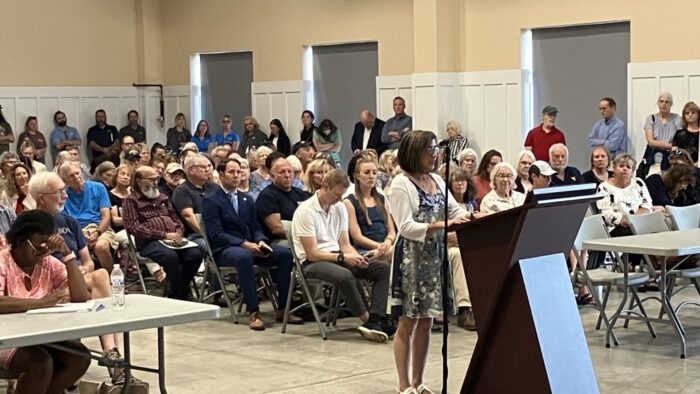
The Public Service Commission of West Virginia is conducting four public comment hearings concerning a high-voltage transmission line from Pennsylvania through West Virginia to Virginia.
More than 200 people attended the hearing at the Monongalia County Center to voice their opposition to the MidAtlantic Resiliency Link (MARL). More than 40 speakers like Judith De La Garza expressed concern that the project will bring environmental and economic harm to the state while providing little to nothing to show for it.
“MARL is poised to take from West Virginia rate payers and landowners their hard-earned money and some of West Virginia’s most precious assets, their land and peaceful living, without any long-term benefits in return,” she said.
Developer NextEra Energy has said it plans on running as much of the 107.5-mile-long line along rights of way for existing transmission lines that would cross Monongalia, Preston, Mineral and Hampshire counties.
But community members were joined by elected officials in voicing their concern that local ratepayers will pay the financial and environmental cost for the project.
Del. Evan Hansen, D-Monongalia, spoke on behalf of House Democrats to urge the commission to deny the application.
“I’ve heard repeated concerns from West Virginians who live and who own property along the path of the line, which would directly threaten numerous homes, residences, farms, potentially even with eminent domain,” he said. “I’m also concerned about impacts to nearby communities and forests and waters. I just simply don’t see any meaningful benefits that this project will bring to West Virginians and to the state economy. Instead, I see the prospects of increased electric rates and impacts the private property.”
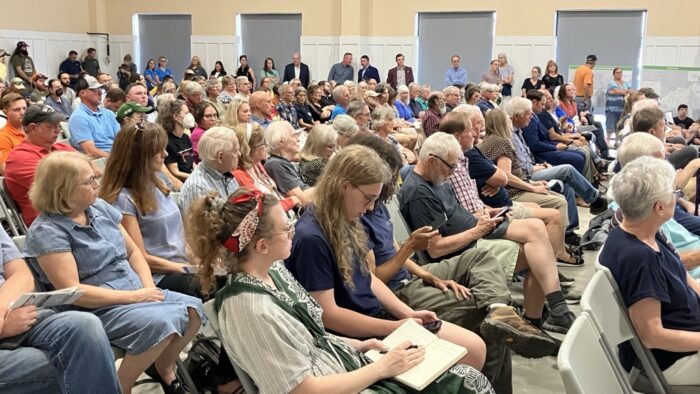
Several more state legislators were in attendance, with five speaking in person and another – Del. Gino Chiarelli, R-Monongalia – sending a comment to be read by a representative.
Two speakers, both union linemen, spoke in favor of the project on the basis of its promise to bring 200 jobs and $37 million in payroll to the region.
“This work will help our members’ retirements and keep their health insurance for their families,” said Kyle Kull, an organizer for the West Virginia and Appalachian Laborer’s District Council. “It will also provide opportunities for new construction workers to enter the workforce through our apprenticeship program. Beyond the construction site, 135 million in total spending over the two-year construction phase is expected to support the additional 264 jobs across the state, benefiting local hotels, restaurants, and gas stations, other small businesses. We need new construction and projects like this to keep our members working.”
The final public hearing was scheduled for Kingwood Thursday evening.
NextEra has had a presence at all the hearings so far and planned to attend the Kingwood meeting according to Kaitlin McCormick, senior director of project execution at NextEra.
“We really appreciate everybody’s taking the time to come out and share their opinions and make their voice heard,” she said. “This is their opportunity to do that in the process. We’ve been really committed to community engagement and outreach through our eight open houses that we had earlier, and we appreciate that there’s people taking the time to share their opinions here.”
The commission set regulatory hearing dates for late October and early November, with a decision due date of March 6, 2027.
Add WVPB as a preferred source on Google to see more from our team

Ryan Saxe, superintendent of Berkeley County Schools, said the suit is about whether West Virginia school funding system adequately supports what school districts are responsible for providing their students.
Continue Reading Take Me to More NewsThe West Virginia Mine Wars Museum is getting a sizable donation from retired union leader Cecil Roberts.
Continue Reading Take Me to More NewsA new study ranks West Virginia in the middle of the states when it comes to measures of freedom.
Continue Reading Take Me to More NewsWith the midterm elections approaching, Us & Them host Trey Kay takes the Dinner Party to Huntington, where eight West Virginians from different generations and political perspectives gather around the table. Half the guests are under 30, and while they disagree on immigration, foreign policy, the media and the direction of the country, they also discover some unexpected common ground.
Continue Reading Take Me to More News