This week, too often, people with mental health challenges or substance use disorder wind up in jail. But crisis response teams offer another way. Also, changes to the Endangered Species Act could benefit big business. They could also kill animals like the eastern hellbender. And, in troubled times, a West Virginia writer says to find peace in nature.
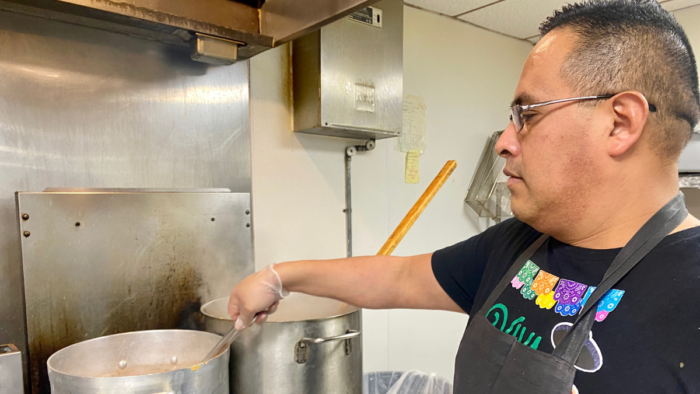
Juan Ríos stirs the pot of frijoles charros in the kitchen at Viva Jalisco. Ríos offers the dish once a week on the buffet line, and he plans to add it to the menu.Nicole Musgrave/West Virginia Public Broadcasting
Listen
Share this Article
This week, climate change is changing what grows in Appalachia, and where. Some peach varieties usually found in Georgia are moving north.
We also learn how the bean dish frijoles charros made its way from northern Mexico — to Appalachian Ohio.
And we revisit our interview with Crystal Wilkinson, who was appointed Kentucky poet laureate in 2021.
You’ll hear these stories and more this week, Inside Appalachia.
A bowl of brothy pinto beans is a comfort food for lots of folks here in Appalachia. In southeast Ohio, one man is serving up soup beans that remind him of his childhood home. Frijoles charros — or charro beans — is a popular dish among the ranching communities of rural northern Mexico. Now they’re on a menu in the former coal town of Wellston.
Folkways reporter Nicole Musgrave has this story.
Climate Change Prunes Peach Trees Of The South
Georgia is known for its peaches. They’re practically a state symbol.
You can find peach trees throughout the state. But now, varieties once found only in the southern part of Georgia are moving northward into Appalachia. That’s because fruit trees need a certain amount of cold weather — and climate change is resulting in milder winters and earlier springs.
It’s not just peaches. Climate change affects all sorts of fruit — from apples and blueberries, to pawpaws, pears and plums.
Jess Mador has this story of fruit tree migration. It begins in Georgia.
Tough Conversations About End of Life Plans
Much of Appalachia has an aging population. And with fewer services available in rural communities, it’s often left to families to care for the needs of seniors. That includes end of life care — and beyond.
But talking about funeral arrangements can be awkward. Tom Nichols is the owner of Bartlett Nichols Funeral Home in St. Albans, West Virginia. He spoke with WVPB’s Eric Douglas about ways to ease the conversation.
Revisiting KY Poet Laureate Crystal Wilkinson
Our final segment revisits our former co-host Caitlin Tan’s 2021 interview with Crystal Wilkinson. Wilkinson was the first Black woman to be named poet laureate of Kentucky. A lot of her writing focuses on Black women and their experiences in Appalachia.
Wilkinson grew up on her grandparents’ farm in Casey County, Kentucky. Her grandfather, Silas, raised cash crops like corn and tobacco.
Caitlin began by asking Wilkinson to read a poem. She chose an ode to Tobacco and her grandfather.
——
Our theme music is by Matt Jackfert. Other music this week was provided by Town Mountain, Carolina Chocolate Drops, Sierra Ferrell, Wes Swing and Paul Loomis.
Bill Lynch is our producer. Our executive producer is Eric Douglas. Kelley Libby is our editor. Our audio mixer is Patrick Stephens. Zander Aloi also helped produce this episode.
You can send us an email at InsideAppalachia@wvpublic.org.
On this West Virginia Week, the primary election in the state turns ugly and racist, an ambulance driver is indicted for the death of a man in Elkview and Democrats call for an investigation of Senator Jim Justice.
This week, too often, people with mental health challenges or substance use disorder wind up in jail. But crisis response teams offer another way. Also, changes to the Endangered Species Act could benefit big business. They could also kill animals like the eastern hellbender. And, in troubled times, a West Virginia writer says to find peace in nature.
A plan to funnel millions of dollars in oil and gas royalties toward conservation efforts is getting support from an unexpected group. From The Allegheny Front, we learn about fracking proposals in southeastern Ohio – and what WVU researchers say could be the impact on wildlife.