Alert (09/29/2026): Our Parkersburg TV transmitter is still undergoing maintenance and remains temporarily inoperative. We apologize for the inconvenience.
All our programming is available via our TV livestreams on our website and WVPB Passport. Thank you for your patience!
This week, author Silas House returns with a sweeping new novel. Also, some folks say, you have to fake it 'til you make it, even if you're trying to establish a state park. And, the story of the first Mothman sightings as written by a small town journalist in 1966.
Businesses in Charleston may soon be allowed to reopen, but West Virginia American Water customers will still have to wait- maybe as long as days- before the “do not use” advisory is lifted.
Kanawha Charleston Health Department Director Dr. Rahl Gutpa said the county health department will begin reviewing plans from businesses that can show they can safely reopen their doors.
He said they will have to find an alternative source of water to be approved and will go through onsite reviews for safety.
Adjutant General James Hoyer says the National Guard and a team of experts have created a standard methodology for testing water samples.
Friday, Hoyer said water samples were testing at 1.7 parts per million. The Centers for Disease Control says the water is safe for use and consumption at 1 part per million, but West Virginia American Water President Jeff McIntyre said they are not releasing Saturday’s testing sample results- at least not yet.
“We can collect all the samples we want, but the equipment that we run it through is very sophisticated and it takes time to run those samples,” McIntyre said. “So, we have a lot of samples that we’ve collected that we’ve not even had time to run.”
Each sample takes 20 minutes to test.
McIntyre said once his company can assure the water processed in the treatment plant is at the CDC approved level then they can begin flushing their water lines. Giving customers the closest thing to a timeline they’ve received yet, McIntyre said the flushing process will likely take days.
As far as the leak site itself, Mike Dorsey with the state Department of Environmental Protection said approximately 7,500 gallons of Crude MCHM leaked from a one inch hole in a storage tank, but they’re still not sure how the hole got there.
The DEP has set up booms in the river to collect any water that may still be leaching from the shoreline and have dug multiple interceptor trenches to collect any contaminated groundwater.
Credit Ashton Marra
/
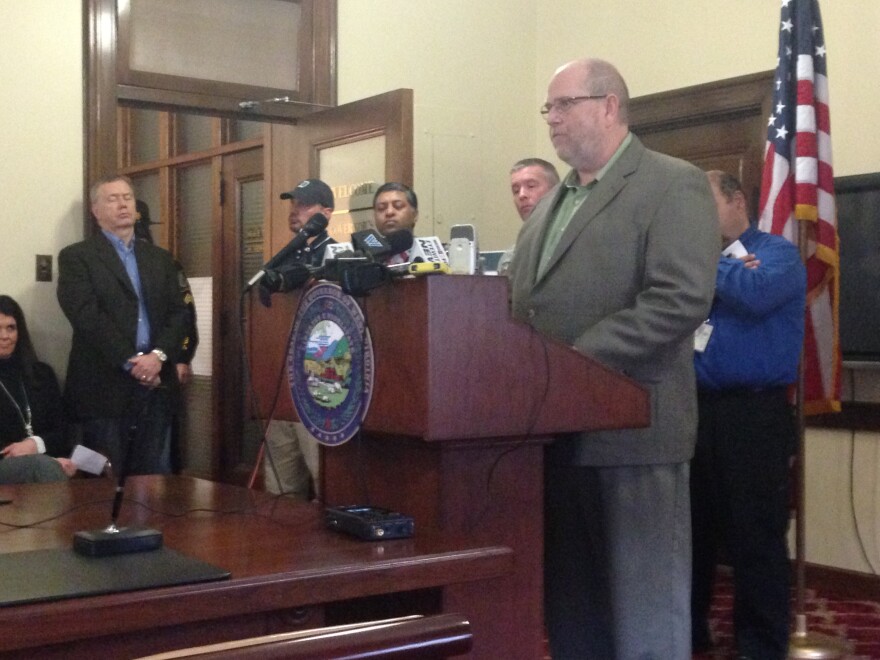
West Virginia American Water President Jeff McIntyre told members of the media it may take days to flush the entire water distribution system before people can resume using their water.
Dorsey said Freedom Industries- the company responsible for the contamination-is now cooperating fully.
“There’s a great deal more cooperation now than there was early on,” he said. “It’s a serious issue and it’s in everyone’s best interest to communicate well.”
There was a concern about the chemical continuing to move downriver, impacting the drinking water of more than just West Virginia American Water customers, but Dorsey said by the time the chemical reaches the Kanawha River and then eventually the Ohio River, he believes it will be too diluted to impact public health.
Add WVPB as a preferred source on Google to see more from our team
On this West Virginia Week, our voter's guide is out, and it has all the information you need to know about the upcoming general election in the state. Also, another lawsuit targets the state's public school funding formula. And, a million dollar giant troll is making its way to the woods of West Virginia.
Silas House is a major voice for Appalachia. The Kentucky native has written more than 15 books and served as the state's poet laureate. His latest book is The Tulip Poplars, a sweeping novel about the lives of four people as they navigate friendship and forbidden love throughout the 20th century. Inside Appalachia's Mason Adams spoke with House.
Ryan Saxe, superintendent of Berkeley County Schools, said the suit is about whether West Virginia school funding system adequately supports what school districts are responsible for providing their students.