Alert (09/10/2026): Our Parkersburg TV transmitter is undergoing maintenance for a few days and will not be operational. We apologize for any inconvenience.
All our programming is available via our TV livestreams on our website and WVPB Passport. Thank you for your patience!
This October, the Adaptive Climbers Festival will gather in Kentucky’s Red River Gorge for the fifth year. In 2023, Folkways Reporter Emily Chen-Newton covered the event for Inside Appalachia. Since then, the Adaptive Climbers Festival has grown. Organizers say they’re nearly at capacity, with 300 climbers, caregivers and volunteers. Ahead of the festival, the campground has made accessibility improvements. Volunteers with the ACF have also been sprucing up the trails.
Home » Stories » Trump Tariffs Hold Promise, Peril For Ohio Valley Industries
Published
Trump Tariffs Hold Promise, Peril For Ohio Valley Industries
Listen
Share this Article
The Trump administration has made good on a promise to impose steel and aluminum tariffs on some major U.S. trading partners, including the European Union, Canada and Mexico.
The U.S. commerce department exempted the EU, Canada and Mexico from a 25 percent tariff on steel and 10 percent tariff on aluminum in March. Those exemptions were set to expire in May, but countries were given one more month. U.S. Commerce Secretary Wilbur Ross announced Thursday the exemptions were expiring and the tariffs will go into effect at midnight. The President is still able to cancel or extend those exemptions.
The move has major implications for the Ohio Valley, home to more than 220 steel and aluminum facilities. But other industries in the region could suffer from higher prices on raw materials and punitive tariffs other countries have pledged to impose targeting some of the area’s major export products.
Credit Becca Schimmel / Ohio Valley Resource
/
Ohio Valley Resource
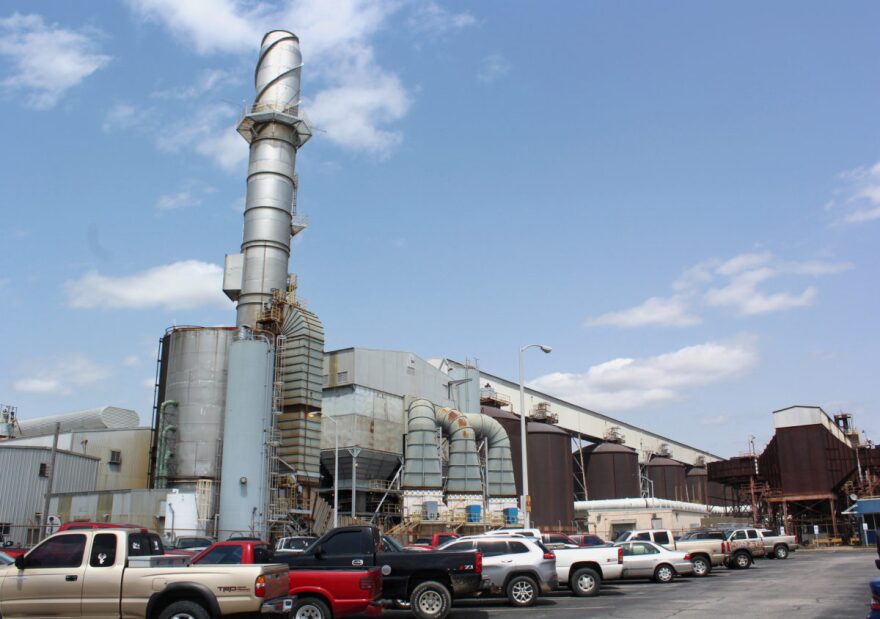
The Century Aluminum smelter in Hawesville, Kentucky.
Aluminum On A Roll
The Ohio Valley still provides more than 44,000 jobs in the steel and aluminum industries despite sharp declines over the years due to foreign competition. Century Aluminum Executive Vice President Jesse Gary said President Trump’s decision to implement tariffs will increase U.S. production of aluminum by more than 60 percent by the end of the year.
“The goal of these tariffs was to restart U.S. production, to protect our national security as a country and to be sure we have some industrial base to service our military, to service our electrical grid and the other uses we have for aluminum in this country,” he said.
Century Aluminum is in the process of increasing production capacity at its smelter in Hawesville, Kentucky, which had earlier cut production and employment.
Credit Becca Schimmel / Ohio Valley Resource
/
Ohio Valley Resource
Brady Carwile applying for a job with Century Aluminum.
But Erica York, a Policy Analyst with the free-market think tank the Tax Foundation, said tariffs can carry a steep price for other U.S. industries. York said the Bush administration placed tariffs on steel for similar reasons and it ended up hurting workers.
“What we found then was that the higher prices of steel caused more American workers to lose their jobs than the number that were employed by the total steel industry itself at that time,” she said.
York predicts that while the industries protected by tariffs could see a bump in employment that is unlikely to last. In the long run, she said, the unintended consequences of the higher prices and job losses in other industries outweigh the short term benefits.
Credit Becca Schimmel / Ohio Valley Resource
/
Ohio Valley Resource
Maker’s Mark workers hand dip bottles in red wax.
Bourbon On The Rocks?
Another consequence of tariffs is the risk of retaliation by affected trading partners. The European Union has already indicated that retaliatory tariffs are coming. The EU filed a list of target US products, including agricultural goods and bourbon, something important for Senate Majority Leader Mitch McConnell’s home state.
There are 32 distillery companies in Kentucky selling to customers around the world, including liquor giant Brown-Forman, where Paul Varga is CEO.
“A company like Brown-Forman could be an unfortunate and unintended victim of a policy which in part is aimed at promoting something which Brown-Forman is a stellar example of, committed long term American manufacturing company,” Varga said during a quarterly earnings call in March.
Credit Becca Schimmel / Ohio Valley Resource
/
Ohio Valley Resource
Barrels of bourbon are stored and aged for about 5-7 years.
The Kentucky Distillers’ Association said bourbon and distilled spirits accounted for more than $450 million in Kentucky exports last year, and nearly half of that went to European Union countries.
Association President Eric Gregory said in a statement that the distillers remain hopeful that continued negotiations will avoid a costly trade war. Gregory added that bourbon is an $8.5 billion industry in Kentucky, generating 17,500 jobs.
Add WVPB as a preferred source on Google to see more from our team
Two federally important facilities located in West Virginia require a strict limit on radio frequency interference. But for decades – increasingly as communication systems have become more advanced – those limits have made it difficult for emergency crews and first responders in Pendleton and Pocahontas counties to do their jobs as safely and effectively as possible. Now the results of a lengthy federal study show exactly how precarious the situation is. We caught up with Pendleton County Emergency Management’s Rick Gillespie to find out what the study shows and what happens next.
In recent years, physicians across the country have monitored surges of a condition known as Alpha-Gal Syndrome, which can cause allergic reactions to red meat. Hannah Saad with Appalachia + Mid-South Newsroom member station WKMS reports that, now, farmers, restaurateurs and the afflicted are flocking to a new source of protein.