Alert (09/10/2026): Our Parkersburg TV transmitter is undergoing maintenance for a few days and will not be operational. We apologize for any inconvenience.
All our programming is available via our TV livestreams on our website and WVPB Passport. Thank you for your patience!
Appalachians have always made use of the region’s wide variety of plants. A new book, called Appalachian Plants: In the Garden, In the Yard, and In the Wild, explores some of the history and lore of regional staples. It’s written by Linda Hager Pack and illustrated by Pat Banks. Inside Appalachia Host Mason Adams spoke with them.
These Groups are Reforming West Virginia's Food Economy
Listen
Share this Article
The phrase “food-desert” might sound like a landscape of sagebrush and armadillos, but it’s really a place where SlimJims, chicken nuggets and Slurpies count as dinner. A food desert can happen anywhere- we’ve all seen them. People who live in a food desert may be surrounded by food—fast food or convenient store hotdogs, instead of fresh, healthy food.
Even in rural West Virginia, where small farms still dot the roadside, fresh food isn’t available to all people. In some places it can take over an hour just to reach the next grocery store. Reawakening some of the old, small farm traditions-- and bringing a new local food movement to West Virginia-- is the work of five non-profits that were highlighted by the James Beard Foundation. Groups were chosen based on their work to bring healthy, local food to more people.
“We focus on helping people connect with each other so they can educate each other and be stronger together,” said Spellman.
The coalition trains farmers and advocates for statewide policies that help nurture small farmers.
Spellman says that because West Virginia has the highest number of small farms per capita in the country, there is a unique opportunity here to help transform the local food economy.
Credit Roxy TOdd
/
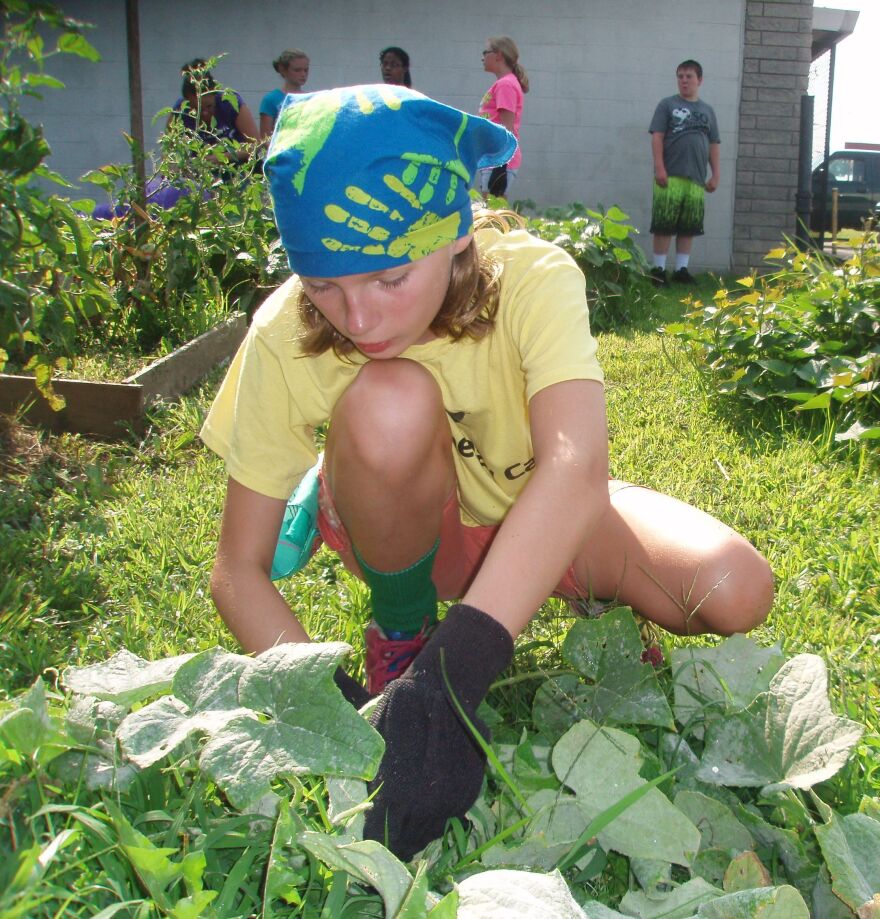
Children with a YMCA camp helping find harlequin beetles in the West Side Community Garden Project in Charleston
“Yeah, and we’re uniquely positioned to show what a small farm state can do because we don’t really have that many large farms. We’re mostly small farms. And people relying on each other and working together.”
Data center proposals are popping up in West Virginia – and in neighboring Pennsylvania, where one small community is juggling seven different potential projects. From The Allegheny Front, a public radio program based in Pittsburgh, we hear from that community and their concerns.
West Virginia has seen at least five major flood events over the last two years, but the head of emergency response in the state says changes coming to the Federal Emergency Management Agency (FEMA) are throwing a monkey wrench into federal support.
Many West Virginians may not remember the name Doris “Dorie” Miller, but he served on the USS West Virginia when it was attacked at Pearl Harbor. While Miller was never trained to fight, he raced to the deck on the day of the attack and fought back - shooting down at least one enemy plane. In 2020, a new aircraft was commissioned by the U.S. Navy and named for Miller. But recent stories have surfaced with talk of renaming it after President Donald Trump. We speak with Scott Womack, the commander of American Legion Post 100 in Monroe, West Virginia, to discuss the group’s recent resolution that the Navy should retain Miller’s name on the ship.
On this West Virginia Week, the state signs a memorandum of understanding about nuclear energy, the Public Service Commission disputes need for a transmission line, and 9/11 is remembered.