Alert (09/29/2026): Our Parkersburg TV transmitter is still undergoing maintenance and remains temporarily inoperative. We apologize for the inconvenience.
All our programming is available via our TV livestreams on our website and WVPB Passport. Thank you for your patience!
Inside Appalachia Host Mason Adams met with author Barbara Kingsolver at her home outside Abingdon, Virginia, a couple weeks before her new novel "Partita" was set to publish.
Western North Carolina Volunteers, Nonprofits Address Invasive Plant Removal At The Root
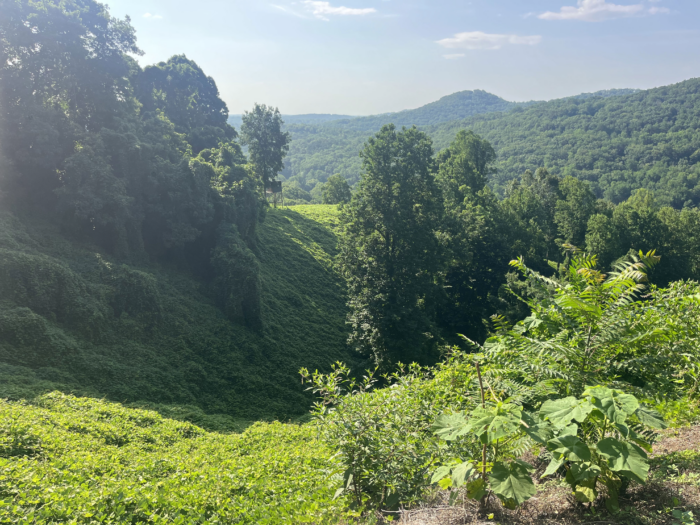
The Kudzu Warriors work in the Norman Wilder Forest in Polk County, North Carolina, every week. On June 29, they made it to this hilltop, which overlooks other property covered in kudzu. Eliza Benbow/West Virginia Public Broadcasting
On a Monday morning in June, a hilltop in the Norman Wilder Forest in Polk County, North Carolina, has become a battlefield.
The enemy? A relentless, invasive vine: kudzu.
Almost every week, the Kudzu Warriors meets in the forest to cut away at the invasive, which people often call “the vine that ate the South.” And if you’ve spent enough time in Southern Appalachia, you’re probably reminded why every day — around here, kudzu covers hillsides and hangs from branches and telephone poles.
The Warriors are volunteers and staff members with Conserving Carolina, a land trust that has protected over 51,000 acres in Western North Carolina.
The group take a sharp, winding path up to their current project: a clearing where native plants are growing alongside kudzu vines.
Many of these volunteers have been showing up weekly for years, and when we reach the clearing, they quickly get to work. There are a lot of creative ways to remove kudzu, but volunteer Ford Smith, who was the first to arrive this morning, has a simple strategy: just create enough of a path forward to be able to see your feet.
“It’s kind of see your feet, but that’s about it,” he said. “And trimming out anything that’s crossing the path from last week.”
The Warriors’ goal is to clear Conserving Carolina’s property. Looking ahead in the June heat and fighting against a vine that can grow up to a foot a day, it seems like a monumental task — even getting to this clearing has been a feat.
The group began clearing the forest’s 185 acres in 2011. Volunteers started at the parking lot and have been fighting their way up the 1.3 mile trail of Little Warrior Mountain ever since.
For Smith, knowing where you’ve been is important for continuing to move forward.
“When you turn around and look, you realize what you’re facing, and it’s just a lot,” he said. “But fortunately, we’re forcing it down the hill on this side.”
Many of North Carolina’s invasive species were brought to the area with a purpose. Some were brought as ornamentals or for cooking. Others were intended to stabilize soil or serve as natural fences.
Not all non-native plants are invasive, necessarily, but all invasives are non-native.
Kudzu was originally introduced to the region to prevent erosion and enrich the soil in mountainous areas. But, as with most invasives, it has thrived in a new area without its natural competitors, climbing up native plants in search of sun and rooting deep in the soil.
“We get the vast majority by hand-digging,” Ben Henderson, a habitat restoration associate at Conserving Carolina, said.
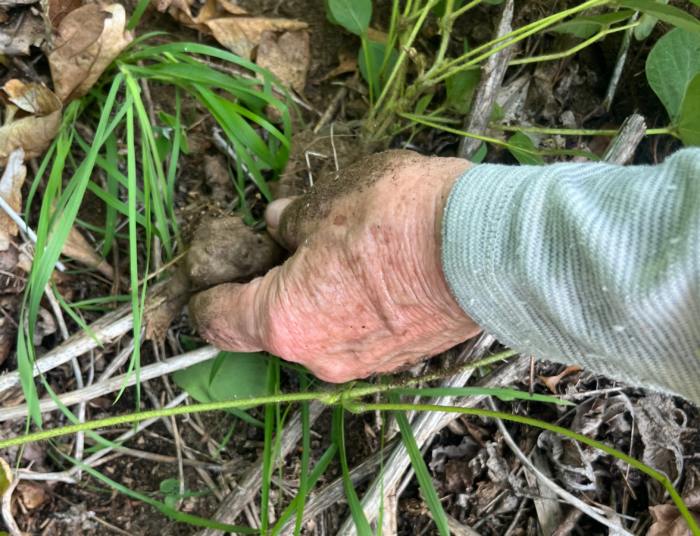
To be totally rid of kudzu, it must be removed by the crown, a bulb-like area in the root system where all the vine’s energy is stored.
Ford Smith removes a crown from the path he is clearing on Little Warrior Mountain.
Photo Credit: Eliza Benbow/West Virginia Public Broadcasting
Invasives are often removed with a combination of manual labor and herbicides applied carefully by trained workers or volunteers.
Elsewhere across the region, land trusts and nonprofits, like Conserving Carolina and MountainTrue, are pairing invasive species control with native plant education and stewardship.
Part of the goal of these groups is to help people recognize the difference between the region’s natives, like goldenrod, ironweed, or wild columbine, and non-natives. Especially harmful invasive species.
Once you learn how to tell them apart, you can’t unsee it.
At least, that’s how Mary Miller, the volunteer coordinator for Conserving Carolina, feels.
“I’m the biggest Debbie Downer to my family and my friends,” she said. “It’s like, they’ll say, oh, that’s really pretty. I’ll say, ‘that’s invasive.’ Or they buy a plant, God forbid. I try to be kind and nice, but might want to buy something different.”
Conserving Carolina has a pollinator garden where staff, like Miller, teach volunteers about native plants and their benefits to the pollinators in an area.
MountainTrue’s Resilient Forests Director Josh Kelly also works with other conservancy groups to host events called BioBlitz, which gathers citizen scientists and expert naturalists to explore and document species across a specific geographic area.
These events connect volunteers with experts and teach them how to use documenting apps like iNaturalist. In turn, volunteers contribute to databases used by scientists worldwide.
Emma Crider, the High Country Outreach Coordinator with MountainTrue, has a saying: If you can’t beat it, eat it.
During field work where she removed edible invasives like garlic mustard or oriental bittersweet, Crider began to realize that the bags of plant matter could be eaten, while still being removed to make way for native growth.
Now when she leads groups of volunteers to clear properties in Northwestern North Carolina, they’re able to donate removed edible invasives to local non-profits like F.A.R.M. Cafe, a pay-what-you-can restaurant in Boone.
“Those kinds of workdays create this very collaborative and very unique circled system that puts a purpose to a previously unused or negatively interpreted plant,” Crider said.
Further West in the Smoky Mountains, the Tuckasegee River flows around a unique wildlife habitat: Bryson City Island Park.
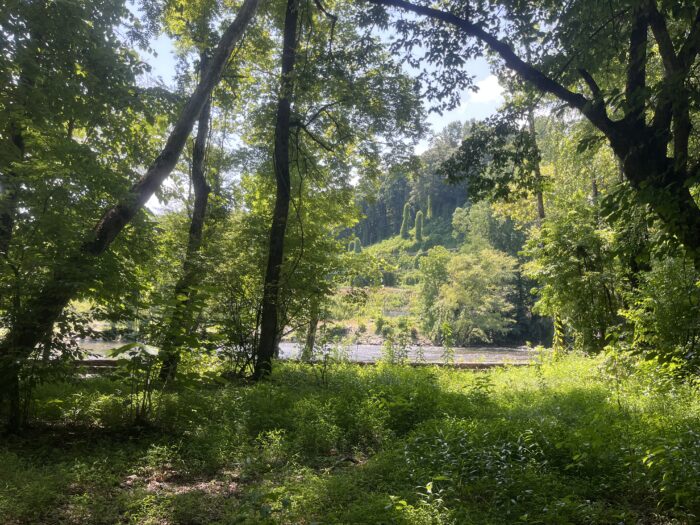
Just a short walk from downtown Bryson City, a metal bridge leads to an island of green in the middle of the river. Gravel paths lead around the perimeter, and in the center, trees like American Holly grow amid picnic tables.
At first glance, it’s hard to tell that the island experienced devastating flooding in 2020, or that nonnative species like kudzu, Chinese privet and English ivy once dominated the habitat.
MountainTrue staff and volunteers have been removing invasive species from Bryson City Island Park for years.
Photo Credit: Eliza Benbow/West Virginia Public Broadcasting
“[Kudzu] was, you know, 30 feet up in these trees,” Tony Ward, MountainTrue’s Southwestern Regional Habitat Restoration Coordinator, said.
MountainTrue has been working on this site for years.
At one time, the vine was completely eradicated on the island, but the stubborn invasive requires yearly chemical treatment to keep it from coming back.
That’s what he’s here to do today.
“With invasive plant control, that’s something you just have to do,” he said. “You can get it completely under control, and it will start slowly trying to creep back.”
Many volunteers with the Kudzu Warriors began showing up every week because they were already fighting the vine on their own properties and wanted to do more to help.
For longtime volunteer Don Dicey, it’s as much about clearing the land as it is about the opportunity to work on conservation strategies with other volunteers, especially young people.
“You know, that’s why I’m here, is the people,” he said.
At times, the amount of invasives like kudzu can feel overwhelming, like for first-time Kudzu Warrior volunteer Liam Finch on Little Warrior Mountain. But it’s also ultimately the reason he’s here: to be a part of the solution.
Finch, who lives in Tryon, said he sees kudzu everywhere he goes.
“It looks like something out of a horror movie,” he said.
There is a noticeable difference between where these volunteers have been and the surrounding area.
On one side, trees are overrun and collapsing under the weight of vines. On Conserving Carolina’s property, the kudzu is not gone, but significantly reduced, and native plants like tulip poplars and black-eyed Susans are beginning to grow.
With the space to breathe, native plants return quickly to familiar ground. But they’re not the only ones, as Dicey has found.
As they clear the land, he said, the animals follow.
“The bears came first, then the deer, then you get raccoons, and you get all kinds of other little guys, foxes and coyotes and so on,” he said. “But we try to kind of capture what’s going on as we open up paths.”
Across the region, volunteer-based groups like MountainTrue and Conserving Carolina are filling gaps for local and state park services with specialized, environmentally conscious care — especially in areas that were affected by Hurricane Helene.
It’s not that these entities don’t want to fund the work, Ward said, it’s just that they have other things to worry about.
MountainTrue also advocates for the natural world, including legal challenges of forest plans by the U.S. National Parks Service, settling a coal ash cleanup by Duke Energy and partnering with federal organizations to remove dams.
All the advocacy is worth it — the Southern Blue Ridge Mountains are a refuge for unique species, including ones who have gone extinct in other places. Protecting the region is especially important now, Kelly says, because we are in a time of ravage, human-caused change.
“If we find harmony with this place, with this land, it will shelter us too,” Kelly said. “It’s also been a place where people have been sheltered through the ages. So I think our task as people of the Southern Blue Ridge is how to live in harmony with this place.”
Add WVPB as a preferred source on Google to see more from our team
Inside Appalachia Host Mason Adams met with author Barbara Kingsolver at her home outside Abingdon, Virginia, a couple weeks before her new novel "Partita" was set to publish.
On this West Virginia Week, a mine operation in Kanawha County gets a WARN Notice, three Wyoming County Schools will remain closed until next week, and we learn the origins of the Flatwoods Monster.
This week, Barbara Kingsolver’s new novel takes on issues of class and classical music. Also, kudzu warriors band together to fend off invasive plants and take back the land. And, it’s pawpaw season, but a new bug could be harming the trees.