This conversation originally aired in the Oct. 11, 2026, episode of Inside Appalachia.
Barbara Kingsolver is one of Appalachia’s foremost writers.
She’s written a string of bestsellers, like The Poisonwood Bible, and developed a devoted readership around the world. Her 2022 novel Demon Copperhead won the Pulitzer Prize.
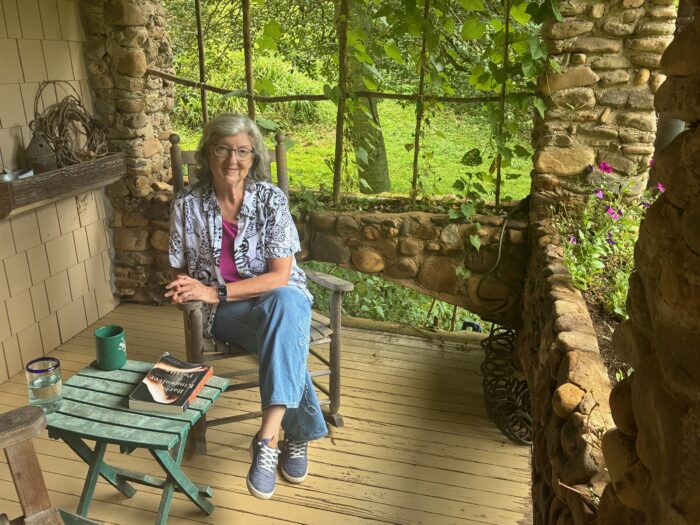
Inside Appalachia Host Mason Adams met with Kingsolver at her home outside Abingdon, Virginia, a couple weeks before her new novel Partita was set to publish. They sat on her front porch, enveloped in the sounds of late summer in Appalachia.
The transcription below was lightly edited for clarity.
Kingsolver: Can I paint a little picture for your listeners? We’re sitting on the front porch of this farmhouse which was built in 1902 by Sanford Webb. We bought this farm from the family that originally settled this hollow and built the house, and that’s the original barn we’re looking at down there. We have a flock of sheep. We’re going to shear them on Saturday. We shear twice a year. We have a flock of chickens and guineas.
This hollow, when my urban friends occasionally ask me, “How can you live out there in the middle of nowhere?” I just think, “You have no idea. This is my everywhere. This is my everything.” We grow our own food. That garden up there feeds us and our family very well. The “middle of nowhere” is in the eye of the beholder, and I feel so lucky to behold these woods that surround us and that I get to walk in these woods every day. We forage mushrooms in these woods.
This place feeds me literally and it feeds my soul. I feel like I belong to this land, and I belong to this neighborhood and the people that I’m lucky to call my friends, who do all kinds of work from writing poems to building houses, practical things, beautiful things.
The work comes out of who I am, and who I am is all of this stuff. I mean it’s completely of a piece. I’ve been thinking so much about Wendell Berry, who passed just a week ago. This is a great loss. He was a friend to me, a great mentor to me. I left my little Kentucky town and went out to seek my fortune, but I ultimately understood my fortune is here, my home is here and anything I could possibly write that would be meaningful needs to be rooted in this place.
The way Wendell put it is, ‘What I stand for is what I stand on.” And those are the truest words I know.
Adams: Demon Copperhead was just so recognized, so adored and it’s been added to the canon of books about Appalachia.
Kingsolver: Well, I’m really happy that, because my intention when I set out to write it was really to write The Great Appalachian Novel, which I couldn’t have written until until I reached a certain age, a certain level of experience and maturity, and also a certain comfort with my full embrace of my own Appalachian heritage.
I’ve lived a long time with the presumptions — and I will say even the contemptuous assumptions of outsiders to this region — about what Appalachia is. I’ve lived my whole life with this feeling of invisibility — that we don’t get to see ourselves reflected on television, in the movies, in the daily news, in magazines, in literature.
We are so accustomed to being overlooked we kind of internalize that.
I had to really live with that for decades before I could say to myself, I” am ready to tell the story of us in the biggest way I can,” but in the voice of one person who’s living through the worst of what the world has thrown at us, and blamed us for, and bring in the back story — the back story of coal, the back story of timber, how these companies have come in and taken the best of what we have in this very resource-rich place and left behind a mess.
We have a suppressed economy. We have high unemployment. We have fewer opportunities here. We have fewer educational opportunities. The quality of our schools is not what it should be. That’s not because we asked for it. It’s because this was quite deliberately done to us. And you can track how the coal companies, they didn’t want an educated population. They didn’t want a population that could choose other things to do, like work in factories or mills. They kept those things out so that they would have a ready population for their work. They really had no other choice.
So, that was a big story and I waited a long time to tell it. And when I did, I was quite amazed honestly that the world was ready to hear it in such a big way.
Adams: After Demon Copperhead, did you feel pressure heading into this next book?
Kingsolver: I did, in an unusual way. I always feel daunted by my subject matter and I think that’s a healthy thing. Self-doubt is a writer’s best asset, because we spend our whole lives striking out what we wrote yesterday and trying to make it better. Self-criticism is an essential tool for a writer because it drives revision. It drives us to keep working until we’ve created what we think is our very best work at the sentence level, at the plot level, everything.
So I always walk into a new novel with humility. It’s a lot of power. The power of a novel is magical. When you read a novel, you set yourself aside and become a different person. You enter the lives of people you’ve never met, and you experience the world through another human being. That is a magical power. It’s a superpower. I don’t take it lightly.
I think long and hard about what I’m going to do with that that can enrich your life as a reader. And of course, you’ll bring to it as a reader the material of your own life and you will make a new creation. But I want to do my half of that as best I can so that it’s worth your while.
I try really hard to write with nobody looking over my shoulder because I think I can do my best work by thinking about what I have to say, rather than what anybody wants to hear from me. If I start thinking about what’s popular, what sells, what kind of novel are people wanting this year — I’m going to get pulled off of this point, this place, this rocking chair on this farm, this life I’ve lived that has given me a particular wisdom that I have to share. I need to stay on that spot to be true to the story I have to tell whatever it’s going to be.
After Demon Copperhead — because you’re right, it bumped me into another orbit, and I did have a kind of an awareness that there is an expectation now. I did feel a bit of, now what? How’s she going to top that? Which is a very dangerous thing for a writer to think about.
The writer Richard Powers is a wonderful friend. His amazing novel The Overstory did I think in his career what Demon Copperhead has done for mine — it bumped him into another orbit. The Overstory is a magnificently large novel in its time frame. It brings you as a reader into the mental time frame of a tree, which is hundreds of years. It’s a remarkable thing that a novel could do that. So, next he said, “I’m going to write a little fable.” Now, what did he write? Bewilderment, which is hardly what I would call small, but in his mind, it was and that’s what matters. It got him into feeling comfortable with the next project.
So I said, “OK, I’ll do the same.” I’m going to write, I decided, a little love story. And so I began. That was liberating in one way to think, “OK, this is going to be so so different. Nobody will even remember that I wrote Demon Copperhead. They’ll think I’m a whole different writer.” And then what happened, I don’t think “little” is one of my skills. It just grew.
It was a little love story that grew into a bigger love story, a sort of a story told in two time frames of a woman in mid-life looking back on a very important … that part of her life is told mostly in just a period of a few months, where she fell, it was really the first time that she’d ever fallen in love. It was so ferociously passionate that it completely unsettled her life and caused a domino effect of catastrophes in her life.
I thought of it as a first love/last love, with this tragic thing that can happen to people, where you fall in love at a very young age so passionately and sort of crazily that nothing will ever match up to that in your life again after that. You’re kind of disappointed with all relationships that ever happen again.
That’s what I was going to write, but when I was thinking myself about looking back at my own youth and my own experiences of first love and that sensation you have of losing yourself, and the life you had planned just goes out the window because it’s really obsessive — it it really is kind of a mental illness. And when I was thinking about that, I realized I can only look at it now through a filter of everything I’ve learned since about relationships, about love, about companionship and comfort and all of the things that you learn in life that you understand as a different kind of love, mature love. OK. So I thought, that’s worth writing about.
So it became a dual love story: young love, mature love, back and forth sort of contrasting. And all of these other things that come in mid-life in terms of acceptance, forgiveness, accommodation. A new level of selflessness maybe that you can bring to your relationships, all these things.
And then, because I had decided right from the beginning that my young Livia — her name is Livia, the protagonist of this novel, the narrator of the novel — is a musician, she’s a pianist. Because of that, her passion for her art became like a third examination of love, which ends up kind of wrapping the whole thing up like nested boxes.
I just had the best time building this complicated plot. It grew out of the confines of “small” very quickly, but I didn’t care, because what I understood is that in contrast to Demon Copperhead, this is another kind of Appalachian novel.
I’m happy about that because it goes to the point that I think so many of us are always trying to explain to outsiders, which is we are not all one kind of person. We are not, first of all, the black and white picture of the dirty barefooted kids standing on the porch. YWe’re not all sad, we’re not all shoeless, and we’re not all white either. We are not a monoculture.
We are complex, nuanced communities of people. And Livia and her family are another kind of Appalachian that all of us know and that many of us are, which is, we’re not born on the floor of a trailer home to a drug-addicted mother as Demon Copperhead was. We are farmers. We are teachers.
We are people who live in this place making the best lives we can, who think of ourselves as pretty ordinary people among our neighbors. We don’t think, “Well I’m poor,” nor do we think I’m rich, but certain facts remain. For farmers, likely, we don’t have health insurance. And that plays an important role in this novel. Or if we do, we don’t have easy access to doctors.
We are people who cannot, for the most part, afford to send our children to college. That’s a reality for not just the poorest, but for everyday people in this region. I would say that’s pretty common. And there’s more subtle things like that. One is, we don’t all necessarily want our kids to go to college. Or even if we say we do, in our hearts we’re afraid because in all likelihood, they won’t come back.
That is a grievous thing to live with. So, these are all Appalachian realities that I enjoyed writing about, because it’s the ecosystem of the novel that I felt really good about putting on the map.
Adams: And it is the essence of storytelling in that it’s very specific — so a woman who has a very different life than many of us have — but it is so relatable. The main character is so richly drawn and we see her at snapshots all throughout her life at pivotal moments that just tell us so much about everything before. Can you share some of your inspiration for Livia and where some of her details came from?
Kingsolver: Well, she is a musician. She’s a pianist, and she’s a very good pianist. I was consciously working on and thinking about class barriers — not just to education, but also class barriers to what we think of as “fine art.” We all know kids in these little rural towns like this one where I live, who love poetry, who love classical music. A good friend of mine is a piano teacher, and she teaches Mozart and Bach to the children of farmers, and she has students who just can’t wait to come to their lesson and learn a new piece.
I was one of those kids. I grew up in the littlest town you can really imagine — 1,300 people and it was the county seat. So there was nothing bigger anywhere near us. And I just fell in love with classical music. I begged for piano lessons. I outgrew my teacher really fast, and kind of by hook or by crook managed to find better teachers and get myself to lessons, finally in Lexington.
Lexington was an hour and a world away from where I grew up in Kentucky, but I managed once I could drive to find teachers and find my people who also liked reading and liked other things that kind of made me feel like an outsider. So, I was a kid who grew up as a weirdo. I was unpopularly bookish and suffered the bullying that can happen when you’re not like your peers and that you take very hard. So, I knew that feeling that I gave to Livia of not fitting in.
And also I was one of the few from my own high school class who was lucky enough to go to college, and the culture shock was indescribable. I didn’t go that far. I went to college in Indiana, but people treated me like I was the quaintest, dumbest little thing. And I was not prepared for the cultural barriers. So I knew how to describe that feeling of being lost — that feeling of being a class migrant as we now say — of being from a working-class family and entering into a world where people have very different levels of preparation, privilege, and expectation, and just feeling lost.
I still play piano, and I love piano, and I did actually study classical piano for a few years until I figured out I was not going to make it as a concert pianist. I was neither that good or that delusional. Of course, we always do research as novelists and we also mine the veins of our own experience to begin with, and then usually have to embroider from there.
There are passages in the novel where you are inside this person who is playing beautiful music, and you feel what she feels. She thought of herself as the string-bean, gawky, invisible kid, but when she sits down at a piano, the whole audience falls in love with her. And she mesmerizes them, and that’s a power that she feels and describes. We don’t just make music to mesmerize people. We make it because we lose ourselves into this beautiful thing we are making.
And I loved describing that and writing about that because I don’t know if I’ve ever read a novel about that — about being a musician and making music and what that feels like. So, those are some of the things.
There’s also a suicide in this book. A a person extremely important to Livia — the most important person in her life, her brother — dies by suicide. And this is not a spoiler because you learn literally in the first sentence that this happened. That was a prime mover of the plot and of the emotional arc of Livia, because the way she sees it is, he left her. That is a profound abandonment in her mind that she’s carrying through her life. And she was 11 years old when it happened. As an immature human, as an 11-year-old, you think of everything in terms of yourself. And the way she took that loss is that, “He left me. I was leavable. I was not important enough for him to stay.” It’s a very big thing to write about and something I took very seriously.
In my life, I’ve lost four friends to suicide in different decades. Honestly, when I think back, the first time when I was 20 and most recently in the last few years. In two of these four cases, I was the last person to speak with the lost friend. And that is a very serious thing to carry. And so, I’ve spent a lot of time processing that loss. That’s something that I thought, “I’m old enough, I’m wise enough maybe I hope to write about in this novel.”
Adams: [When I read your new book, Partita,] Not only was I experiencing all these waves of emotion, but you also had me reaching for Spotify.
Kingsolver: Well, I will point out to your listeners that this book comes with a playlist. Right here, printed in the back of the book, is a list of all of the pieces that Livia plays that are very important to her and also sometimes important to the movement of the plot. And you can listen to them. I did that when I was writing. I listen to these pieces over and over to figure out how to capture them in words, to translate the emotions of this music. By the end of the year or two that I was writing this novel — I would guess it was two and a half — that music was in my head as a soundtrack. And I also want to emphasize that you do not need to know or love classical music to enjoy this book, anymore than you need to have been on a whaling ship to enjoy Moby Dick. I think one of the great things a novel can do is take you into a world that’s completely unknown to you, and that’s a plus, that’s not a minus.
So I don’t want anyone to be daunted, and that’s part of the point of this novel and talking about class and culture and cultural barriers. What we call “fine art,” which is the art that’s in museums and the music that’s in concert halls, belongs to everybody. It should belong to everybody and we country people, we Appalachians, have internalized a lot of the presumptions that other people have about us. And one of those, I think, is this feeling that so-called “fine art” is for snooty people.
We have our own very rich cultural traditions of music and art, but it tends to be quilts and it tends to be bluegrass, and the music you can make on a front porch, not in a concert hall. Yes, we do have that but a lot of the most beautiful art that people have made in our history, in other times, in other countries — that can be ours too. We should not be afraid to claim any beauty that people have ever made. We deserve and have every right to be in an art museum and to be in a concert hall.
Adams: One of the features of your work is that your books are dense with sentences that — they don’t interrupt the flow in any way, but you’ll be reading along and then you come across a sentence and when you finish it, you say to yourself, “She just encapsulated this really insightful truth. Very subtly, very gracefully in a way I didn’t even notice until I hit that sentence.” These insights are just captured in these elegant sentences that slip right into the flow. And your books are dense with those. It’s one of their features. When you write like that, are you laboring over that sentence or does it just slip out, or how does that work? How do you do that?
Kingsolver: Sir, that is labor. And a lot of the labor is to make it look effortless.
I always think of ballet. The point of ballet is to look when you’re dancing as if you’re defying gravity, but the truth is, your feet are bleeding inside those shoes. So, trust me, as a writer, my hands are bleeding inside those sentences.
Not to ask for pity! No, it’s a great compliment to me when someone asks, “Did it just come out that way?” Because that’s what I’m going for. But the truth is, every sentence in this book was rewritten between two and 40 times. Every paragraph was rewritten. So, yeah, it’s a lot of work. I don’t want it to look like a lot of work. And I have read books that read like poetry and you see all the work on the page. OK, pretty language, but where the heck are we going? Can we get there already?
I have a commitment to accessibility. And I think that comes from my background. I did not grow up among people who read 18th century novels or 19th century novels. I grew up among people who read the newspaper and the catalogs mostly. And maybe detective novels or something. I want anybody to be able to read my books. So, I work really hard on things like plot and flow. And while the poetry is there for the people who want poetry and appreciate it, the bones are there too for a person who just wants to find out what happens to this girl.
Adams: I think it’s an understatement to say you’re a successful novelist.
Kingsolver: Thank you.
Adams: Where every new book causes these ripples of anticipation and excitement.
And I guess for some artists, that’s enough. But certainly there seems to be — in Appalachia especially, but maybe more broadly as well — artists and creators who feel a responsibility that comes with that. One doesn’t need to dig deep to find out that you’ve been doing the same. So, first of all, do you feel that responsibility? And can you share some of the ways — I know you’ve not only been a writer, but you’ve engaged in your community. You’ve given back. I’d love to talk about that aspect a little bit.
Kingsolver: Well, sure. I don’t think of it as “giving back,” I think of it as belonging. I am from this place and of this place. Just like being in a family, you do what you can for your people because you know that they’ve always done what they could for you.
I never meant to be successful. That was never my object. I actually didn’t even mean to be a writer. I didn’t grow up thinking that that was an option I had. I just knew I loved books and I thought that magical people made them, wrote them. I didn’t think I was such a person. I didn’t study writing. I didn’t tell anybody I wanted to be a writer.
I just wrote because I read so much, and I just wrote privately in diaries and in journals, and I wrote poems and stories, and eventually writing came and got me and pulled me out of myself by the collar and said, “OK, this is a thing you do and it is useful and people want to read it.” And so OK, I consented to being a writer.
But I never thought, “Oh, I’m going to be famous.” I never thought of it as something that was going to pull me out of my community or out of my world or my sense of duty to my family and community and nation for that matter. We here grow up with a very very strong injunction not to get above our raisings. I value humility and modesty very much. I think it’s important to remember how thoroughly we are indebted to the people and place who made us.
I look to the great and dearly departed Dolly Parton as a person who went way up, but she brought her raisings with her. She never ever betrayed or denied or separated herself from the people to whom she belonged. And so she made sure that children got books and then and still will — from birth until they start school, if they live in homes that otherwise wouldn’t have books. She did all of these great great things with the swell that she rose upon. And I don’t think it probably ever occurred to her to do otherwise.
That’s how I feel too. And I don’t even have to spend the money she did on hair and makeup! That’s a savings, in my book. I don’t need or want to live that differently from my neighbors. These CEOs who make paychecks with so many zeros in them, you can’t even count them — I don’t think they can count them either — I don’t think they know what to do with that money. I see a paycheck as something to share. I’ve been so lucky to be able to use the so-called success that has come to me and the resources that have come to me as a consequence of it. I’m so grateful to share that with people who need it because, in my book, that’s where resources should go.
Lee County gave me the story of Demon Copperhead and Lee County desperately needs support for people who are in recovery from addiction. And so with a lot of the royalties from Demon Copperhead, I was able to found, establish, and support a recovery home for women, the Higher Ground Women’s Recovery Residence, which has been such a gift to me, honestly. We bought a house. We pulled together a group of people who could help us kind of establish how this house will work, and it immediately filled with women who need a safe place to live as they move back into the world from day one of their recovery. While living there, they are safe. They’re in community with each other. They support each other and their sobriety while they pull together the things you need to live like a GED, a driver’s license, a job.
We’ve arranged for our women to have free tuition in community college classes, the things that they need, and help with their paperwork. All of the burdens that society puts on a person who’s trying to rebuild a life, we can help them with until they’re ready to move out of this house into their own lives and in many cases regain custody of their children and so forth. So how lucky am I that I get to be a part of that community and see these really inspiring women and what they can do for themselves and each other?
My husband and I have been for years involved with and supporters of Appalachian Sustainable Development, which is a 30-year-old organization in this county and and spreading out to surrounding counties, that originally was designed to help farmers transition from tobacco to other crops when the bottom fell out of the tobacco economy, which was the base of the economy of this county. That was a disaster that people outside of here don’t understand. There is not another crop you can grow on the little three- to five-acre bottoms that we have that are arable, that are plowable in this terrain. There’s not another crop — that was legal in those days anyway — that you can sell for enough to make your truck payments and your mortgage payments.
Appalachian Sustainable Development was first organized to help these farmers grow organic vegetables — which also are a pretty high-value crop, but the problem is getting them [to market]. A tomato has three or four days from the day you pick it to get into somebody’s shopping cart, and there was no infrastructure for that around here to get crops to market. My husband created a restaurant to support these farmers to purchase from these farmers. And Appalachian Sustainable Development has grown into a really interesting, thriving organization that addresses food insecurity, that trains people in farming and gardening, that does all kinds of other things. We’ve loved being a part of that and a major supporter of that organization, both in terms of time and resources.
We also are very involved in a place called the Blue Ridge Discovery Center, which is also an organization that helps connect people both from this region and from outside this region, with the incredible beauty and value of the biological diversity we have in our natural regions of this area, our natural preserves in the mountains. The Blue Ridge Discovery Center does educational programs, nature writing programs, programs for kids that get kids out into nature to teach them about salamanders and wildflowers and all of these things that we have here that in our culture we have lost a little connection with. Again, because of economic duress and other needs [that] come to the fore. We’re trying to help people relearn how to appreciate the beauty and the value that we have in our natural heritage here.
Adams: It’s been about a year since Higher Ground launched. How’s it going so far?
Kingsolver: It’s going really well. We have our ups and downs. It’s a ways. It’s a two-hour drive to get there. so I don’t go real often. When I do, it’s wonderful.
I love meeting with the women in the house and just hanging out with them, talking with them about their experience and just seeing how much community support there is. I’ve just been so impressed. The home is in Pennington Gap. The whole community rallied around when we were getting started. Different churches adopted rooms and brought us quilts and lamps and pictures to pretty the place up to make it beautiful. The local furniture store donated our living room furniture and so forth.
It’s ongoing. You don’t just open a house like that and walk away from it. I’m on the board of directors. We meet every month, and we talk about the challenges, because there are always new challenges that we’re figuring out as we go. We’re a new nonprofit and there are programs, there’s grant writing. There should be funds available to support this project.
People heard about those gigantic sums of money in the settlement for Perdue Pharma and think, “Oh, well, that’s going to help people.” It is not. It is not reaching Lee County, so we have to work really hard to find other sources to support, because it takes money to keep it going. It takes funds. It takes work. As people graduate and move out, we evaluate the applications of people to come in. There are many nuances to a house like this.
But we’re expanding because there’s one recovery home for women in Lee County, and we need at least 10. So we have purchased the building immediately adjacent, and it needs substantial renovation, but we are renovating it to create more housing, more apartments for women to live in — ideally, apartments where women could graduate into to live with their children or families. In the ground floor of the building we’re going to have a second-hand store, which is just the kind of retail that Pennington Gap would love and that would give our women experience with meeting the public, with managing this store and handling money and these kinds of skills, which are very important life skills.
We have all kinds of projects, and I’m very much a part of even everyday decisions. I have emails every few days with something we need to sort out, but I really love being involved with that.
Adams: Barbara Kingsolver, thank you so much for speaking with me.
Kingsolver: You’re so welcome.
--
Barbara Kingsolver’s new novel is Partita. It’s available from HarperCollins.