


Preston County Org Recognized For Preservation Of New Deal Project
The recognition is a testament to the work of 40 years to preserve, interpret and educate about the community's history.
Continue Reading Take Me to More NewsAlert (09/10/2026): Our Parkersburg TV transmitter is undergoing maintenance for a few days and will not be operational. We apologize for any inconvenience.
All our programming is available via our TV livestreams on our website and WVPB Passport. Thank you for your patience!




To Educate, Inform, and Inspire by Telling West Virginia's Story

Mountain Readers Week will be held Oct. 5-9, 2026! Celebrate and foster a love of reading in children across West Virginia.

Learn more about Be My Neighbor Day! And check out our recap from last year.

On Demand

On Demand

Stream original productions from WVPB

Watch locally produced documentaries & more.

On Demand

On Demand






West Virginia Morning

Inside Appalachia

West Virginia Week

Mountain Stage

Us & Them

The Legislature Today

The Legislature This Week

Send us your comments and questions.

Stream our board meetings.

Check out the latest WVPB news.

Sign up for our newsletter and get weekly updates.

Meet the WVPB staff.

WV Educational Broadcasting Commission, the WVPB Foundation, and the Friends of WVPB.

Come work with us!

Read our annual report and learn how we educate, inform and inspire with your support.

Sponsor impactful and engaging media and entertainment.

Use your IRA to make a gift to WVPB.

Become a member with your gift of $1,000 or more.

Make WVPB part of your legacy.

Manage your membership account.

Learn how you can Protect and Sustain West Virginia Public Broadcasting.
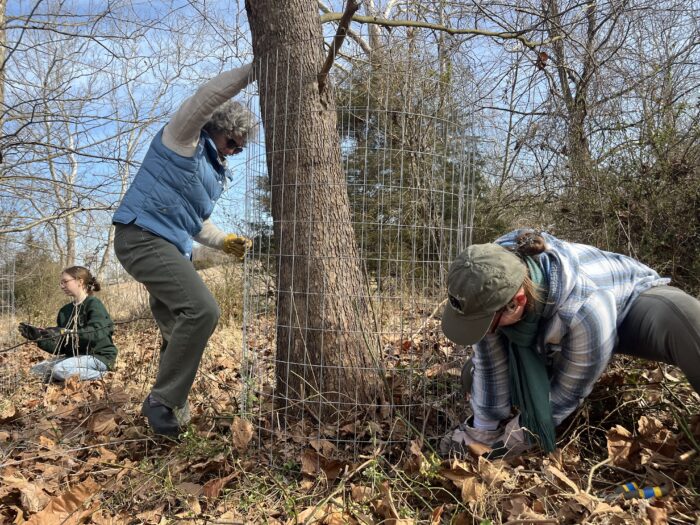
Donning rain boots and gloves, volunteers trudged across a Charles Town wetland Tuesday to prepare the habitat for a pair of unexpected residents.
Jefferson County’s Cool Spring Preserve is currently home to at least two beavers, possibly mates, according to local conservationists. If trail camera photos did not offer proof enough, their presence is made clear through bite marks on trees and a growing number of dams in Bullskin Run, the local stream.
Beavers are native to wetlands across North America, including those in West Virginia. But they were hunted to near-extinction during the 18th century fur trade. With fewer people hunting them for their pelts, beavers are growing in population across the continent. According to many conservationists, that’s a good thing.
Alison Zak serves as founder and executive director of the Human-Beaver Coexistence Fund. The group develops nonlethal strategies to manage beaver populations across the mid-Atlantic.
Zak said that beavers play a key role in bolstering biodiversity, storing groundwater and filtering pollutants in wetland ecosystems. But they also bring what she describes as “beaver problems,” which fall into two main categories: flooding and tree damage.
When beavers build dams, they can redirect the flow of water and prompt flooding. This can disturb roadways and personal property, so conservationists often fence off culverts so beavers cannot disrupt the flow of water with their dams.
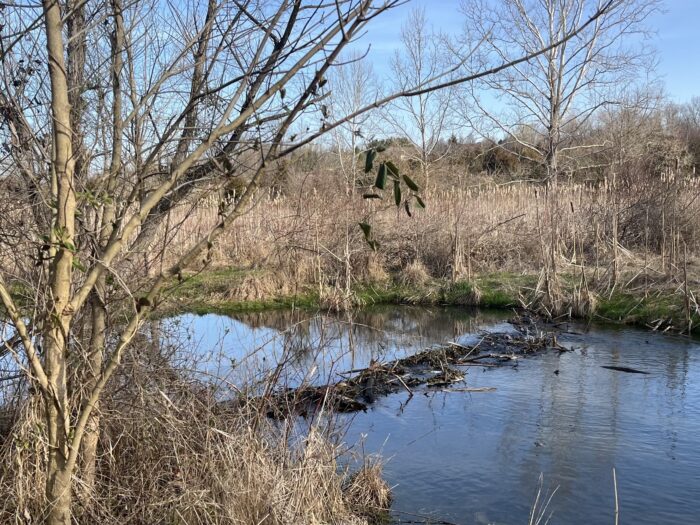
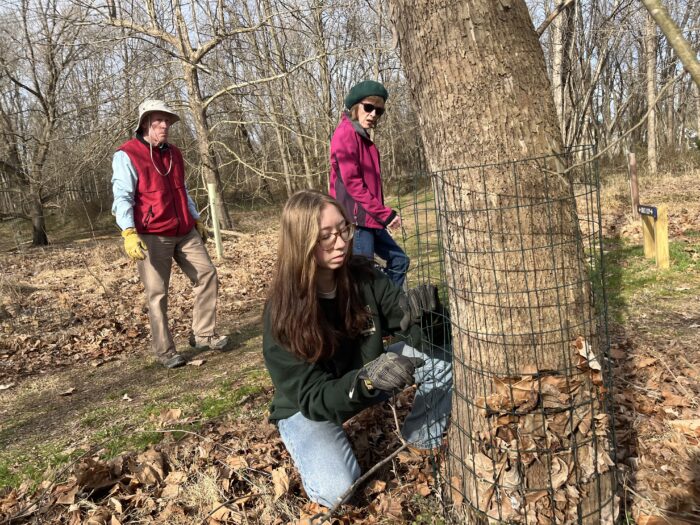
Beavers can also chew trees that protect rivers from erosion, as well as saplings planted as part of reforestation efforts. In response, conservationists build wire fences around the bases of trees that need to be protected from local beavers.
That is what brought a team of volunteers onto the preserve Tuesday: to help build fences that ensure trees and beavers can coexist in West Virginia and to strengthen wetland ecosystems.
“A lot of people aren’t aware beavers are around unless, all of a sudden, they come across very obvious signs of beavers, maybe even causing problems on their property,” Zak said. “But also, we’re seeing an increase in tolerance toward beavers, and people wanting to use nonlethal management and wanting to coexist.”
Tuesday’s volunteers placed new wire frames around the bases of trees with overly tight fences or no fences at all. They took particular care to cover saplings, and to give trees enough space to grow freely.
KC Walters, associate director of conservation at Potomac Valley Audubon Society, organized Tuesday’s event. She said that coexistence strategies like these help people come together to solve environmental problems.
“It’s not just conservation, and not just about the relationship with wildlife,” she said. “It’s also about the relationships of the human organizations that exist in keeping us all working together for a common goal.”
Zak said she hopes volunteers left Tuesday’s event with a better understanding of how conservation works.
“I hope they got a little taste of how complex it can be, but how also doable it is,” she said.
Add WVPB as a preferred source on Google to see more from our team

With the general election just 46 days away, voters can learn more about candidates at planned forums and debates.
Continue Reading Take Me to More NewsAppalachians have always made use of the region’s wide variety of plants. A new book, called Appalachian Plants: In the Garden, In the Yard, and In the Wild, explores some of the history and lore of regional staples. It’s written by Linda Hager Pack and illustrated by Pat Banks. Inside Appalachia Host Mason Adams spoke with them.
Continue Reading Take Me to More NewsKen Burns, known for his expansive documentaries on topics ranging from jazz music to baseball and most recently the American Revolution, expressed his love for Jefferson County and the Shenandoah Valley, calling the region the center of our shared national history.
Continue Reading Take Me to More NewsOn this West Virginia Morning, a new book, “The Beasts of the East: The Fall and Rise of America’s Eastern Wilderness,” looks at the process to reintroduce large game to parts of Appalachia.
Continue Reading Take Me to More News