Alert (09/29/2026): Our Parkersburg TV transmitter is still undergoing maintenance and remains temporarily inoperative. We apologize for the inconvenience.
All our programming is available via our TV livestreams on our website and WVPB Passport. Thank you for your patience!
This week, author Silas House returns with a sweeping new novel. Also, some folks say, you have to fake it 'til you make it, even if you're trying to establish a state park. And, the story of the first Mothman sightings as written by a small town journalist in 1966.
Appalachia is home to one of the world’s richest temperate forest ecosystems. It’s a massive hotspot for biodiversity, with thousands of species of plants. Now, some of them have been showcased in a new book.
Linda Hager Pack says for this book she was inspired by legends and the historical origins of plant use. The beginning of the book explores a historical medical theory called the doctrine of signatures.
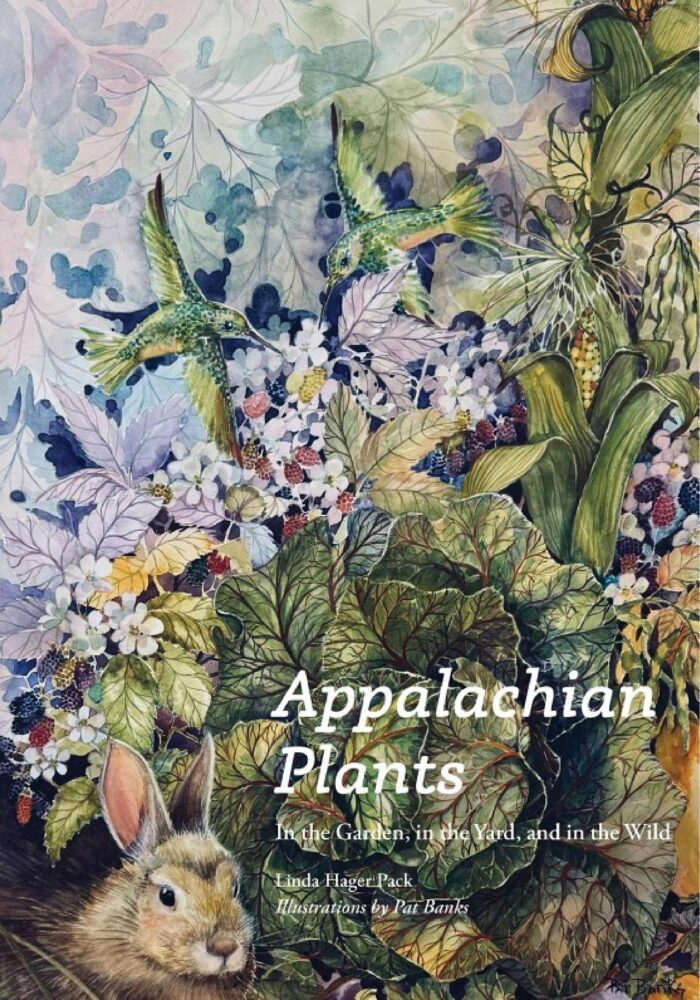
The cover of Appalachian Plants: In the Garden, In the Yard and In the Wild by Linda Hager Pack and illustrated by Pat Banks.
Courtesy of The University of Tennessee Press
The transcript below has been lightly edited for clarity.
Pack: In simplest terms, the Doctrine of Signatures was a belief that God had marked each plant with a sign.
“And by carefully observing a plant and studying its form and place, one could learn God’s purpose for the plant. Signatures of a plant might include color, shape, texture, scent and location. Because beets were blood red, the signature of color dictated that they be used to treat blood diseases. Walnuts resembled a miniature brain. So the significance of shape dictated they be used to treat conditions of the head and the brain.”
Now, that is followed by a Cherokee legend about the origin of disease and medicine. I won’t read it, but I will briefly tell you it began, when man was hunting the animals, and the bears met and they eventually decided, “Well, man’s not really after us.” And then the deer met and the deer decided they would give man rheumatism. Then the fishes and the reptiles met and they decided that they would cause man to have nightmares and see them in their visions and that’s why we dream of them today. Then the birds and the insects, they devised numerous diseases and put those on man.
So then the plants decided that they were going to help man out. And this ends with: “When man did not know what medicine to use for an illness, the spirit of the plant would tell him.”
And that’s the end of that legend. I thought that was an important part of the book and something I really enjoyed learning about.
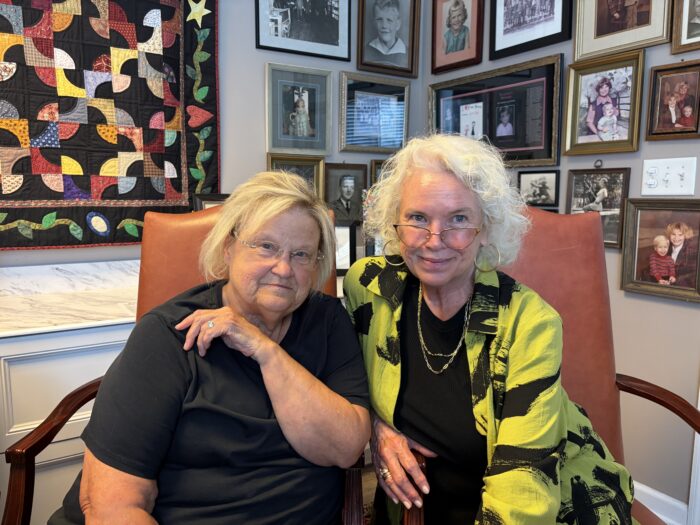
Adams: Thank you for reading that. Pat, there are so many great illustrations in here.
Banks: The cover is the last painting I did. We originally conceived of this book being for children, and Linda discovering the stories and histories of the different plants and how they were used. She knew that I would love to do plants. I love the flora and fauna of the region.
And so I started thinking about the plants, but I thought, well, if kids are going to be reading this and looking at this, I wanted to add some bees and butterflies and bugs and snakes and lizards and bunny rabbits and birds to the different compositions. I wasn’t trying to relate an animal with the plant. It’s just they’re part of the neighborhood. They see each other. They live with each other. And so I just thought these little mysteries for kids to find would make it more interesting.
So the cover has some tree leaves, some blackberries, some cabbage, some corn and birds and a rabbit just all smooshed together as if they live all on the same planet, just like we do.
Adams: Linda, you take pains to make it clear that you are not a specialist or an expert about these plants. But the book is full of information and thoughtful observations, not to mention it’s published by a university press. So how would you describe this book if it’s not an expert treatise on the plants of Appalachia?
Pack: This book tells the story of the people. And I’m a student of the people and the place. The plants came to man’s aid. Even the Cherokee tell us that story. So the plants fed the people. The plants housed the people. And the plants clothed the people. And so I just thought it would be an interesting way to present our rich heritage by using the plants. It was supposed to be a children’s book, but when University of Tennessee Press got hold of it, they didn’t agree. So now, it’s a book for all ages.
Adams: Well, it may not be a children’s book, but it certainly delights my kids, and my own inner child as well. I certainly enjoyed flipping through and reading and looking at the pictures. So Pat, the book is full of these brightly colored wonderful illustrations that go well beyond the plants themselves. How did you make the decisions about exactly what to show in these images?
Banks: Linda is an incredible researcher, and she will pile on mounds of reference materials. As most people know, a lot of photographs are not a good painting. I use a lot of her research, and we happen to live in the middle of this. So we’ve got all of the trees and the plants and the animals in our yard. I’ve had bear actually come up from the river and went through our yard, went into our neighbor’s basement and decided to eat all of their cat food. We’ve had sandhill cranes land in our yard.
If I’ve seen it in our yard, I thought those animals and birds were fair game. And so that was my inspiration, because it is something we live, and I feel like we need to be more connected to our outside, our grass. You know, sometimes I remind people to just walk across your grass in your bare feet. Sometimes going into a forest and just taking a minute to smell it and touch a tree. I think you get strength from that. And I try to convey that in my work.
Adams: So you’re literally telling folks, as the kids say,to touch grass?! It sounds like y’all have known each other a long time. How did you all get together to collaborate and how did the collaboration work on this?
Pack: It begins with me. I was attending the Berea Craft Festival and I had never owned a piece of original art. I saw the most beautiful painting I’d ever seen. And I thought, “I’m going to buy that.” And so I walked back to find her at her booth. By this time, I had been working on writing A Is for Appalachia. And I said to her — she’d never met me, I’d never met her — “Would you be interested in illustrating a book I’m writing?” [And she said] “Yes.”
And we had a wonderful experience. A big art show at the end. And of course, Appalachian Toys and Games. Of course, that’s going to be Pat. And then, Appalachian Plants. But we started, I guess, in the early 1990s. Early 1990s or late 1980s.
Adams: Appalachian Plants started out as a children’s book and then ended up as a university press book. But it seems like it could be read by all kinds of people from all walks of life. So what do you hope folks will take away from this book?
Pack: I began writing these books because I was a teacher, and I wanted the students in my classroom to be proud of their heritage. Because oftentimes we are made to feel lesser than. So I began writing the book at that time Cynthia Ryland had When I Was Young in the Mountains. But there were not a lot of Appalachian-themed books for children. I started writing A Is for Appalachia.
My whole goal is for Appalachia’s children to be proud of their people and their place.
Adams: Pat, I’m curious, if you don’t mind answering the same question, as far as what you kind of hope folks will take away from Appalachian Plants.
Banks: That these are things that we need to live with, that the plants are part of us. We’re part of the system. I think people feel so disconnected from their environment and from even our region. I just hope this is a way to bring people in, and have them look for some of the little surprises and mysteries around them. And kind of a celebration of the opulence that we have here.
We have such a diversity of plants and animals. I don’t want us to take it for granted. And like with Linda, I feel like if we can empower people to love their place and take pride in their place and welcome others into this place. That’s what I hope.
This week, author Silas House returns with a sweeping new novel. Also, some folks say, you have to fake it 'til you make it, even if you're trying to establish a state park. And, the story of the first Mothman sightings as written by a small town journalist in 1966.
The annual West Virginia Book Festival, a free event for book lovers of all ages, will be held on Saturday, Oct. 24, at the at the Charleston Coliseum and Convention Center.
Silas House is a major voice for Appalachia. The Kentucky native has written more than 15 books and served as the state's poet laureate. His latest book is The Tulip Poplars, a sweeping novel about the lives of four people as they navigate friendship and forbidden love throughout the 20th century. Inside Appalachia's Mason Adams spoke with House.