Appalachia has a rich history of protest music. Today, some regional musicians are using their voices to oppose data centers being built across Appalachia and the artificial intelligence they power. Folkways Reporter Andrea “river” Peterson has more.
Crochet World Tangled Up With AI Is A Knotty Problem
AI proponents say the technology will revolutionize our lives. It’s also started a conversation about creativity and what’s really art.Courtesy Kimberly Frye
“I think it’s an amazing art in general. It cannot be machine replicated. All crochet that you see out in stores in the wild, somebody had to make that by hand,” said Frye, a crochet artist from Cabell County, West Virginia.
She is concerned about the number of patterns generated by artificial intelligence (AI) in the crochet world these days.
“How I first started noticing it was on Facebook. People who don’t crochet, they started sending me pictures for commissions.”
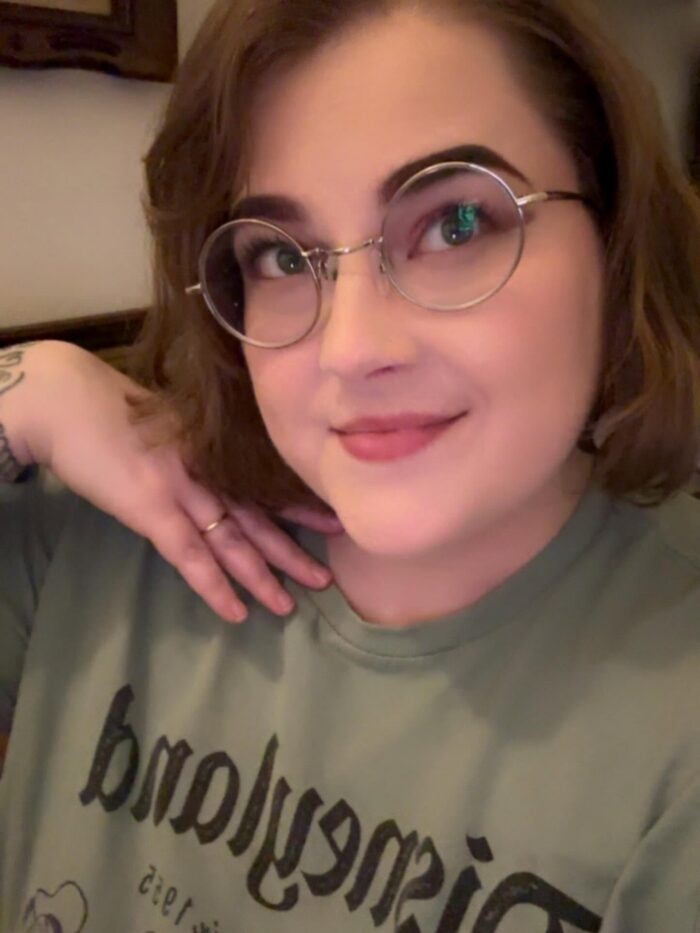
Kimberly Frye is a crochet artist from Cabell County, West Virginia.
Photo courtesy of Kimberly Frye
Every skilled crocheter has been shown a picture of a finished item without a pattern link and asked if they could make the item, just from the picture, without a pattern. Many can do so. But the pictures Frye received had no holes showing between stitches — a good way to spot AI fakes, according to Frye. She took one look and prepared to tell her potential customers some hard truths.
“Yarn doesn’t work that way,” which made the customers think she just couldn’t do it. Frye said having her skills questioned over “a fake robot hallucination” is discouraging, since she has more than 20 years of experience in the craft.
Frye doesn’t like losing commissions because people believe in impossible designs. But she feels even worse when AI begins deceiving new crocheters.
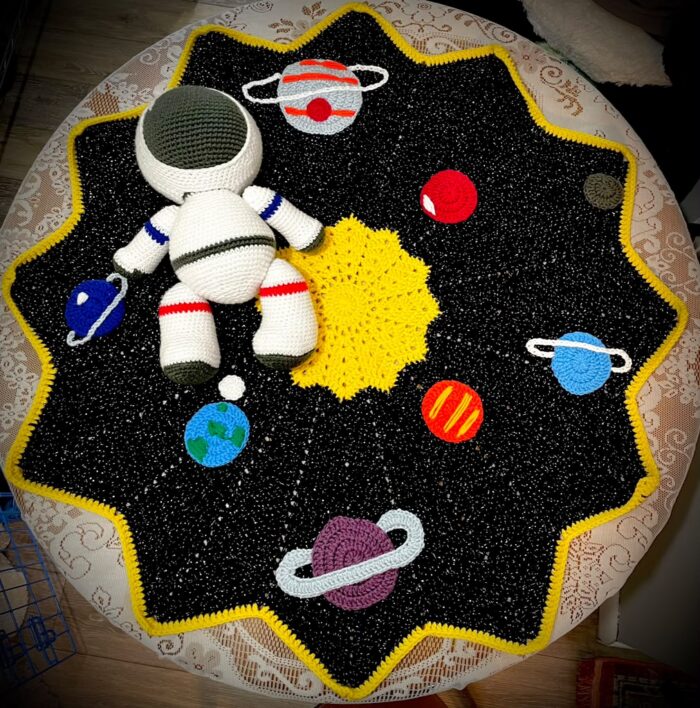
Frye said crocheters with experience could make great art, but nobody could make “a fake robot hallucination” like AI patterns produce.
Photo courtesy of Kimberly Frye
“I started seeing it in actual crochet groups, and it was again these robot accounts that were just pushing them out to farm likes and engagement.”
Bots had flooded the online crochet world by 2022. Many newcomers took up crochet during the pandemic, so they didn’t have enough experience to discern a fake pattern from a plausible one. And those AI patterns were impossible to make. Not to mention, weird.
Frye summarizes one particularly terrible AI pattern: “OK we’re gonna make this granny square elephant sweater, here’s a 3D elephant head on there. It takes different skill sets to make a flat lay than it does a 3D piece and AI does not have the artistry to tell those apart. People who buy the AI patterns are quitting because they can’t tell what’s real or fake anymore.”
The impossible elephant sweater pattern is one example of AI. But AI can also be used to steal legitimate patterns from established makers, patterns that work. YouTube is awash with videos that explain how someone can use AI to steal other people’s work; we’re not planning to reveal that information and advise readers to stay away, too. Because pattern makers like Theresa Kicher are being harmed by such actions.
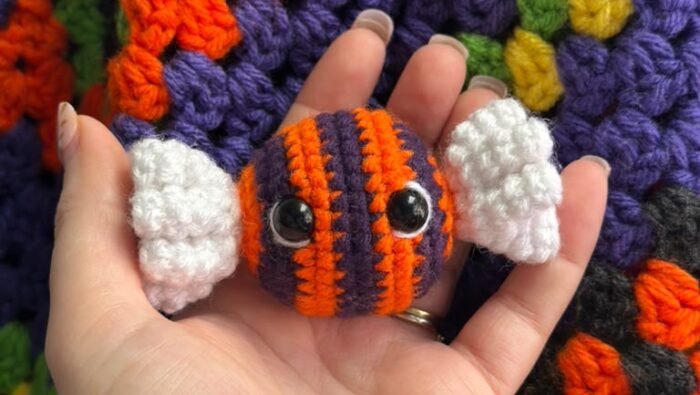
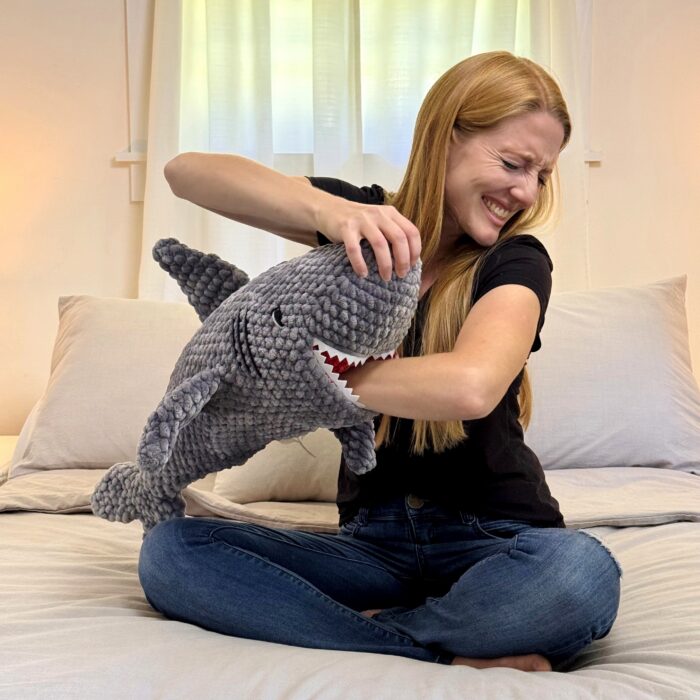
Theresa’s Crochet Shop offers multiple small animal patterns like this shark. The patterns are stolen by people using AI on a regular basis, the Kichers said.
Photo courtesy of Kent Kicher
“My patterns have been stolen for many years, but AI has just taken it to the next level,” Kicher said.
Like Kimberly Frye, Kicher lives in West Virginia. She opened her ETSY shop 11 years ago. Theresa’s Crochet Shop has upwards of 185 amigurumi patterns that sell between $3 and $5 each. These generate about half her family’s annual income, according to estimates by Theresa and her husband Kent Kicher. Theft used to mean another crocheter bought a pattern, made a couple of minimal changes, and sold that “new” pattern on their website.
The Kichers could then go after specific people who were stealing patterns and selling them on their website, back when it was one at a time. Now that AI has enabled 10 to 20 thefts at a time, the couple said, it just feels like whack-a-mole.
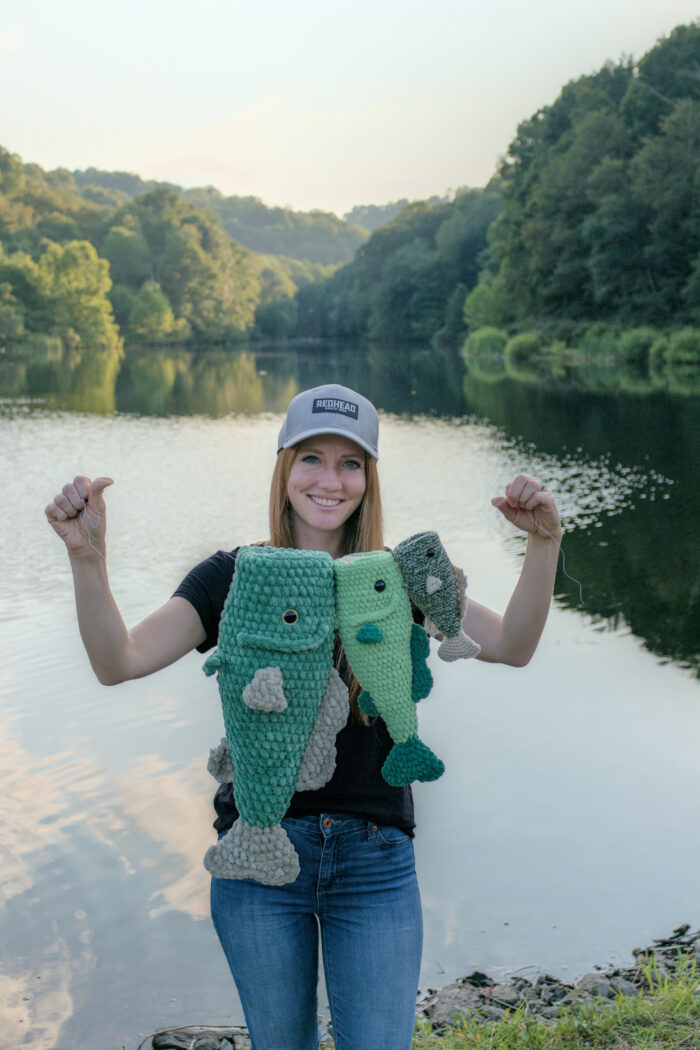
Putting the face of the artist in the photo cuts down in AI theft capabilities, Kent Kicher said.
Photo courtesy of Kent Kicher
The Kichers find most stolen patterns these days on sites hosted outside the United States. Cities in Australia, Pakistan, Ukraine and Singapore are among recent theft reports.
Kent was succinct. “When you live with a separate legal system, what is there to do? I saw a listing recently of one of Theresa’s stolen patterns, and like in the description it said, this is not AI.”
People using AI to steal patterns will fight back when reported. Theresa recounted an email from someone whose site she reported as having her stolen patterns in it.
“’Please remove your report I need to feed my family.’ And I was like well, I also need to feed my family and you can’t steal my stuff to feed your family, I’m sorry,” Theresa said.
She became a crocheter because she was looking for a cottage industry that would allow her to raise her kids while setting her own work schedule and help pay bills. The couple have six children ranging in age from 8 down to twin infants.
Although AI thefts eat into their livelihood, Kent said such sellers are naturally self-destructive, and the Kichers have a lot of faith in the trustworthiness of the community at large. Shops selling stolen patterns can’t generate enough positive reviews to earn spots at the top of an algorithm. There’s a small irony there, they pointed out. Shops that take high quality photos and have many positive reviews like Theresa’s Crochet Shop are at the top, and therefore prime targets for AI theft.
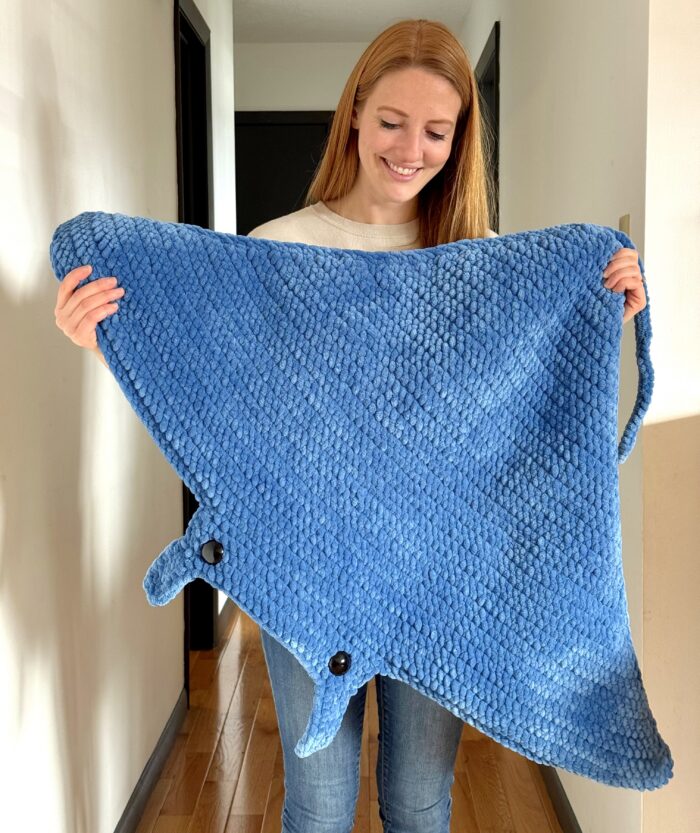
Theresa Kicher is shown holding a crocheted stingray.
Photo courtesy of Kent Kicher
Theresa is not giving up. “I’m gonna keep working hard and doing the next steps and trying to learn new things. And I’m hopeful that it’s not gonna be the end of it. We’ll just keep being creative. Kent’s good at pushing me in new directions, try a new type of yarn.”
While the Kichers will continue to focus on creativity, Caroline Teal and Tammy Elwell are focusing on community. Both are staff members at John C. Campbell Folk School in Brasstown, North Carolina. Both make their livings from working with crafts and crafters. Yet neither sees the biggest threat AI brings to crochet as economic. They see it as the disruption of the tradition of community that has surrounded crochet since it began as an art form in the 1800s.
“Having this kind of robot come in and start trying to sit down in that circle of crafters, it’s obviously upsetting,” said Teal. “It feels like this kind of tightknit community of crafters has been disrupted by folks who are really just looking to make money.”
Teal said those selling fake AI patterns know that they’re trying to sell something that doesn’t work, which disrespects both buyer and seller. Teal also echoes Kimberly Frye’s concern that people using AI to sell stolen patterns are chasing people away from a craft that could bring new friendships, new community participation and new economic opportunities to their lives.
“They’re not looking to make new makers, they’re not looking to encourage new makers, they just want to make that sale and they don’t care. You’re setting up someone who might be really interested in this craft for failure right off the bat. And that might be really discouraging and in this world we need more makers,” Teal said.
Tammy Elwell agrees. She thinks AI dishonors the work that generations of predominately women have put into honing crochet as an art form. It also robs the community of enjoyable bonding experiences by solving stitchery problems together, she said.
Taking from all the knowledge out there means actively stealing the inherent knowledge built up from working on that craft, “feeling it in your hands and working through that,” Elwell said.
Stealing the very foundations of community is bad enough, but far worse is that AI may be robbing people of friendships. Elwell cited a 2018 study out of the University of Kansas showing that it takes about 50 hours to make a casual friend, and more than 200 hours to make a close friend.
“Craft in general is very community based. And that just seems like the antithesis of AI,” Teal added.
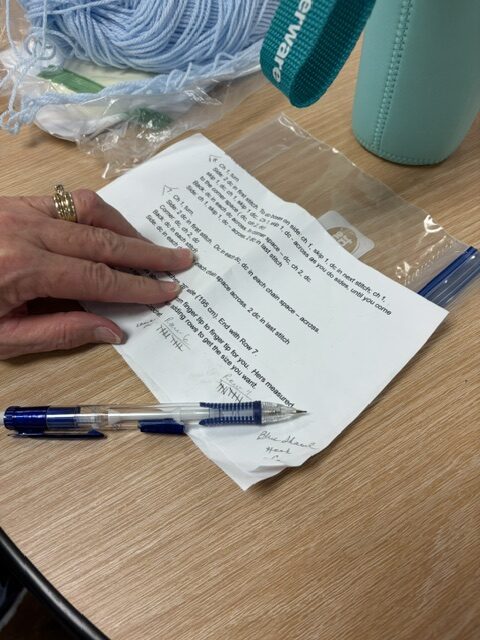
A traditional pattern, such as this one at a crochet club in a Wythe County, VA library, uses abbreviations and a combination of a few basic stitches.
Photo Credit: Wendy Welch/West Virginia Public Broadcasting
Kimberly Frye, the maker from West Virginia, suggests crafters remind themselves that AI can’t do what people can do.
“It can’t think abstractively. It can’t think of my grandmother’s favorite shade of orange and think of how she loves really thick yarn and create a blanket. It can’t do that,” she said.
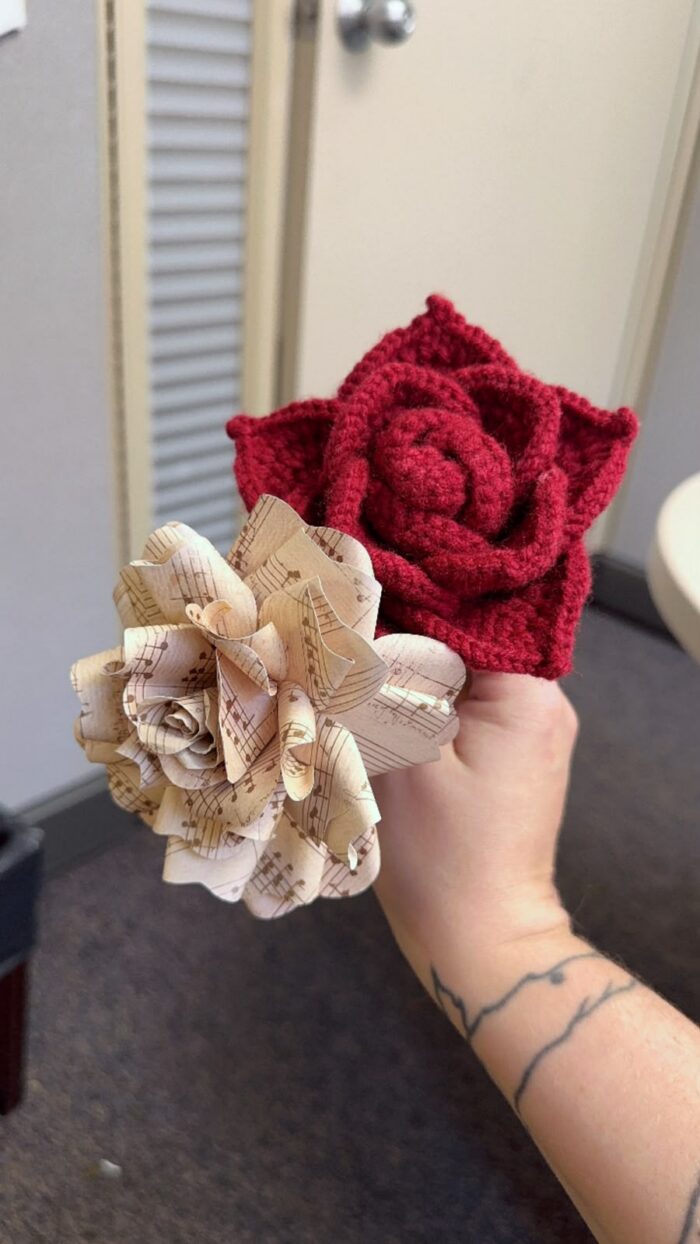
This is one of the flowers Frye crocheted for her own wedding bouquet.
Photo courtesy of Kimberly Frye
Nor will AI teach people to crochet, at least not successfully. Frye learned from her mother. She remembers a blur of tangled yarn, swearing and her twelve-year-old attitude, until suddenly, everything coalesced and Frye popped out a perfect granny square. AI doesn’t have the capacity to lean into someone’s learning curve the way her mother did, Frye said. It doesn’t care how frustrated the learner gets. And it doesn’t care about family traditions.
“I like the fact that I’m reconnecting with my roots,” Frye said of crocheting. She thought about women in her family who crocheted and sewed.
“I may not have ever met them, but I carry a skill that they carry. And it makes me feel connected to them. It’s something I’m gonna teach my children and hopefully they teach their children,” Frye said.
Advice to crocheters on beating AI comes down to this: join an in-person crochet group. AI may still threaten the livelihood of some makers. It may scare away a few novices. But as long as generational makers exist to pass down their knowledge, they will instill a love for crocheting things – and a reminder that we love the people we are crocheting them for.
Add WVPB as a preferred source on Google to see more from our team
Appalachia has a rich history of protest music. Today, some regional musicians are using their voices to oppose data centers being built across Appalachia and the artificial intelligence they power. Folkways Reporter Andrea “river” Peterson has more.
There is a lot riding on the outcome of Tuesday's election, both in this state and across the nation. Assistant News Director Maria Young spoke with Marshall University Political Science Professor Marybeth Beller about what to watch for as the results come in.
More than 3,000 pumpkins decorate the Pumpkin House in Kenova, an event that has turned into a community carnival but started out with five simple carved pumpkins.