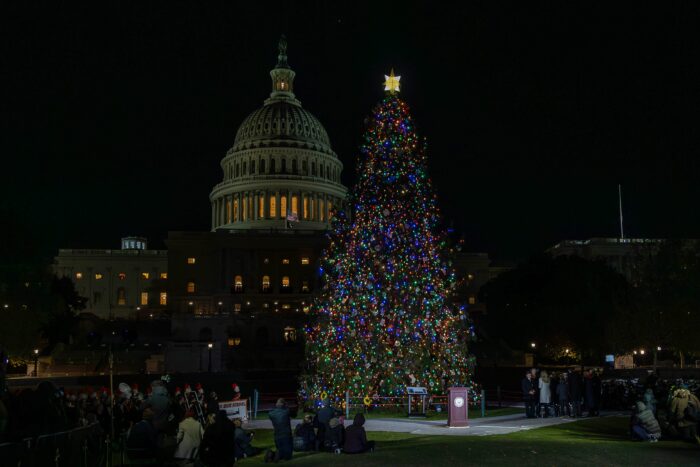
Christmas has become a huge cultural and commercial holiday, but where did we get traditions like Christmas trees? And how do people in other countries celebrate?
Reporter Chris Schulz talked to West Virginia University religious studies professors Aaron Gale and Alex Snow to learn more about Christmas’ ancient history.
This interview has been edited for length and clarity.
Schulz: How old is Christmas? How far back would what we recognize today as Christmas exist?
Gale: Well, let’s begin by talking about when Christmas did not exist. It certainly does not go back to Jesus. The date of December 25 is not biblical. There’s nothing in the Bible, as I tell my students, Jesus didn’t decorate a Christmas tree. Jesus didn’t go to midnight mass. There was no church.
So the origins of Christmas, if you go back to where some of the traditions came from, it might go back about 2000 years. Maybe some of the earliest origins of Christmas go back to Roman Saturnalia, which was a celebration in mid December, a party, total party celebration of the Roman god Saturn, who was a god of agriculture. By the time of the late Roman republic, first century, second century, first century BCE, a little bit about 100 years before Jesus was born, the Romans in the middle of December, for several days, celebrated a festival called Saturnalia, which was dedicated to Saturn. Why? Because Rome has the Mediterranean, has a much more compatible environment and a much more compatible weather pattern. We’re already in December. They were sort of looking forward to spring and looking forward to agriculture and looking forward to the sun coming back, so that in December they would have this huge party for this huge feast of Saturnalia, in which they’d celebrate the god Saturn.
They’d party. There were role reversals. They would wear masks. There would be feasts. So sometimes scholars say that Christmas goes back to some of the traditions. Obviously, this was a pagan celebration, nothing to do with Christianity. Jesus wasn’t even born yet, but they say that some of the traditions may be traced all the way back to Saturnalia, some of the later Christmas traditions. Again, it’s kind of like saying, “Well, does Halloween come from the Druids?” Maybe some of the things do, maybe they don’t.
The origins of Christmas are probably then we have to go back a few 100 years after Jesus, supposedly the pope that gets credit, and it’s disputed now, but the pope that gets credit for introducing Christmas to the Christian world is Pope Julius, the first, supposedly, he was the pope in the in the Three hundreds of the Common Era who talked about Christmas, who is making Christmas December 25 Some sources say December 25 goes back earlier. But the origins of Christmas probably wasn’t even called Christmas yet, by the way, but the celebration then probably traces its origins. Of the holiday of Christmas, celebrating the birth of Christ, probably goes back to the early Middle Ages, and some scholars say that the early Middle Age celebrations were like the wildest 12 day party you could ever imagine in your life. Like one scholar put it that beginning on December 25 you would be expected to party for 12 days straight, dress up in costumes, bang on people’s doors, yell and scream in the streets, celebrate for 12 straight days until, as the scholar put it, you literally dropped in a heap like you just couldn’t party anymore. That’s probably where the 12 Days of Christmas come from. People think it’s the days leading up to Christmas. In reality, it’s probably the days from Christmas on to into January. So that’s where the, probably the very earliest origins and celebrations come from, celebrating Christmas. And I’m sure later on, we’ll talk about some of the specific symbols. So I don’t want to jump too far ahead, but the origins of Christmas go back to the Middle Ages. That’s when the birth of Jesus probably first started to be celebrated. Yeah.
Schulz: Professor Snow, anything to add about the origins of Christmas?
Snow: I’m not going to add a whole lot to the origins from the perspective of Western history. But what I am intrigued by, in some ways, though I’m not a specialist in this, is the linguistic aspect of the word Christmas itself. So I’m going to add just a tidbit to what Dr. Gale, I think, was very rightly putting forward. But the idea that Christmas can be broken down into the idea of a Christ Mass, so a full fledged celebration that has all kinds of liturgical connotations, music, ritual, observance, prayer, celebration. And so it’s this ongoing mass-like celebration. I’m also intrigued by the musical aspects of this, and I’m going to get into this later with China and Japan, but it’s a celebration using, oftentimes, music and chant in a pre pagan form to be appropriated by Roman politics, to then sort of play into the Pax Romana wherever Rome will go. These new types of celebrations are going to go with it.
Schulz: What exactly is it that ultimately leads these traditions to cement themselves around the 25th and the days preceding and following?
Gale: Why did the church designate December 25? Why not March 14 or whatever? I’m a very practical historian, and my best guess would be the church did that in the Middle Ages to counter the pagan festival of Saturnalia. No one knows for sure when Jesus was born. Actually, some scholars, some biblical scholars, say that December doesn’t make any sense at all. Why would you be out sheep herding in the middle of winter? Doesn’t make any sense. The spring was probably a more likely date. Some biblical scholars will say so.
The date itself was probably meant for marketing. You know, in the early Middle Ages, you had the remnants of paganism and these pagan festivals which people were aware of. You had Judaism and you had Christianity, sort of all duking it out in a very competitive environment in which, after the destruction of the Holy Temple in Jerusalem by the Romans, a lot of the other groups were wiped out. So it was, I think, a marketing move, and once it became cemented into the calendar, it went from there. If you ask biblical scholars, why is it December 25 I mean, there’s not necessarily a great date where we say, okay, that’s officially makes the most sense. Honestly, most biblical scholars would say it doesn’t make the most sense. But once it’s out there. I mean, I know some before social media, it’s hard for us to imagine things being out there, but once December 25th was out there, then it was up to Christians to decide what to do with it.
Origins of Traditions
Schulz: Where do the traditions that we see here in the United States come from?
Gale: Well, they come from mostly Europe. The Christmas tree is probably a German thing. There were other countries. Evergreen trees were always a symbol of eternal life and survival, even the midst of very cold winters. But Christmas trees themselves probably come from Germany. On Christmas Eve, it was traditional, starting some scholars say, in the 1500s in southern Germany, you would have these plays called Paradise plays. It was traditional on December 24 to have a play about Adam and Eve in paradise. And the tradition became, you dragged a tree into your house or viewed this big evergreen tree, which would be the only trees left green by this time in the year. And they would put these trees in their house, and they were called paradises, or paradise trees. And what you would do with these trees, since it was a festive time of year, is you would decorate these trees with nuts and all sorts of stuff. And one of the foods that became associated with decorating trees and became eaten in places like Germany were wafers, probably in remembrance of the Eucharist. So then it became customary, that’s where some of the baking stuff comes from. It was a feast from Saturnalia, so the baking aspect and things like that. But Christmas trees come from Germany.
Santa Claus. You have to talk about Santa Claus, right? Santa Claus. The word probably is Dutch from Sinterklaas, which was a shortening of St Nicholas. And we could talk about St Nicholas, but a lot of the traditions that made their way to the new world, even before the United States, came from Germany, the Netherlands, England, and that’s where a lot of those traditions we have in the United States comes from Europe. The problem was, when the settlers came from Europe to the New World, as it would have been back then, before the United States, the million dollar question was, do we celebrate Christmas at all? And one of the most fascinating aspects about Christmas in the new world, it was not always celebrated. It was, in fact, very much taboo to celebrate Christmas. Let me give you an example in the Virginia colonies. When the Virginia settlers came, by the 1600s they partied, yes, celebrate Christmas as a day off from work. However, when the Puritans came from England and William Bradford came in the 1600s they came to Maryland. “No, no, no, no, no, we do not celebrate”. In fact, we have actual letters from William Bradford, the governor in Maryland, who said these people need to be better informed. Like, why are they going out? Party? Like, no, absolutely not. You cannot celebrate. So for the Puritans, it was a work day. In fact, we actually have documents of the Puritans beginning to build houses on December 25. So for some of the colonists in the United States, Christmas was not celebrated at all. Was taboo.
So you had sort of a dichotomy in the early New World, where the Puritans did not celebrate Christmas at all. So many of the other colonists did, and eventually they brought with them the ideas of, again, the Christmas tree ornaments. By the way, it was said that the Protestant the most famous origin guy of the Protestant Reformation, Martin Luther. There’s a tradition that said he was the first one to put lights on a Christmas tree. It was actually Martin Luther who put lights on a pair on a paradise tree. And so a lot of those traditions came over from Europe. And of course, as we learned with Halloween, they were appropriated, molded, evolved into these unbelievably, sometimes viewed as gaudy United States traditions. Christmas in the United States was not even a federal holiday until 1870. I think the first White House Christmas tree celebration was 1923, I think was Calvin Coolidge. So Christmas took a long time to be formalized, but informally, a lot of these celebrations, as we talked about earlier, were held. They were sort of discontinued at some point. Like Halloween, Christmas really gained momentum in the United States in the 1900s.
Christmas Abroad
Schulz: Professor Snow, what can you tell me about the influence of Asia, but also the Global Diaspora at this point in our Christmas traditions?
Snow: I think it’s a fascinating question. We’re going to talk about lots of different things here. One of the things I hadn’t thought about and preparing for this for the last couple days, and just sort of occurred to me while Dr. Gale was talking, is the tradition of St. Thomas. A controversial figure in so many ways, whether he is “doubting Thomas” or whether he is, with the Gospel of Thomas, one of the truest of the disciples, but also the tradition that he has sent off to India to take the message East. And as I understand the story, though, this isn’t my specialty, he very much didn’t want to go. He begged not to go, but he was given instructions, as I understand, by both Jesus and the Holy Spirit that suggested this is where his life was going to take him, as I understand the tradition that Christianity, for some people and scholars could be claimed to be one of the first Christian churches, if not the first Christian Church on the face of the planet, in Goa, India in the first century.
I think there’s a long therefore tradition of Christianity moving east, not only with the Silk Road, as we talked about in our Halloween special as well, but also non-traditional, non orthodox versions of Christianity that also head east, like Manichaeism and Nestorianism. We have Nestorian Stele in China in the second century, and most people are just completely unaware of that. I don’t want to get too far off topic, but I’ve been studying something recently called the Jesus sutras. These are new and hot on the market. Literally, these are texts found in Mongolia that combined the teachings of Jesus, Lao Tzu, Confucius, and the Buddha. And so we have all of this evidence that Christianity is moving east. And so it’s going to have an effect.
Obviously, what I think was interesting about Dr. Gale’s discussion about the origins of Christianity is even some of the dates that I’m talking about in the first and second century as Christianity moves east, Christmas still wasn’t even being celebrated at that point in time. So for me, Christmas comes up in a colonial context as well, once again, in the 16th, 17th, 18th century, as Europe and the United States starts to move east and look for all of its destinies with regard to economic opportunity. I’m going to start this with just one simple story that Dr. Gale and I were talking about before we started.
In 1970 if we’re to believe this, in Japan, the first owner of the first Kentucky Fried Chicken had some friends in his local town. His name is Takashi Yokoyama, and his friends were lamenting they were expats and Americans, that they couldn’t find any turkeys, and how are they going to celebrate Christmas? This guy comes up with a great marketing campaign, loosely translated as “Kentucky is Christmas.” This marketing campaign in Japan in 1974 just explodes. I can’t show you on a radio show, but I’ve got images of Colonel Sanders dressed as Santa Claus with the rising star of Japan, sun of Japan’s flag, in the background. And it’s these types of traditions that I’m intrigued by that we can talk about, and country after country after country in the Far East before we move forward.
What I think is most interesting about Christmas in Far East Asia, Southeast Asia Indonesia, is that it’s oftentimes going to take on the culture and color of the local country in its response to Christmas. So for a quick example, in places like China and Japan claiming, at least politically and publicly, to be secular countries, not overwhelmingly religious conversation for another time, they appropriate Christmas in beautiful ways, but it’s just a cultural, festive time to celebrate, eat a lot, actually have romantic occasions, almost like Valentine’s Day in countries like South Korea.
In countries like Indonesia, where it’s a Muslim majority religion, you can still find it practiced. But even the laws in places like Jakarta and Java are going to very specifically suggest that the minority Christians in that part of the world are going to have to hold these festivities in particular ways that won’t bother the majority population in those places. So as we talk about some of these places, I’m very intrigued with things like the origin of Christmas trees and festive stars and lanterns lining streets, because these are all related to things like Jesus coming into Bethlehem on Palm Sunday the star. Bethlehem and Jesus’s birth, and though we’ll get to this, things like Santa Claus and even elephants in Thailand being dressed up like reindeer that are going to deliver presents to children on Christmas Day.
Christmas Food In Asia
Schulz: Are there any foods that have kind of influenced the United States in the same way that fried chicken has influenced East Asia that way?
Snow: Christmas in India, not having access to Turkeys, but having overwhelming access to chicken. And for those of us who like things like chicken curries and chicken biryani and rice dishes and things like this, what you will find in too many images on my computer right now are these beautiful spreads of Indian curries and rices with these overwhelmingly gigantic chicken legs. It almost looks like you’re at a Renn Faire with a gigantic turkey leg. And so they’ll present these gigantic chicken legs as big as they can make them in the middle of a big bowl of curry or big bowl of rice or something like that, to try to sort of play off their traditions.
I was also going to talk briefly about, and I’ve been intrigued by the ways in which Chinese Americans have incorporated this new practice called the giving of peace apples. So for China, Christmas is secular, but it’s a time to bring people together on especially romantic occasions. Again, not being a linguist, I’m probably going to butcher a few terms here. But in Chinese, the word Apple sounds something like ping Gao, and the word for peace sounds something like ping on and the word for Christmas, and the way they translate it means peaceful evening, but it’s ping on ye. And in this context, what they’re really looking for is to exchange these apples. I think of the tree of knowledge and apple trees and all these other ways of thinking. But it’s this plane of knowledge, through gift giving, through relationship forging that’s become overwhelmingly powerful, powerful in China before I move on, Santa Claus in China is fantastic. If you were to get online and look at images of Santa in China, he will oftentimes be portrayed playing a saxophone.
Now, pausing briefly for a second, just for a fact, the pictures of him playing a saxophone are related according to history, because China has understood and appropriated Christmas as a cool time, and the saxophone represents, quote, unquote, for the jazz fans in the room and people who listen to Miles Davis and Johnny Coltrane, Birth of the cool and cool jazz. I don’t want to take this too much further, but in some ways, we have to also pay attention that Johnny Coltrane plays his music in 1966 for the first time in Asia, Miles Davis plays both his classic live albums, “Pangaea” and “Agartha” in Japan in ‘75 and ‘76. And in this context, Santa Claus begins to be represented with cool American pop culture in this scenario. And it’s that marketing that just really explodes, especially in secular contexts,
Schulz: I’m also so curious about the traditions that have come from the response to Christmas, specifically Chinese food on Christmas Day and Christmas Eve. Do you have anything to say about that? It’s so limiting for the people that don’t celebrate it that it creates these very unique pockets of culture where you see Jewish people at Chinese restaurants now, extending now almost 50 years.
Snow: I’m not sure exactly I was thinking earlier about the Vietnamese context I was looking at last night and being colonized by France. And even for those of us who like Vietnamese curries or bahn mis, we understand great French baguettes in their Vietnamese context, Vietnam became very interested in the quote, unquote, yule log cake. It became very popular in both the North and the South. Those yule log cakes have now been appropriated and reinvented, re-spiced up and made in their particular ways, once again, now slightly more spicy and hotter and less sweet. And now I’m beginning to see them in stores at least when I was in San Francisco about two or three months ago. I was talking to a friend of mine who said, “You’ll start to see yule logs that aren’t like chocolate and sweet with strawberries or something. But all of a sudden, are filled with these really, really sort of spicy scenarios.” I see this sort of happening back and forth in various different ways.
Gale: What I want to talk about just briefly is getting away from Christmas as just being a day going through, you know, just mentioning the Christmas season, even. Thanksgiving and Halloween aside, you know, we have Advent, where Christmas is a month long thing, and then another 12 days after that.Some of the traditions that are associated with Christmas do not come on Christmas. And this is especially the case in Europe. For example, when I was in Hungary teaching in a fall semester one year, the celebration of St. Nicholas is not December 25 it’s actually December 6, because that’s the date that he died. That’s the feast day, the Feast of St. Nicholas in Hungary, Mikulás, as he’s called. And there in a couple other countries besides Hungary, it’s also Krampus day, because Krampus is involved. But December 6 is a big day for a lot of countries in Europe for different reasons. In Hungary, it’s a holiday associated with St. Nicholas, or Mikulás, as they call him, and it’s a tradition that you really don’t see in the United States at all. And what the tradition is, is that on the night of December 5, so the night before December 6, kids leave out their shoes, and Mikulás either puts candy and sweets and gifts in your shoes, or, if you’re bad, the Krampus, kind of like his nasty little devil like sidekick, will put sticks in your shoes. So when kids wake up on December 6, they either find sticks in their shoes or candy and sweets and gifts. So it’s kind of like the coal in stockings version, maybe in the United States, but there’s no formal day for that in the United States. We just associate Christmas, December 25, everything happens Christmas Eve or Christmas day. But in countries, in Hungary, when I was there, my colleague, my Hungarian colleagues, like, “No, no. December 6 is a big day, like the night of December 5.” Kids all leave out their shoes and the gift giving.
You say, Well, gee, well, then who gives gifts on Christmas Eve or Christmas for some Hungarians, for example, it’s actually like angels or other beings that leave gifts on Christmas Eve night. It’s not really Santa Claus, or, you know, anything like that, because St. Nicholas already came on December 6, in the early morning of December 6 and left them stuff. We also have to remember that during Communist times, when Dr. Snow was talking about China and Japan, I was thinking about communism, that some of these religious traditions were banned. So for example, you weren’t allowed to use St. Nicholas or Sinterklaas or Santa Claus or Mikulás. You had to say Father Winter. So the only symbol you could have is Father Winter. They made it generic.
So there were some of these twists and turns and things that happened outside Advent. The word again means coming. Advent was originally a fast time. One of the reasons why you partied so hard for 12 days beginning with Christmas, is you basically fasted for four Sundays before Christmas, you had fasted and you were ready to unleash. So it was a fast time going back to the foods. Dr Snow did a great job summarizing foods, some of the foods in Europe, fish, for example, is still a tradition among some Italian families, the Seven Fishes. And even in Europe, it’s still traditional, I think, in countries like Austrian stuff, to still eat fish because they couldn’t eat meat during Advent. So they still carry over that tradition of fasting, kind of like we would see during Lent, where we couldn’t eat meat. So that’s one of the reasons why, for example, fish is a tradition. Why eat fish on Christmas? What’s that after the oh, Jesus was a fisher. You know, he got fishermen, and you will be fishers of men. Okay? I think some of it just comes from Advent. So there are these little time points in time in other countries, outside of Christmas Day or Christmas Eve, that are still part of European tradition, but they never really made it fully into American tradition.
Snow: In the Philippines, and I was talking earlier about when we think about these in Asian context, one of the things that we really need to do is think first about the particular country we were talking about, it is that country receptive to fill in the blank Christianity or whatnot. In the Philippines, where it’s a majority Catholic population, according to what I understand, Christmas is the longest holiday celebrated in the world. It starts in early September. It ends in mid January with what’s called the Feast of the three kings, and provides almost a four month sort of Christmas season. I think that’s intriguing again, when we think about the socio politics behind the scene. If I talk about Indonesia, which I had a few minutes ago, which is a majority Muslim tradition, you are allowed to celebrate, but you got to, you got to get it done. Get it Get it done quick and over. We got to go on and do other things, whereas in this majority Catholic tradition in the Philippines, we’re going to hang on, we’re going to do this, we’re going to do this for three, four months, or something like that. And I think that’s another way of thinking about the ways that these traditions are appropriated and applied in their different cultural context. It’s in the east.
Gale: In other words, we can’t Americanize everything and assume that in other countries, they celebrate the same way we do, and it’s natural. I mean, we’re the United States, you know, and this that and the other. But Dr Snow brought up a great point in that we have to respect these appropriated holidays, and even the holidays that were native to those traditions in Europe, Asia, wherever they’re looking at it from a different lens, they’re looking at it from their own cultural lens. And we can’t always Americanize that and just say, Oh, well, it’s certainly America influences, and it’s to be American way. It’s not always in other cultures. Dr, snow and I have both traveled over the world, and we one of the first rules you learn when you travel overseas. We’ve both taken students overseas, is you need to respect the native culture, and you need to be aware that you know you’re in a different culture. Don’t pretend you know you’re not United States.