Alert (09/29/2026): Our Parkersburg TV transmitter is still undergoing maintenance and remains temporarily inoperative. We apologize for the inconvenience.
All our programming is available via our TV livestreams on our website and WVPB Passport. Thank you for your patience!
Through early October, the Blowing Rock Art and History Museum in North Carolina is hosting an exhibit celebrating one of the region’s most notable fiber artists – Barbara Grennell. The exhibit does more than expose people to great art; it asks people, what makes art, art? Folkways Reporter Wendy Welch reports.
Inside Appalachia occasionally hears from educators who find ways to work stories that appear on the show into their class.
In December, the show was tagged in an Instagram post by West Virginia University Professor of Art Joseph Lupo.
The post showcased four-color reductive relief prints made by WVU students — each one inspired by a story or episode they heard on Inside Appalachia.
Inside Appalachia host Mason Adams spoke to Lupo and three of his students about their work and its connection to the show.
The transcript below has been lightly edited for clarity.
Adams: This art is fantastic. What was the assignment you gave the class?
Lupo: The project was that students had to listen to an episode of Inside Appalachia, and the main theme of that segment became the center point of the inspiration. From there, we started to talk about ideas about how to integrate that inspiration into their work and into their imagery. So the idea was how to find something outside of the students to get inspired by. The thing that I talk about briefly with this specific project is that, whether students grew up in Appalachia or not, they are in Appalachia now. So it just made sense as an interesting way of getting students to think about place and think about how their lives are affected by where they live.
Adams: Let’s hear from your students about how they took on the assignment. I’ll let you all introduce yourselves.
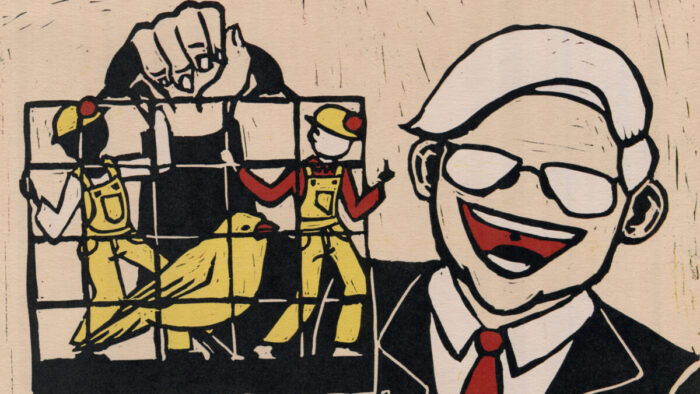
Sheldon: My name is Brenna Sheldon. I am currently a senior ceramics major here at West Virginia University. I don’t remember exactly what the episode was that I had listened to, but I know what it was about. It was basically referencing how friends of coal and how politicians, especially in this region and the state, like to say that they’re friends of coal, but they don’t actually care about the coal miners. My piece is titled, “The Price You Pay.” It depicts your generic, run-of-the-mill, white, old politician guy holding up a cage with two miners and a canary, and he’s smiling, and he’s presenting it like it’s a nice little trophy, like an infomercial. It’s like, “buy now,” and the miners are dressed in yellow to insinuate that they are also canaries, and that they are the price that you are paying for your coal. I’m from this region, and I grew up here before moving out at age seven, and then coming back, being from this region, especially this area, the issue of coal miners and coal in general is very near and dear to me. Choosing that topic was obvious for me.
Adams: Yeah, I love this piece. It was one of those that struck me. It’s an eye-popping piece. That was from my interview with Leann Ray, who’s the editor of West Virginia Watch. What else do you want to say?
Sheldon: Support the arts. I don’t know. Support the arts, support local schools. Yeah, fully fund your public schools. Support your arts, support your artists, shop local.
Adams: Thank you so much, Brenna.
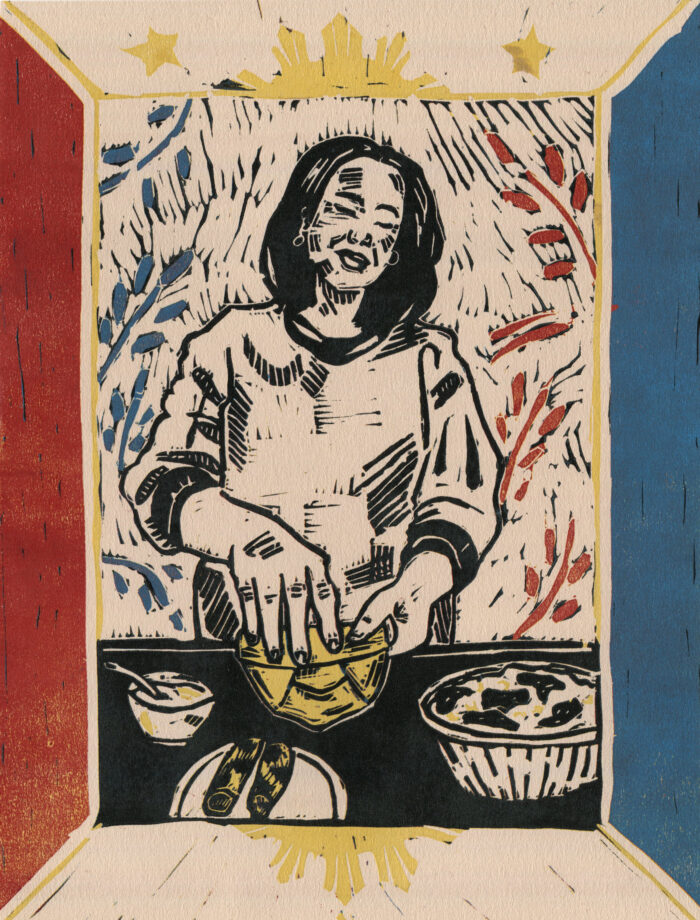
“Mona Making Lumpia,” reductive relief print by Maisie Montanes.
Courtesy of Joseph Lupo
Adams: Who’d like to go next? Would you mind introducing yourself?
Montanes: My name is Maisie Montanes. I am a junior art education major with an emphasis in sculpture here at West Virginia University.
Adams: Yeah, I’m actually looking at your print here on the screen. Can you say what the name is and sort of describe it?
Montanes: Yeah, it’s called “Mona Making Lumpia.” It’s my mom. So, it’s an image of an Asian lady. She’s making lumpia, which is a very popular Filipino dish. If you think of spring rolls, it’s like that. But I feel like the outside is thinner and crispier, and usually it has meat and vegetables in it. And then I have the Filipino flag dissected at the border; I split the sun in half that’s on the flag, and then the two colors of the flag on each side, blue and red.
Adams: It’s interesting you have that sculpture background, because looking at this image, it almost feels a little bit like a sculpture with the way your mom’s hand is in the foreground, and the way she’s shaping this dish. It feels sculpture-ish to me, even though it’s a two-dimensional print. What Inside Appalachia story did you hear, and how did that affect the end product?
Montanes: It was, “Hare Krishna Kitchens in West Virginia, Soul Food and Musicians Call to Arms.” The two main things that really called out to me were the soul food aspect, and then also hearing the podcast talk about the culture of the kitchen, how it was very spiritual for them, and how they did everything a certain way, and kept everything fresh and used specific utensils for specific things. For the soul food part, I forgot his name, but he was teaching one of his family members how to cook very important foods in their family. Hearing him speak about that, and how it’s so important to their traditions and their culture, it reminded me of my mom and what kind of foods we made growing up and how she’s brought that love for cooking down to me. I’ve always lived in West Virginia, but I think my idea of Appalachia is a little bit different than most, since my mom immigrated from the Philippines here. I know her culture. I feel like I was introduced to West Virginia culture through my peers and school and stuff. Even growing up, sometimes I felt like I had a hard time connecting with other people, because I knew I lived a different life, I guess, than other people. But again, at the end, I feel like these little things like food, really connect everyone, no matter where you come from. People love to eat, and it always brings people together.
Adams: To my mind, that’s the story of Appalachia, is immigrants who come in and bring their culture here with them, and it becomes part of the whole. Really, that’s like the whole melting pot idea in America. I appreciate hearing that story and your experience. That’s quintessentially Appalachian from my perspective. So what else do you want to say?
Montanes: I love my mom. Shout out to Mona!
Adams: This print is so evocative. And I’m glad you called out the flag, because that was an element that I did not pick up. You can feel the humanity in this and the richness and the motherliness of it all. She looks very much like a mom making food.
Montanes: I wanted to make something really special for her, and the flag was especially important to me, because we have matching sun tattoos from the flag. I gifted this to her, and she sobbed. She loved it for her birthday.
Adams: Oh, very cool. I love that. Well, thank you very much. Yeah, I’d love to speak to the third person.
“Bearing the thought of being disposable,” reductive relief print by Meghan Sterrett.
Courtesy of Joseph Lupo
Adams: Do you mind introducing yourself? Say your name and a little bit about who you are?
Sterrett: I’m Meghan Sterrett. I’m a third year at WVU. This is actually my first printmaking class, but I’m going to continue doing printmaking after this semester.
Adams: Would you mind saying the name of your relief print? And can you kind of describe it for our listeners a little bit?
Sterrett: It’s called “Bearing the thought of being disposable.” The image is an angry bear baring its teeth, and it has a paw smashing my instrument, a clarinet. There’s a lot of chatter, and it’s a very dynamic image that was made from a place of rage, which is out of character for me. I don’t usually make rage filled images. My art doesn’t usually speak to that side of my emotion. I usually have a lot softer pieces. I get “children’s illustrator” a lot from my work, but yeah, this came from a place of rage. It was inspired by the episode called “‘Disposable,’ Accessible Climbing And Memes.” That was something that was very powerful to me, because COVID-19 and disability in general has affected my family very heavily, including myself. Because of COVID-19 and complications that I’ve had from long covid, I had to quit marching band, which is where the imagery of the clarinet comes in. I lost my ability to play music in a way that I love doing. I was in the marching band here at WVU. A lot of the reason why I decided to come to WVU is because I love the marching band here so much, and it’s something that my sister was a part of, and I really wanted to continue that legacy. I’m grateful that I was able to have two years in the band, but it was also something that I grieved when I left, when I had to quit because of complications from my disability. I started fainting so I couldn’t safely be on the field. And just in general, the way that COVID-19 and disability have impacted my family, I have multiple family members who have cancer. When people choose not to mask or not to be vaccinated, people who decide to come to class infected, even though they know they’re infected, those things are a really big deal to me, because it’s something that I could bring back to my family and put them at risk even further than they already are at risk.
Adams: Yeah, this is a really powerful piece. You’ve got this greenery, but this bear is emerging from this greenery and just smashing this instrument. I thought at first it was a train car at the bottom, but it makes sense, given your story about long Covid and how it affected your ability to participate in the marching band. It’s a very striking, powerful image. I think the episode you talked about included my interview with Sarah Jones, who was from Washington County, Virginia. Sarah’s book Disposable talks about societal inequities and how the COVID-19 pandemic really brought them to the fore. What else do you want to say?
Sterrett: Don’t go out when you’re infected, and wear your mask and get vaccinated.
Add WVPB as a preferred source on Google to see more from our team
A U.S. Energy official visited the West Virginia University campus Tuesday, to promote an effort to increase the number of graduates with expertise in mining, minerals and associated supply chain technologies.
Through early October, the Blowing Rock Art and History Museum in North Carolina is hosting an exhibit celebrating one of the region’s most notable fiber artists – Barbara Grennell. The exhibit does more than expose people to great art; it asks people, what makes art, art? Folkways Reporter Wendy Welch reports.
Gwyneth Philips is an ice hockey goalie for the Ottawa Charge in Canada. Philips, who grew up in Athens, Ohio, played on the U.S. Women's National Team during the 2026 Winter Olympics, where the team won gold. Inside Appalachia Associate Producer Abby Neff spoke with Philips.
Many farmers in our region raise sheep for meat, but not so much for wool. There’s not a great market for it with textile companies overseas, but researchers at Virginia Tech have teamed up with farmers, to figure out how to use wool to insulate houses, potentially creating a new market.