Alert (March 14, 2026): Due to recent high winds, our radio/TV tower in Bethany is not operational. Our engineers are working to resolve the issue. Alert (March 11, 2026): Our TV translator in Flatwoods is experiencing technical issues. Our engineers are troubleshooting the problem and expect it to be down for a couple days.
Thank you for your patience.
This week's premiere broadcast of Mountain Stage features Don Was and The Pan-Detroit Ensemble, Vienna Teng, Joe Crookston, and William Matheny with host Kathy Mattea.
Thank you to the ...
Eastern Panhandle Slated For Aerial Spray Treatment Against Invasive Spongy Moth
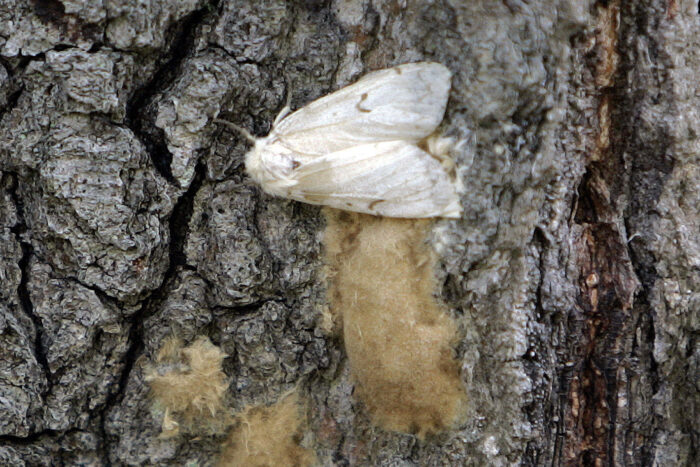
A female Lymantria dispar moth lays eggs on the trunk of a tree in the Salmon River State Forest, located in Hebron, Conn., on July 28, 2008.Bob Child/AP Photo, File
Listen
Share this Article
Lymantria dispar — also known as the spongy moth or, formerly, the gypsy moth — is an insect native to Europe, western Asia and northern Africa. But the invasive species was introduced to North America more than a century ago, and experts say it has wreaked havoc on domestic plants.
Spongy moths lay egg masses known to hatch in the early spring, according to the Animal and Plant Health Inspection Service. Adult spongy moths prey on native plant species like oak trees and various shrubs, sometimes literally eating them to death.
Bracing for the arrival of a new brood, the West Virginia Department of Agriculture (WVDA) will soon embark upon spongy moth population control efforts in six Eastern Panhandle counties.
The WVDA announced Tuesday that more than 17,000 acres of land in the region were tapped for an insecticide spray treatment disbursed via helicopter. The effort will affect certain preselected properties in Berkeley, Hampshire, Hardy, Grant, Mineral and Morgan counties. The department plans to begin the project by early May and finish by mid-May, weather permitting.
The treatment bears no risk to the public and is funded by landowners, according to Tim Brown, director of the WVDA Plant Industries Division.
“It is definitely hard on those environments [where] these high populations are present,” Brown said. “It’s an avenue for the landowner to protect their property.”
Previously, some treatment expenses were subsidized through a federal cost-share called the Spongy Moth Suppression Program, but the program was not offered this year.
Which Properties Were Selected For Treatment?
Roughly 17,000 acres of land across six Eastern Panhandle counties are slated to receive Lymantria dispar treatments next month through the West Virginia Department of Agriculture.
Map Credit: West Virginia Department of Agriculture
To qualify for the treatment, landowners first had to directly request intervention from the WVDA, Brown said. Then department then assessed whether these properties warranted treatment, considering factors like the presence of vulnerable plant species or existing egg masses.
“A lot of times, the public might think that [their properties] are getting treated. The aircraft may be turning or something like that,” Brown said. “But if they were not a part of a payment [for the] treatment, they will not be having treatment administered. It’s totally their choice.”
While the presence of spongy moths is more than likely to affect properties beyond those selected by the WVDA, that means the insecticide treatment itself will not reach beyond predesignated boundaries, Brown added.
Curbing the spread of spongy moths can be difficult because their eggs and caterpillars can fix onto vehicles and get spread around, according to the WVDA. The department said site-specific treatments are “the only way” to effectively address spongy moth infestations on a population level, and to protect native trees.
The WVDA received approval to conduct spongy moth treatment in the area from the West Virginia Division of Natural Resources and the U.S. Fish and Wildlife Service, confirming no “rare, threatened or endangered species” were likely to be placed at risk.
Brown called the spongy moth “a major hardwood defoliator,” meaning the insects consume significant amounts of leaves on living trees.
“It feeds on over 300 species of trees and shrubs,” Brown said. “You’ll have maybe total defoliation as they have experienced in some of these county locations. That’s what prompted them to sign up.”
For more information on the Lymantria dispar treatment process, the West Virginia Department of Agriculture said residents can contact program coordinators Jeff Johnson or Scott Hoffman at jjohnson@wvda.us and ghoffman@wvda.us, respectively.
Add WVPB as a preferred source on Google to see more from our team
A tech company that builds and operates the infrastructure needed for artificial intelligence development, is setting up shop on the 2,200 acre Monarch Compute Campus in Mason County, where it plans to build and operate an advanced AI data center powered by a microgrid that will begin operation by late 2027.
On this West Virginia Week, a group sues over SNAP waivers, the coal forecast for next year is gloomy, and we learn how online gambling is affecting college students.
Online gambling commercials in the state seem to dominate the television and radio airwaves. Those messages are not lost on our college students. Marshall University Broadcast Journalism senior Abigail Ayes just completed an impactful story about student online gambling for the campus news program, MU Report. Randy Yohe, who is also Ayes’ instructor, spoke with the student reporter about her findings.