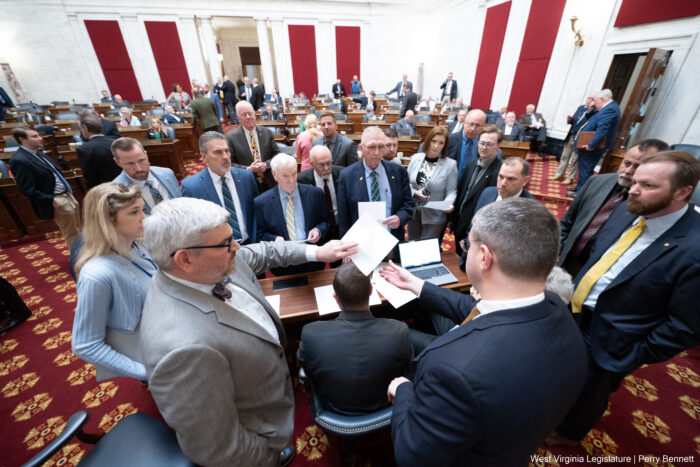
The House of Delegates took up more than 130 bills Thursday as the end of session looms Saturday.
Fireworks came early and often in the lower chamber’s all day floor session.
Delegates pushed back on Senate Bill 641, which would create multiple exceptions to the state’s Above Ground Storage Tank Act.
The act was created in the wake of the 2014 Elk River chemical spill of coal detergent. The spill left 300,000 residents in Charleston and surrounding communities without potable water for weeks.
Del. Kayla Young, D-Kanawha, noted that the state has continuously loosened restrictions on storage tanks in the ensuing 12 years since the spill.
“This bill, originally, the Above Ground Storage Tank Act in 2014 covered a whole bunch of tanks. In 2015 it got pushed back a little bit. It was a little more reasonable, and then it was 46,000 tanks,” she said. “Today we regulate only about 4,200 tanks.”
Young credited the House Energy Committee for amending the bill and limiting the bill’s exceptions, but said it still created hazards to community drinking water.
“In this bill, we are specifically talking about tanks that are near drinking water, within the zone of critical concern or peripheral concern,” she said. “It means if they spill, they can get into the drinking water. And we’re going to say those tanks don’t need to be regulated.”
Del. Mike Pushkin, D-Kanawha, said that the 2014 spill loomed over the start of his political career, as well as the careers of several other delegates in the chamber. He said the Above Ground Storage Tank Act not only passed the House unanimously, but did so after passing through three committees.
“Since then, it seems like every year industry comes back to take a little bite of the apple,” Pushkin said. “First, they want to deregulate the tanks that are just by rivers and streams that aren’t anywhere near a public water intake. Then they’re just going to limit it to brine. And then now they’re coming for the tanks that are actually right next to a public water intake.”
Despite objections, SB 641 was approved and now returns to the Senate with an amended title.
Senate Bill 645 spurred an hour of debate, including the reconsideration of an amendment that the House rejected Wednesday.
The bill requires private health insurance providers to pay Emergency Medical Services like ambulances at a rate of 400% of Medicare.
Del. Adam Burkhammer, R-Lewis, was part of a contingency that thought the bill’s rate was too high and sought for a lower rate of 150%
“I just want to make sure that everybody is aware that they’re currently getting about 50% to 60%. So going to 150% is a substantial increase,” he said. “There is no need to jump clear to 400% when already the step that we are taking is getting more funds to our EMS. And that’s what I think the entire goal is here.”
Del. Rolland Jennings, R-Preston, argued that part of the reason the state’s EMS have struggled in recent years is precisely because the state’s mandatory reimbursement rates are so low.
“Once we get one organization’s group paying what they should be, others will have to start following suit. That’s one way we get Medicare up, is bring our cost up here,” he said. “Once we get our cost, they will raise their rates. But if we leave our rates down, they will leave their rates down. That’s just how it works. If you don’t think so, go to Ohio, go to Pennsylvania and see what Medicare pays there per run. It’s quite a bit more than what they pay here.”
Under questioning from Jennings, Del. David Green, R-McDowell, told the House that several states including Colorado, Washington, New Hampshire, Mississippi and Louisiana set their rates above 300%.
The amendment to set rates at 150% was rejected a second time, and the bill was returned to the Senate to finish action.