This week on Inside Appalachia, we talk with East Tennessee’s Amythyst Kiah. Her new album contemplates the cosmos. Also, hair salons are important gathering places where Black women can find community. And, West Virginia poet Torli Bush uses story to tackle tough subjects.
Photo Credit: Glynis Board/West Virginia Public Broadcasting
In June of 2020, former West Virginia Public Broadcasting videographer Chuck Kleine and Pennsylvania resident Joe Buckland recorded their experiences with having children during the pandemic.
Buckland and his wife had a baby in mid-February, nearly a month before the lockdowns.
Kleine and his wife, Glynis Board, WVPB’s assistant news director at the time, had a baby in March, about a week after most staff were sent home.
Mortgage Lifter Heirloom Tomato
Mary Lou Estler slices up her family’s heirloom mortgage lifter tomato. But there’s a mystery with this tomato.
Photo Credit: Zack Harold/West Virginia Public Broadcasting
One of Inside Appalachia Host Mason Adam’s friends hates tomatoes — but started growing them in 2020 because he “wanted to be part of it.” It being growing a garden, complete with a swath of heirloom tomatoes. Like a variety called Radiator Charlie’s Mortgage Lifter tomato. This heirloom breed got its start in Logan County, West Virginia.
A guy known as Radiator Charlie bred two varieties of tomato together to get a giant, juicy fruit. Word spread, and eventually so many people bought his $1 tomato plants that he was able to pay off his house. That’s how the “mortgage lifter” got its name.
But in 2020, Folkways Reporter Zack Harold brought us a story about another West Virginia tomato plant, also called “mortgage lifter.” And it’s even older.
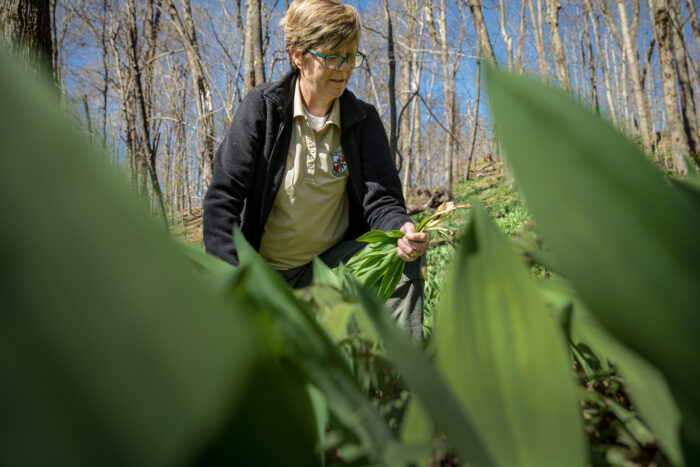
The Ramp Hunter
The Ramp Hunter. Caroline Blizzard, Secret Location.
Photo courtesy of Michael Snyder
A lot of big events were canceled in 2020 — high school proms, baseball games, and even family reunions — but some annual traditions would not be stopped. Like foraging for ramps.
People still went out to their favorite ramp patches in early spring. In 2020, we aired this story of a ramp-hunting expedition, led by Maryland park ranger Caroline Blizzard.
Shape-note singers in the region most often use oblong-shaped tunebooks like The Sacred Harp and The Shenandoah Harmony. This singer has personalized their copy of The Sacred Harp.
Photo Credit: Kelley Libby/West Virginia Public Broadcasting
One of the oldest European musical traditions in Appalachia is shape note singing. It’s also called Sacred Harp singing. It’s sung acapella, often in large groups, with singers facing each other in a square.
Social distancing made shape note singing a lot harder, but a group figured out a way to continue to sing through the pandemic. Inside Appalachia Editor Kelley Libby — then a Folkways Reporter — filed this story in 2020.
——
Our theme music is by Matt Jackfert. Other music this week was provided by Jeff Ellis, John Inghram, Joe Dobbs and the 1937 Flood, Mary Hott and the Cornelius Eady Trio.
Bill Lynch is our producer. Abby Neff is our associate producer. Our executive producer is Eric Douglas. Kelley Libby is our editor. Our audio mixer is Patrick Stephens. We had help this week from Folkways Editors Chris Julin and Caitlin Tan.
You can send us an email: InsideAppalachia@wvpublic.org.
On this West Virginia Week, seven mining operations are to close, the state Senate votes to ban abortion medication by mail, and Gov. Patrick Morrisey presses for tax cuts.
On The Legislature This Week, two senators tell us how the state needs to change its school funding, which has remained largely unchanged for decades. We also hear lawmakers discuss reforms to the state’s response to water crises.
On this episode of The Legislature Today, in this school year alone, the state Board of Education has been asked to approve 19 school closures or consolidations. News Director Eric Douglas speaks with Sen. Mike Oliverio, R-Monongalia, a member of the Senate Education Committee, and Sen. Mike Woelfel, D-Cabell, a member of the Senate Finance Committee, to discuss what needs to be done to fix the issue.
This week on Inside Appalachia, we talk with East Tennessee’s Amythyst Kiah. Her new album contemplates the cosmos. Also, hair salons are important gathering places where Black women can find community. And, West Virginia poet Torli Bush uses story to tackle tough subjects.