South Charleston Recognized For WWII History
South Charleston has been recognized as an American World War II Heritage City, the National Park Service announced Friday.
Continue Reading Take Me to More News


To Educate, Inform, and Inspire by Telling West Virginia's Story
Mountain Readers 2026 has concluded! Please fill out our volunteer post-survey.

Nominate an exceptional West Virginia K-12 teacher today!

On Demand

On Demand

Stream original productions from WVPB

Watch locally produced documentaries & more.

On Demand

On Demand






West Virginia Morning

Inside Appalachia

West Virginia Week

Mountain Stage

Us & Them

The Legislature Today

The Legislature This Week

Send us your comments and questions.

Stream our board meetings.

Check out the latest WVPB news.

Sign up for our newsletter and get weekly updates.

Meet the WVPB staff.

WV Educational Broadcasting Commission, the WVPB Foundation, and the Friends of WVPB.

Come work with us!

Read our annual report and learn how we educate, inform and inspire with your support.

Sponsor impactful and engaging media and entertainment.

Use your IRA to make a gift to WVPB.

Become a member with your gift of $1,000 or more.

Make WVPB part of your legacy.

Manage your membership account.

Learn how you can Protect and Sustain West Virginia Public Broadcasting.

There are lots of federal regulations governing what businesses can legally dump into water, the ground, or release into the air. But the gas industry is getting around a lot of those regulations. The oil and gas industry enjoys exemptions from seven federal laws, including one that is supposed to protect human health from the hazards of waste disposal. Other states have passed their own laws regulating this waste to compensate. But it’s a looser system in West Virginia.
West Virginia Fracking Waste: A Buried History
The shale gas boom began to echo throughout West Virginia in 2008. Not much was known about drilling then and many drillers were permitted to simply bury drill cuttings on site. Remediation specialist for the environmental consulting firm Downstream Strategies, Marc Glass, says mounting evidence tells us those sites need to be cleaned up.
“West Virginia DEP acknowledges that the practices of burying waste in people’s yards was a very bad idea,” Glass said. “Tens of thousands of tons of this waste have been buried.”
Communications Director at the DEP, Kelley Gillenwater reports, “no remediation of drilling sites has been deemed necessary due to drill cuttings. [DEP] took radiation meters to more than a dozen sites in 2014 as part of a project with [the West Virginia Department of Health and Human Resources] and no harmful levels of radiation were detected.”
But in 2014 the DEP did take steps to allow municipal landfills to accept gas industry waste. Today that’s what happens to drill cuttings and other solid wastes. They’re separated from household waste but buried in the same city and county dumps. Any liquid that seeps out of those landfills is sent to municipal wastewater treatment facilities. DEP officials say it’s West Virginia’s only option right now.

Be that as it may, the director of the West Virginia Water Research Institute, Paul Ziemkiewicz, wants more definitive information about shale gas drilling waste.
“The big question that’s still unanswered is whether this stuff is hazardous or not. And if it’s hazardous that starts informing what kind of landfill it ought to go into, what standards that landfill ought to be meeting.”
Ziemkiewicz says it’s not that nobody knows what to do with this industrial waste. There are tests and procedures that other industries have to use, and states can require oil and gas companies to follow those requirements, too. That’s what Montana does.
Montana Lesson One: Characterize Waste at the Source
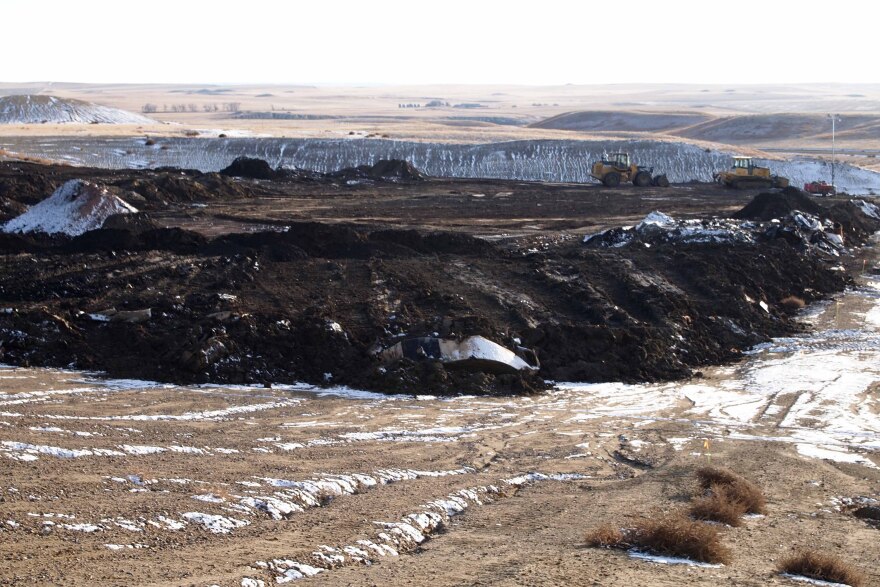
Like West Virginia, Montana has seen large increases in waste from fracking operations in recent years. The gas industry is drilling into the Bakken shale formation in the region. So in 2012 Montanans set up regulations to test and categorize waste where it’s generated – something that doesn’t happen in West Virginia.
“There’s monitoring that gets done at the wellhead in the field,” explains the Waste and Underground Tank Management Bureau Chief in Montana’s Department of Environmental Quality, Ed Thamke. “They have to present the results of that monitoring to the receiving facility. Then the facility is responsible for monitoring their working face, where the material is being disposed of.”
Montana Lesson Two: Use a Separate Landfill
Thamke explains that, like West Virginia, Montana does allows municipal landfills to accept drilling waste.
"The big question that's still unanswered is whether this stuff is hazardous or not. And if it's hazardous that starts informing what kind of landfill it ought to go into, what standards that landfill ought to be meeting," said Paul Ziemkiewicz.
But for the most part, they use separate landfills built by private industry specifically for oil and gas waste.
“It was private industry that saw the need; there was a genuine business opportunity.” Thamke said, “And I think it was a good business investment for those folks.”
Because of the established disposal requirements, Montanans have some clarity about the solid waste they handle. Thamke says solid waste from the Bakken shale formation “is clearly not a hazardous waste”.
But in West Virginia, we’re dealing with a different rock formation. We also live in a much wetter environment. That complicates matters because water that passes through landfills collects toxins.
Montana Lesson Three: Worry About the Water
Thamke explains that Montana has a much more arid environment than West Virginia, and they actually centrifuge the waste before disposal so that landfill leachate can be avoided.
“So if there is leachate,” Thamke said, “it’s characterized and if it meets criteria it’s allowed to be recirculated over the working face of the facility.”
West Virginia easily gets twice to four times as much rain as Montana annually, according to data from the National Oceanic and Atmospheric Administration. Landfills in the state all collect leachate that is not characterized before it’s sent to municipal wastewater treatment facilities (which are not really designed to treat industrial wastewater).
DEP recently determined that water leaching from landfills that accept drilling waste is laced with toxins above safe drinking water quality standards. But DEP officials say the leachate is diluted to safe standards when it’s processed through municipal wastewater treatment facilities.
What’s Next?
DEP is considering changing monitoring requirements at landfills.
But any attempts to further regulate oil and gas companies have been less of a priority with the recent shift in West Virginia’s statehouse from democratic to republican control.
Add WVPB as a preferred source on Google to see more from our team

When Hurricane Helene tore through western North Carolina in 2024, it took lives and upended communities. A community of ballad singers lost a place where they could share their tradition, but what was lost could be restored.
Continue Reading Take Me to More NewsHundreds of West Virginians seeking free health care are expected to show up Saturday for West Virginia Health Right's We Care WV Day.
Continue Reading Take Me to More NewsNew data center developments are changing local landscapes and communities across West Virginia – and one is set to remove a very rare stand of trees.
Continue Reading Take Me to More NewsIn Mason County, West Virginia, new data center developments are changing local landscapes and communities. One of the computing campuses is also threatening a special stand of trees. Reporter Andrea “River” Peterson reports.
Continue Reading Take Me to More News