Alert (09/10/2026): Our Parkersburg TV transmitter is undergoing maintenance for a few days and will not be operational. We apologize for any inconvenience.
All our programming is available via our TV livestreams on our website and WVPB Passport. Thank you for your patience!
This week, one thing about Appalachians: we can get competitive. We’re proud of our local food. Love a good hunt. And enjoy competition with friends. We learn the rules and celebrate our victories. You'll hear these stories and more this week, Inside Appalachia.
Can Ginseng Help Diversify W.Va.'s Economy? Part I
Listen
Share this Article
The War on Coal, pressures from natural gas development, crumbling infrastructure, whatever you want to blame it on – jobs are becoming more and more scarce these days in communities dependent on coal. As a result, some folks are reaching back to their roots, literally and figuratively, to make ends meet – just as they have for generations. And there’s some big money there. Especially harvesting ginseng. But can plants like ginseng play a significant role in our economy today? Enquiring minds would like to know…
“The top five counties [producing ginseng] last year were Mingo, Wyoming, Logan, Randolph, and Mcdowell,” said West Virginia Division of Forestry’s Ginseng Coordinator, Robin Black.
For over 25 years, her role has been to monitor the industry. She says last year over 7,000 pounds were harvested. At last year’s average price of $750/pound, $5.5 million came into the state.
“The miners use that ginseng to pay bills, give them a Christmas, and that kind of stuff,” Black said. “So in southern coalfields, that’s big extra money that they can get during a small time period.”
But can ginseng play a more significant role in our economy? To answer that question, we have to understand some of the driving economic factors – the most important being that the most valuable ginseng roots are those that grow in Appalachian forests.
There are BASICALLY, three types of root:
1. Wild
wild ginseng
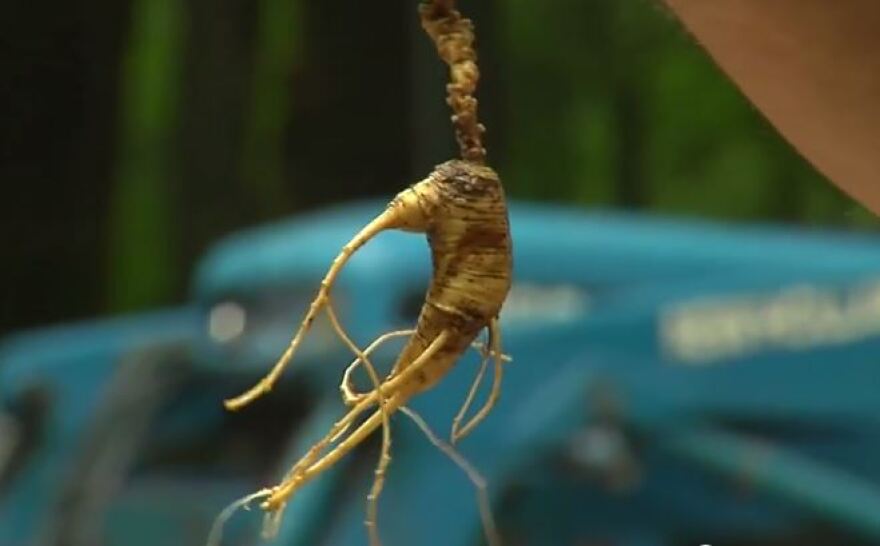
Wild seng is the good stuff. It’s the root that Asian markets will pay TOP dollar for (just as it has for the past 300 years).
“Wild plants tend to grow really slowly, their whole life history is very slow so it takes a long time for them to even get big enough to produce a single seed,” said ginseng researcher, ecologist at the Eberly School of Biology at WVU, Jim McGraw.
2. Cultivated
cultivated ginseng
“In the opposite extreme,” McGraw explained, “with extreme cultivation like happens in Wisconsin and Ontario, plants grow very quickly to adult size two to three years you can have plants producing seeds and be quite large…
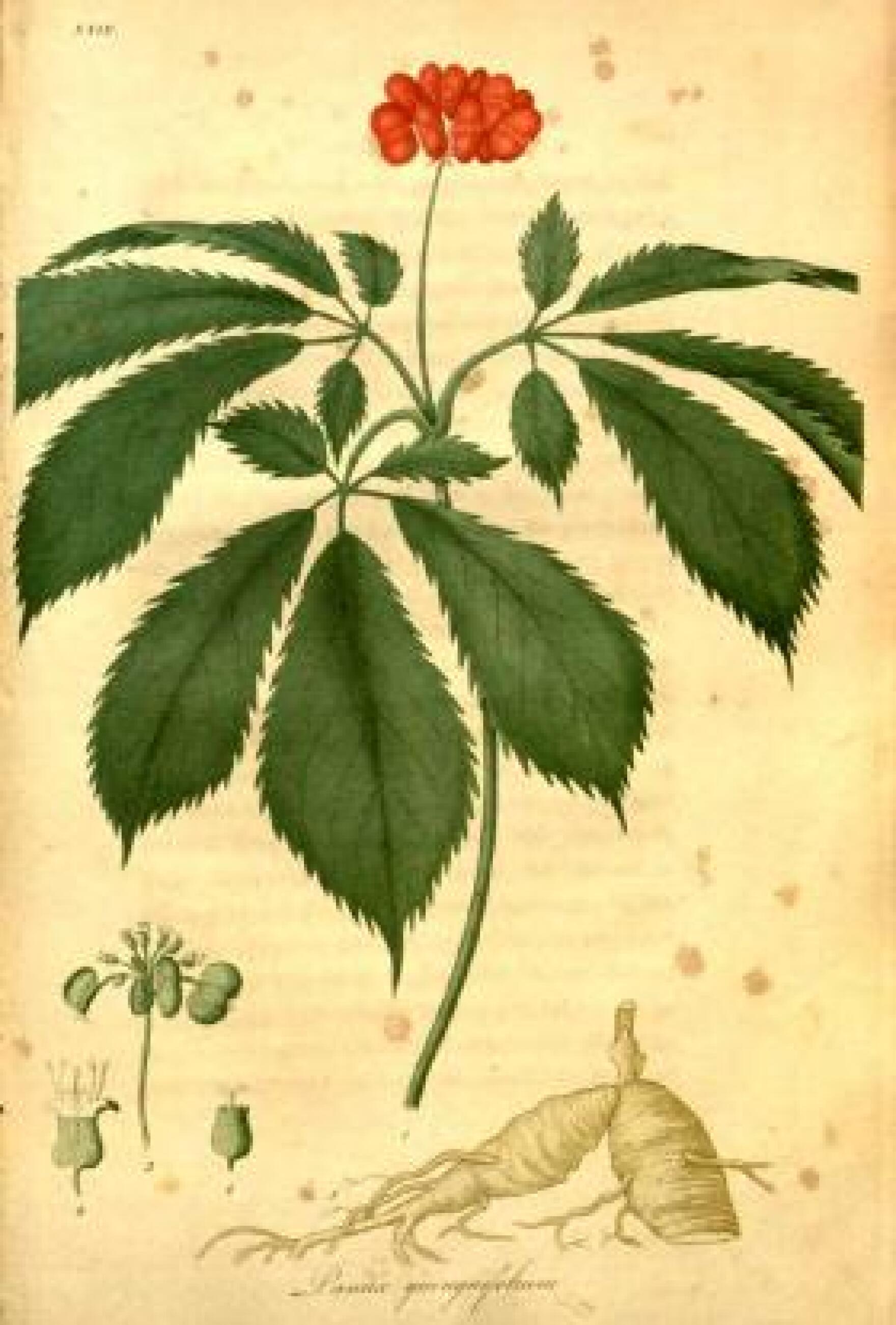
Cultivated root is sold for a fraction of the price of wild ginseng. You can really tell when seng has been cultivated. The root is all swollen, fat, smooth, and white compared to wild seng which is scrawny, tortured, and dark.
3. Forest-Grown
forest-grown ginseng
Some mountain-folk have found that planting ginseng seeds in a more natural or wild setting produces a root that will fetch a more competitive price.
“These forest grown plants where people are actually planting seeds in the woods,” McGraw said, “they tend to be a little more like wild, but it depends what they do to them…”
So depending on the growing techniques, this forest-grown ginseng crop could be a game-changer, according to industry experts, academics, and others involved with ginseng.
Harding’s Ginseng
Larry Harding is one example of someone who has made a comfortable career forest-growing.
Credit Glynis Board
/
Larry Harding at Harding’s Ginseng Farm
“There’s not a person on this earth that could say that that’s not wild ginseng,” Harding said holding up a root he grew, “But that’s not wild ginseng. We planted that ginseng here on the farm.”
Harding’s father started his ginseng farm fifty years ago, just outside of Friendsville, Maryland. That’s just over the West Virginia border. The laws are a little different in Maryland, but Harding says each year he harvests 500 – 2,000 pounds of dry ginseng from over 80 acres of steep, forested land. It’s enough to provide Harding’s main source of income. And the price he can get for his forest-grown root compared to wild root?
“The difference in price when you’re talking about root like this? Little to none,” Harding said standing over a pile of roots.
Harding markets his product as having “wild characteristics, taste, color, and texture.” He says it’s the quality of this forest-grown sang that fetches funds comparable to that of wild sang.
Add WVPB as a preferred source on Google to see more from our team
Twenty-five years ago, on Sept. 11, 2001, at 8:46 a.m., a hijacked plane hit one of the twin towers at the World Trade Center in New York City, ending for this nation a certain innocence, and the belief that such an attack would never happen on American soil. Maria Young caught up an economics professor from WVU who was on site when the planes hit – and gave an exclusive interview to then-West Virginia Public Broadcasting News Director Beth Vorhees.
They love West Virginia. They want to make their future here, but jobs, housing and opportunity can make that choice harder than it sounds. In the first of two Us & Them episodes, Trey Kay talks with young West Virginians trying to decide whether they can put down their own roots in a place they call home.
Economic growth in West Virginia ranks close to the bottom in national rankings. It’s not just losing jobs, it’s also losing young people. In the first of two new Us & Them episodes, host Trey Kay talks with several young adults from the Mountain State asking whether they will stay put or find their future elsewhere.
Anthropic, creator of Claude AI, has agreed to spend $45 billion over six years for computing capacity at the Monarch Compute Campus north of Point Pleasant.