This week, ballads tell stories about all kinds of real-life events, but after Hurricane Helene, one group of ballad singers felt some topics were still too raw. Also, the author of a new book on ancient Ohio credits a former grad student with introducing him to the region’s mysterious earthworks. And, the legacy of Affrilachian poet Norman Jordan includes a summer camp for teens to study their heritage.
The Monarch Compute Campus is a large-scale, multi-phase power generation and infrastructure platform designed to deliver long-term, high-reliability power solutions. Artist rendering courtesy AIP Corporation
Listen
Share this Article
The announcement of a utility scale gas-fired power generation plant Wednesday morning for Mason County — specifically to support data centers — was followed a few hours later with a cooperative agreement for the equipment to get it done.
Fidelis New Energy and 8090 Industries announced the Monarch Compute Campus development in Mason County. When it is fully operational, Monarch is expected to generate 8 gigawatts of power using natural gas.
West Virginia currently generates roughly 16 gigawatts of power.
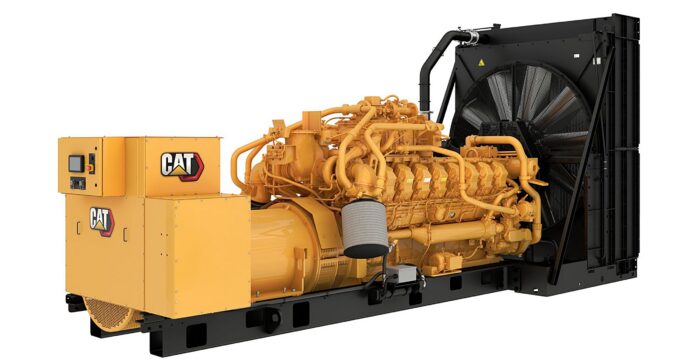
Just a few hours after the first announcement, Caterpillar Corporation announced an agreement to deliver 2 gigawatts of fast-response natural gas generator sets to support the initial phase of Monarch. Those generators are expected to be online in 2027.
Under the purchase agreement, AIP Corp has ordered 2 GW of fast-response natural gas generator sets to support the initial phase of Monarch.
Courtesy Caterpillar Corporation.
The creation of microgrids for data centers was authorized under House Bill 2014 signed by Gov. Patrick Morrisey in 2025.
“These two major announcements today would not be possible without the work of this legislature going back at least two years,” House Speaker Roger Hanshaw, R-Clay, said. “Make no mistake, the things we do and say out on that floor matter, and when we set about inventing a new economy, putting jobs first, ensuring opportunity everywhere, we did so knowing the world would take notice.”
HB 2014 expands the number of small electrical grids, or microgrids, allowed in the state – a move designed to attract Artificial Intelligence (AI) companies that need massive amounts of energy, officials said when the bill was signed.
“We absolutely value our state’s long-time businesses that stay and grow, but we’re especially excited today to have multiple announcements from a company that came to us years ago, willing to take a chance and choose West Virginia,” House Finance Committee Vice Chairman Clay Riley, R-Harrison, said. “We needed to demonstrate that we could make decisions and move quickly; we did that and then some. The moves we’ve been able to make have led us directly to this point of momentum.”
Monarch will also have battery storage systems designed to handle the extreme load swings of AI data centers. The Caterpillar equipment and battery systems are expected to be ready to deliver power within months of delivery. Equipment deliveries are scheduled from September 2026 through August 2027.
According to statements from the company, Monarch is designed to not increase rates or add costs for existing utility customers and will support long-term grid reliability and resilience.
Add WVPB as a preferred source on Google to see more from our team
An heir files suit to keep his community hospital open, disparities in the distribution of school choice vouchers, and a West Virginia lawmaker is among those targeted in White House UFC fight plot.
When Marion County attorney Scott Summers realized Grant Town was planning to tear down an historic building, he decided to see what he could do to stop it.
Indigenous people created hundreds of earthen monuments in what is now Ohio, Kentucky and West Virginia. John E. Hancock, a professor of architecture and design at the University of Cincinnati, spent years studying these earthworks. He published a guidebook for visiting them. Inside Appalachia’s Bill Lynch spoke with Hancock about the book.