Alert (09/29/2026): Our Parkersburg TV transmitter is still undergoing maintenance and remains temporarily inoperative. We apologize for the inconvenience.
All our programming is available via our TV livestreams on our website and WVPB Passport. Thank you for your patience!
This week, author Silas House returns with a sweeping new novel. Also, some folks say, you have to fake it 'til you make it, even if you're trying to establish a state park. And, the story of the first Mothman sightings as written by a small town journalist in 1966.
Postal Insiders Say Rural Delivery Has Storied Past, Checkered Future In W.Va.
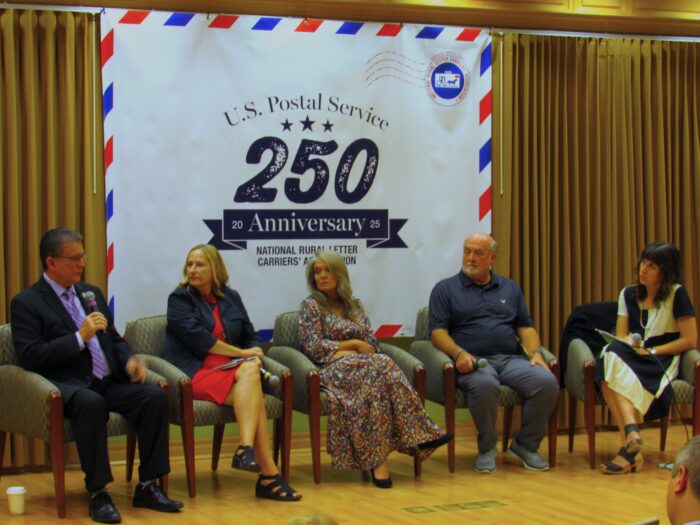
Panelists, from left: NRLCA President Don Maston; presenter Sarah Anderson; rural mail carriers Susan Rowan and Tim Thomason; and moderator and folklorist Emily Hilliard.Jack Walker/West Virginia Public Broadcasting
Listen
Share this Article
Today, a 78-cent postage stamp can send a letter to any address nationwide. But in the early days of the United States Postal Service (USPS), ensuring equal access to mail — even among residents in hard-to-reach places — was more complicated.
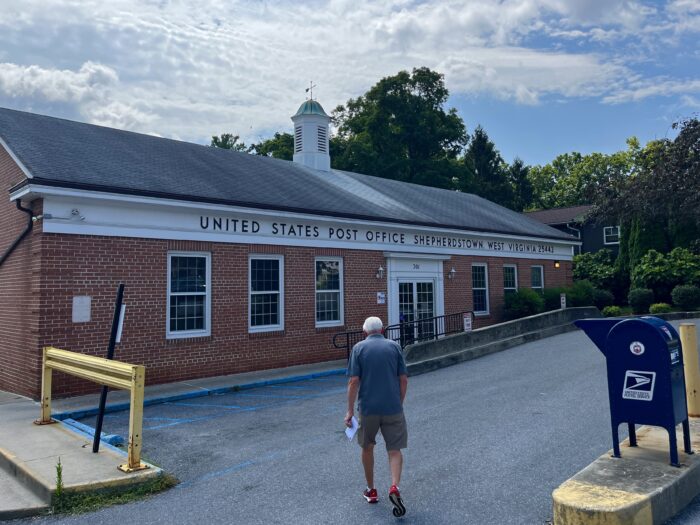
This year marks the 250th anniversary of the postal service. Historians, postal workers and union leaders gathered in Shepherdstown on July 24 and 25 for a pair of panel discussions reflecting on the past and future of USPS, organized by the National Rural Letter Carriers’ Association (NRLCA).
For the panelists, gathering in Jefferson County was of particular importance: Centuries ago, it spawned a service called rural delivery that is still around today. While rural delivery has a storied past in West Virginia, some worry it may soon face risks.
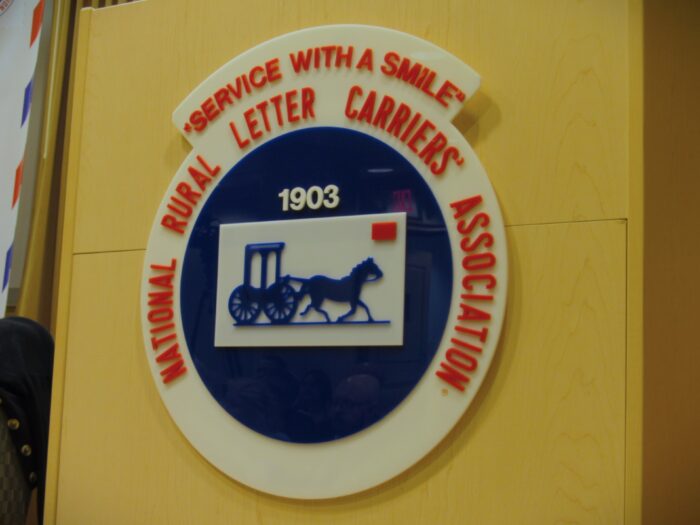
The National Rural Letter Carriers’ Association is a postal union that represents rural letter carriers in the United States Postal Service.
Photo Credit: Jack Walker/West Virginia Public Broadcasting
Delivering To Rural Homes
Prior to the 1880s, picking up mail required residents to travel to their nearest post office — a trek that could take hours for some rural residents.
“That might be a really difficult trip,” said Alison R. Bazylinski, an assistant curator and researcher with the Smithsonian National Postal Museum in Washington, D.C. Bazylinski addressed members of the public during a panel in Shepherdstown on July 24.
Things shifted in 1887 when the United States Postal Service began delivering door to door in towns with more than 10,000 residents. But Bazylinski said this left behind rural areas and small towns.
“You needed to have transportation, you needed to have time which you might not have,” she continued. “So there really is this big disconnect between rural and urban [areas].”
It was not until 1896 that the postal service launched a program called “rural free delivery,” its system for delivering mail straight to rural households without any added surcharges.
The service is of particular importance to Jefferson County, because the first rural free delivery route was created in Charles Town as part of a pilot phase.
“With $40,000 appropriated by Congress, that service starts in West Virginia,” Bazylinski said. “It was very popular very quickly.”
Within one year, rural service spread to 29 different states, Bazylinski said. By 1902, it was adopted nationwide.
Folklorist and panelist Emily Hilliard told West Virginia Public Broadcasting that, since then, rural mail carriers have become more than just service providers. They have become fixtures of regions with few people to regularly check in or lend support.
“Rural mail carriers are lifelines in their communities,” she said. “They don’t just deliver letters and packages. They deliver life-saving medications. They are the eyes and ears of their community. They are who people go to when they might be in need of care and they’re stuck at home.”
Hilliard said that work transcends the written responsibilities of the job.
“It’s more than mail. It’s about being care workers in their community,” she said. “Some of that they’re compensated for, and some of it is kind of beyond their job description and something they do because they are part of the communities that they deliver in.”
Despite its long past in West Virginia, some postal industry insiders worry about the program’s future. For many, those concerns center around the looming possibility of the federal government privatizing the postal service.
After years of development, rural free delivery was broadly adopted across the United States as part of the postal system in 1902.
Photo Credit: Jack Walker/West Virginia Public Broadcasting
An Uncertain Future
Throughout both of his terms, President Donald Trump has floated the idea of privatizing the postal service as a way to save money and boost efficiency. A federal task force he commissioned in 2018 suggested the move could bring risks to rural communities, like longer wait times and a lower standard of service.
NRLCA President Don Maston said concerns like these persist. Maston’s union represents rural mail carriers across the country, and he said he knows firsthand the importance of continuing rural delivery services.
“We go to every house every single day, especially in rural America. To take that away and privatize it and make it a for-profit business; they’re going to have to put surcharges on, or just eliminate that service altogether,” Maston told WVPB.
This would be akin to “[leaving] rural America,” he said, where residents may be “more economically challenged than the folks in the city and rely more on their mail carrier.”
Maston said his organization thinks the postal service could explore other ways of increasing profits instead of privatization. For starters, he thinks the postal service should invest more heavily in parcel delivery, an area of the industry they inadvertently ceded to private companies.
“They thought they would always have letters and magazines to deliver, and they kind of gave that away. That’s how UPS was created [and] FedEx was created,” Maston said. “So now they’re trying to get that market share back. They’ve done that through modernization, streamlining logistics, better equipment [and] parcel sorting machines.”
Meanwhile, Maston said the service should act quickly as new service areas arise, like they did during the COVID-19 pandemic.
“We delivered all those COVID test kits. But we also packaged them, addressed them and sent them out,” he said. “So that was a huge test on the postal service, and just shows our ability to do a lot of different things that we aren’t being utilized for.”
Now retired, Tim Thomason was a rural carrier for 31 years, delivering mail on the same route in Princeton, West Virginia. He worries risks to the postal service could impact reliable jobs in economically disadvantaged regions, which once made a difference in his own life.
It was “really one of the probably top paying 5% jobs in the county that I’m from, Mercer County,” Thomason said. “Especially without a college education, it provided stability for my family.”
But Thomason said it’s not just about personal finances: Losing rural mail carriers would mean losing a fixture of rural towns.
“I was able to become a part of that community,” Thomason said. “Even though I didn’t live in that community that I delivered, I became a part of that community.”
In July, a new leader was appointed as postmaster general for USPS: David Steiner. Steiner has come out against privatization and said the service should maintain its current self-financing model, where the organization is funded by its own earnings, not taxpayer dollars.
While new leadership on the national level may support the stance of postal industry workers like Maston and Thomason, they say the importance of pushing back against privatization remains.
“There’s just a whole host of things that rural carriers perform, especially in rural communities. They are the thread that knits the fabric of the communities together,” he said. “Many times, [we’re] the only face that many of our customers see in a day, and they come to rely on seeing that rural carrier.”
Add WVPB as a preferred source on Google to see more from our team
With the midterm elections approaching, Us & Them host Trey Kay takes the Dinner Party to Huntington, where eight West Virginians from different generations and political perspectives gather around the table. Half the guests are under 30, and while they disagree on immigration, foreign policy, the media and the direction of the country, they also discover some unexpected common ground.