


Quilt Festival Set For September
The 2026 West Virginia Quilt Festival will bring quilters from across the state and beyond to the Cedar Lakes Conference Center in Ripley Sept. 17 to Sept. 19.
Continue Reading Take Me to More News


Mountain Readers Week will be held Oct. 5-9, 2026! Our book this year is Little Red and BIG, BAD FRED by Ashley Belote.

Learn more about Be My Neighbor Day! And check out our recap from last year.

On Demand

On Demand

Stream original productions from WVPB

Watch locally produced documentaries & more.

On Demand

On Demand






West Virginia Morning

Inside Appalachia

West Virginia Week

Mountain Stage

Us & Them

The Legislature Today

The Legislature This Week

Send us your comments and questions.

Stream our board meetings.

Check out the latest WVPB news.

Sign up for our newsletter and get weekly updates.

Meet the WVPB staff.

WV Educational Broadcasting Commission, the WVPB Foundation, and the Friends of WVPB.

Come work with us!

Read our annual report and learn how we educate, inform and inspire with your support.

Sponsor impactful and engaging media and entertainment.

Use your IRA to make a gift to WVPB.

Become a member with your gift of $1,000 or more.

Make WVPB part of your legacy.

Manage your membership account.

Learn how you can Protect and Sustain West Virginia Public Broadcasting.
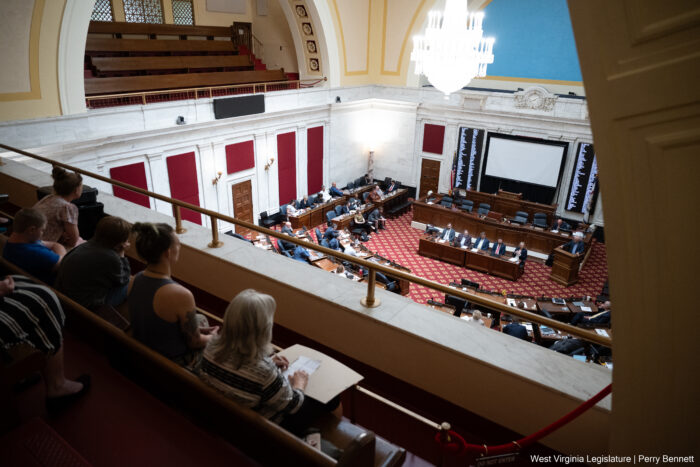
Across two days of interim meetings in Charleston, lawmakers learned more about what it will take to develop data centers in the Mountain State.
A delegation of state lawmakers attended Data Center World, an industry conference held in Washington, D.C. last month. Monday afternoon they told their colleagues in the House of Delegates that due to the industry’s frustration with power generation delays, West Virginia is well-positioned to benefit from planned expansions of power generation and transmission capacity. Gov. Patrick Morrisey has pledged to grow the state’s power generation to 50 gigawatts by 2050.
Del. Marty Gearheart, R–Mercer, said placing data centers on abandoned mine properties was another possible benefit in selling West Virginia to data center developers.
“There is absolutely no reason, based upon my conversations and the things that I learned at Data Center World, that we can’t compete for this business,” he said.
Del. Tristan Leavitt, R-Kanawha, said one of his big takeaways was that companies need to better communicate with locals.
“That said, it strikes me that they are somewhat caught a little bit, because I don’t think any of these projects has been approved by the state yet, right?” he said. “So it’s difficult to go and say these are the parameters when the parameters haven’t yet been approved.”
Leavitt said a history of secrecy due to data centers’ origins in national security has also made the industry slower to adjust to the need for community engagement today.
“There was a time, 20 or maybe even as recent as 10 years ago, when a data center, if it was storing data, like the nuclear codes, things that are really important to our national security, they didn’t really advertise where data centers were,” he said. “They were smaller, and they didn’t want to draw attention to them. Now they’re in a stage where they are realizing that they’re behind the eight ball in terms of explaining how data centers operate, and what all they entail.”
Leavitt presented a list of myths surrounding data centers that had been addressed at the conference, including that artificial intelligence – and therefore increased demand for data centers – was just a fad.
“Almost all of the technologies and other things that we are using are increasingly turning to AI, and so this is something that’s only going to become more and more in demand,” he said. “Companies are willing to do whatever they need to do in terms of developing more efficient methods. In terms of again working with communities, they very much want to get this generation capability and be able to have these data centers, because there’s just a massive amount of potential for them.”
Leavitt also addressed concerns that data centers are significant users of water.
“I think the most important thing to start with is every project is different, right? So, the key will be in what parameters are proposed to the state,” he said. “The state is who receives those applications, even if the state approves moving forward with one. Someone still has to go through the DEP process and receive all the approvals, but in terms of water, I think, a 500-megawatt data center would still only use approximately the same amount of water as an 18-hole golf course.”
Del. Jordan Maynor, R-Raleigh, presented to the group on site development and seconded Leavitt on water usage becoming less of a concern.
“Whether it’s the water issues and the amount of water availability, whether it’s the power usage, whatever the situation may be, I can tell you, the folks that we talked to are very mindful of some of the issues,” he said. “They’re very mindful of some of the pushback and some of the negatives that have been perpetuated out there, and they have innovated significantly to try and address those issues.”
Maynor stressed that access to reliable power sources was the key issue for developers finding locations.
Some delegates expressed concern that data center development would drive up utility prices for the average consumers and strain existing power infrastructure. Maynor cited a recently released “Ratepayer Protection Pledge,” an agreement between the White House and major technology companies like Meta and OpenAI that they will “cover the cost of all power delivery infrastructure upgrades required for their data centers, ensuring such expenses are not passed to American households.” However the pledge is voluntary, and does not appear to include third party data center developers.
Others pointed out that state law does not require companies to use the latest water-saving technology or to engage with local communities and such concessions would only be done voluntarily.
Del. Shawn Fluharty, D-Ohio, pointed out that House Bill 2014, which passed the legislature in 2023 and created the state’s microgrid and high impact data center certification programs, removed almost all city and county oversight of data centers.
“We didn’t allow for any recourse at the local level,” he said. “We kept it all at the state level. We decided in Charleston we’re going to decide what happens in every county and community throughout the state based upon us and not based upon the local community.”
Uncertainty remained the primary theme Tuesday during interim meeting of the House Subcommittee on Economic Development. In particular, it’s unclear how much tax revenue data centers might generate.
Tax revenue is one of the biggest selling points for bringing data centers into West Virginia.
Some estimates, like those from a data center impact tool promoted by Del. Daniel Linville, R-Cabell, show tens of millions of dollars in local revenue from the largest data centers that would use gigawatts of power.
But even the largest current data centers only use around half a gigawatt and accordingly are predicted to generate less local revenue.
Matt Irby, state tax commissioner, told the committee that estimates are based on the best information available today.
“We don’t actually have a data center to value, so there is a lot of missing information from our end on what a base assessed value might end up being, because it’s going to vary by project,” he said.
Irby said it will be years before a large-scale data center is built that state officials can formally assess for tax revenue.
Add WVPB as a preferred source on Google to see more from our team

The ACLU-WV said students in Lincoln County receive a worse education than their parents and grandparents did — and that by some measures the schools are worse off than the system a court already found unconstitutional.
Continue Reading Take Me to More NewsKayla Kessinger said she is excited to help tell West Virginia’s story and credited the existing Tourism team for the state's successes.
Continue Reading Take Me to More NewsIt’s thunderstorm season, but not all of them are the same. For the Appalachia + Mid-South Newsroom, Bill Burton and meteorologist Tawana Andrew break down what we know – and what we don't – about the climate and weather in the region. This week, they examine different types of thunderstorms.
Continue Reading Take Me to More NewsTom Torres, chief of staff at the Ohio River Valley Institute, is concerned about the operation's financial viability.
Continue Reading Take Me to More News