


‘Coolest Thing’ Contest Is Down To The Final Five
After more than 3,200 votes cast, the “Coolest Thing Made In WV” competition is down to five finalists.
Continue Reading Take Me to More NewsAlert (09/10/2026): Our Parkersburg TV transmitter is undergoing maintenance for a few days and will not be operational. We apologize for any inconvenience.
All our programming is available via our TV livestreams on our website and WVPB Passport. Thank you for your patience!




To Educate, Inform, and Inspire by Telling West Virginia's Story

Mountain Readers Week will be held Oct. 5-9, 2026! Sign up to read in your community!
Learn more about Be My Neighbor Day! And check out our recap from last year.

On Demand

On Demand

Stream original productions from WVPB

Watch locally produced documentaries & more.

On Demand

On Demand






West Virginia Morning

Inside Appalachia

West Virginia Week

Mountain Stage

Us & Them

The Legislature Today

The Legislature This Week

Send us your comments and questions.

Stream our board meetings.

Check out the latest WVPB news.

Sign up for our newsletter and get weekly updates.

Meet the WVPB staff.

WV Educational Broadcasting Commission, the WVPB Foundation, and the Friends of WVPB.

Come work with us!

Read our annual report and learn how we educate, inform and inspire with your support.

Sponsor impactful and engaging media and entertainment.

Use your IRA to make a gift to WVPB.

Become a member with your gift of $1,000 or more.

Make WVPB part of your legacy.

Manage your membership account.

Learn how you can Protect and Sustain West Virginia Public Broadcasting.
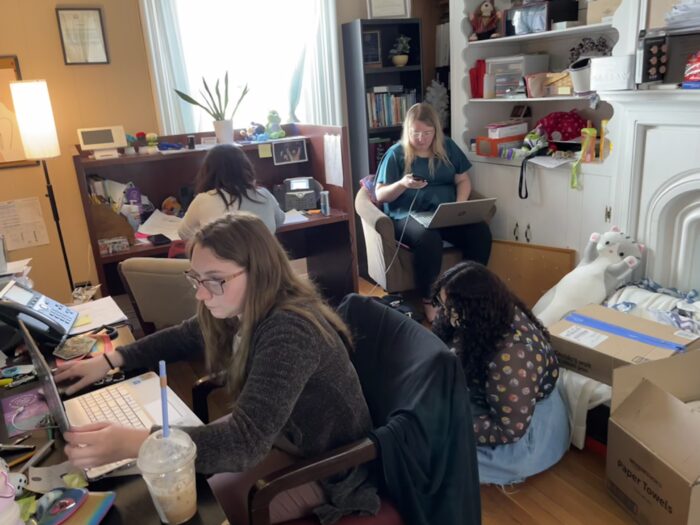
Tucked away on a side street of downtown Martinsburg, the Eastern Panhandle Empowerment Center (EPEC) is a domestic violence prevention nonprofit serving Morgan, Berkeley and Jefferson counties.
EPEC was founded in 1977 and expanded with time. Ten years ago, Executive Director Katie Spriggs said the EPEC served 250 people annually. Now, it serves more than 1,400 people each year.
Visits to EPEC may be on the rise, but Spriggs said funding has not increased sufficiently to meet them.
Looking at EPEC’s first-floor office it immediately becomes clear. Each day, staff members squeeze into corners of the room with laptops and cell phones in hand.
“We have probably on an average day 12 people that work out of this office, so it’s not large enough,” Spriggs said.
According to Spriggs, moving out of EPEC’s apartment-turned-office into a larger space would bring benefits. But a potential move and the expansion of current EPEC services are constrained by the same factor: the budget.
“We’re kind of stuck,” she said. “We haven’t seen an increase in so long that it’s really difficult to make the budget work every year.”
In West Virginia, domestic violence prevention nonprofits receive funding through a variety of sources, like private donations, federal grants and a line item included annually in the state budget.
But the state has not boosted that line item since May 2009, even as the cost of living has risen.
In recent years, Gov. Jim Justice has pursued a flat budget, which means freezing state spending so it stays the same each year. While surplus funds get redistributed, they do not supplement every budget item.
At the same time, Spriggs said that federal support for nonprofits through the Victims of Crime Act has become jeopardized by a recent reallocation of funds.
Continuing to provide resources to survivors of domestic violence requires reliable funding on the state level, she said.
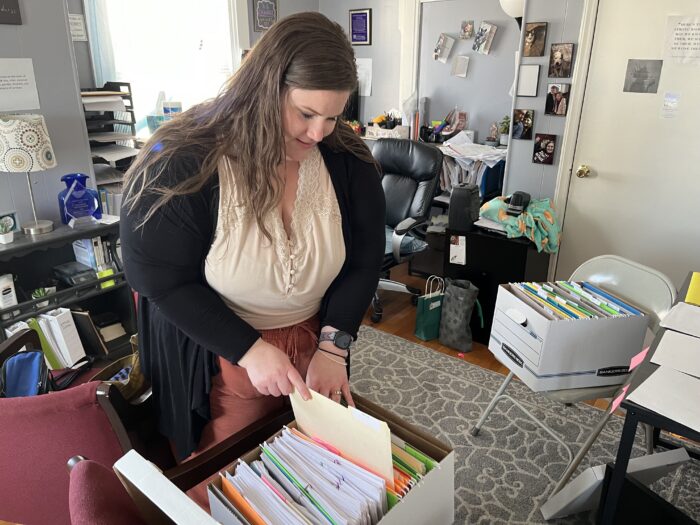
Sara Belvins O’Toole, director of development at Huntington’s Branches Domestic Violence Shelter, said part of the need for additional funding stems from changing conversations around domestic violence prevention.
In the early days, Belvins O’Toole said advocates were focused primarily on removing individuals from crisis situations.
They now understand helping people stay away from abusive relationships requires more holistic assistance, she said.
“People who are just plopped out of a situation and put into another environment don’t have the resources and the skills and the support that they need to actually stay away from a person that was violent in their life,” Belvins O’Toole said. “Especially if that person was in control of the finances.”
Approaching domestic violence on a holistic level means considering other factors that put survivors at risk, like housing insecurity and child care needs.
“We have to do a little bit of that other work like housing advocacy, like legal advocacy — all of those things that are providing support,” Belvins O’Toole said. “It’s not about just getting somebody out of crisis anymore. It’s about supporting them into a life free from violence.”
But this is easier said than done. Joyce Yedlsoky, team coordinator at the West Virginia Coalition Against Domestic Violence (WVCADV), said that the state’s flat budget has also affected separate nonprofits that address these needs directly.
In turn, she said domestic violence prevention advocates must wear multiple hats, spreading their time and funding thinner.
The budget “being able to account for other aspects that survivors need” is important as well, she said.
Through the WVCADV, Yedlosky works with the 14 licensed domestic violence prevention nonprofits located across West Virginia. In February, she helped arrange a visit to the State Capitol featuring representatives from each of these organizations.
The advocates lined the Capitol’s lower rotunda with tables, passing out stickers and informational flyers to visitors and lawmakers alike.
Yedlosky also took the time to speak with lawmakers about the nonprofits’ current financial needs, and said they were generally supportive of securing new funds.
But, since then, Yedlosky said lines of communication between lawmakers and the nonprofits have all but closed.
“Since the session ended, we haven’t heard from lawmakers specifically around our funding,” she said.
By the time this year’s regular session of the West Virginia Legislature ended, no budget line increases for domestic violence nonprofits had been passed. New funding for services like child care were also left out entirely.
Still, this year’s budget is not completely settled. Gov. Jim Justice has expressed disapproval of some funding omissions from this year’s budget, and in March announced plans to call a special legislative session to reconsider the budget.
Justice said he plans to hold the session by May 14, the state’s primary election. Members of the Legislature’s leadership have indicated they would prefer for the session to coincide with interim meetings beginning May 19.
In a dream scenario, Yedlosky said she would like to see a $500,000 cost-of-living increase to the state’s funding for domestic violence nonprofits, which currently sits at $2.5 million split annually between all 14 licensed organizations.
But Yedlosky said she’s not holding her breath for what the special session will bring.
“To be honest, I don’t think that that’s on the table for the special session,” she said. “It would be really nice if it was.”
Instead, Yedlosky said she hopes that lawmakers will reverse course and provide new funding to other services like child care.
“I do believe if they reinstate back some of the huge cuts that they made, that’s also going to help survivors,” she said. “That’s my hope.”
Back in the Eastern Panhandle, Spriggs echoed Yedlosky’s calls for a cost-of-living budget increase. She described an increase like this as a critical way to reduce the risks that survivors of domestic violence face across the state.
“A line item increase on the state budget would not only keep the lights on and give us a foundation to grow on,” she said. “It would also prevent violence. A lot of violence.”
For more information on domestic violence prevention resources in West Virginia, visit the West Virginia Coalition Against Domestic Violence’s website.
Add WVPB as a preferred source on Google to see more from our team

West Virginia’s tourism economy has brought in $9.4 billion in economic impact over the past year.
Continue Reading Take Me to More NewsWith the general election just 46 days away, voters can learn more about candidates at planned forums and debates.
Continue Reading Take Me to More NewsMore than 1,200 volunteers spent Wednesday in six counties of central West Virginia for the United Way's 21st annual Day of Caring.
Continue Reading Take Me to More NewsData center proposals are popping up in West Virginia – and in neighboring Pennsylvania, where one small community is juggling seven different potential projects. From The Allegheny Front, a public radio program based in Pittsburgh, we hear from that community and their concerns.
Continue Reading Take Me to More News