Alert (09/29/2026): Our Parkersburg TV transmitter is still undergoing maintenance and remains temporarily inoperative. We apologize for the inconvenience.
All our programming is available via our TV livestreams on our website and WVPB Passport. Thank you for your patience!
Barbara Kingsolver is one of Appalachia’s foremost writers. She’s written a string of bestsellers, like "The Poisonwood Bible" and "Demon Copperhead," which won her the Pulitzer Prize. Inside Appalachia’s Mason Adams met Kingsolver at her home outside Abingdon, Virginia, to talk art, writing and her latest book, "Partita." We listen to an excerpt from that interview.
In the decades before the Civil War, enslaved people escaped bondage in the South and found their way to new lives up north through Appalachia.
Now, a new project has documented more than two dozen previously unknown underground railroad sites throughout nine counties in Kentucky, Ohio and West Virginia.
Inside Appalachia Host Mason Adams recently spoke with Fain.
The transcript below has been lightly edited for clarity.
Fain: The central goal has been to educate folks on the centrality of the underground railroad within this region. The hope is the folks will get a sense of the brave and courageous freedom seekers and conductors, both Black and white, who risked life and limb to do the right thing, to be really engaged in the nation’s first civil rights movement. I’m exceedingly proud to have worked with Dr. Andrew Feight from Shawnee State University and a bevy of researchers who did really the heavy work, who did the documentation. There was no real appreciation of the significance of this region prior to this effort, and so I come away really, really grateful at the work that we’ve done.
We’ve documented sites in Lawrence County, Ohio, which was the home of historic Black enclave dating from the 1830s forward. We’ve discovered sites in Burlington, Ohio; Ironton, Ohio; Portsmouth, Ohio; Ashland, Kentucky; Greenup County, Kentucky; Catlettsburg, Kentucky; and now, as well as for the first time in the history of Cabell County, three within Cabell County. We’ve also gone all the way up to Adams and Brown counties in Ohio. We’ve chronicled just a great deal of activity.
Adams: What are some of the sites along the way? I’m kind of interested in hearing about some of the actual sites and how they functioned within this underground railroad network.
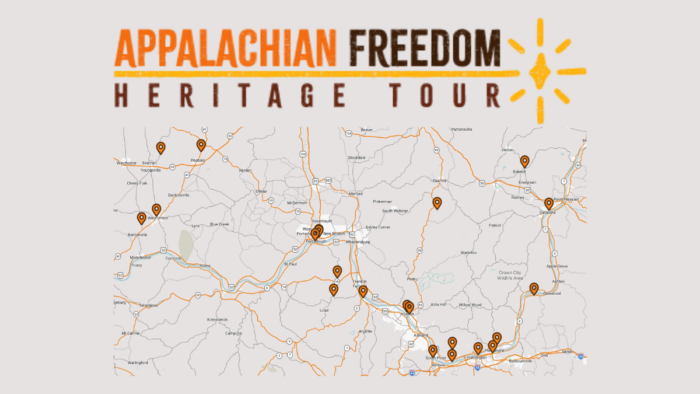
Fain: We’ve identified churches, stores, homes; cemeteries actually, where folks are buried. Trails. Now, folks can actually look up a map and say, “Wow, so this is how they did this.” I’ve learned not only the contributions of the Baptist Church, but of Quakers and Presbyterians. It illuminates that when people committed to righting wrongs, to fight in the good fight, when you have such interracial cooperation, it’s a testament to the best of us.
Adams: I think a lot of times when people think about history, they think about taking the courses in school, and places and dates and battles, but it’s always about people, right? People are at the core of history. So, maybe it’d be good to talk about some of the folks you’ve documented who used some of these sites.
Fain: Let’s talk about the three in Cabell County. Folks may know about the Green Bottom Plantation, which is on Route 2, just outside of Huntington. We document the escape of Moses, Joshua, and Joe there in the 1830s. It should be said that the Green Bottom Plantation would evolve into the Jenkins Plantation by the 1860s.
The Green Bottom Plantation would be the largest plantation in western Virginia: 4,400 acres, upwards of 80 to 100 enslaved persons working there. Moses, Joshua, and Joe realize that their situation is not one they want to endure, and so they escape, and they use forged papers to escape, as well. So, they know the power and importance of literacy. They had to forge papers, they knew how to get out, and one of the things that we also have realized is the importance of the Ohio River and Guyandotte River, and other waterways that exist because it allowed for the transportation not only of goods, but also the transportation of ideas.
When folks docked into Guyandotte, or wherever it may have been, unquestionably, from time to time, information would be transmitted that the freedom seeker could avail themselves of. It is our speculation that Moses, Joshua and Joe learned a few things, they then charted out a plan, and they then sought out to execute that plan. Now, unfortunately, both Joshua and Joe would be recaptured, re-enslaved. We don’t know what happened to Moses. That’s one of the more telling episodes of the difficulty of actually trying to get freedom.
On the other hand, we have James Major Monroe, really around the 1830s, 1840s. He’s working for a merchant, and he overhears his owner basically saying he’s going to sell him down South, and that was the catalyst that he needed to forge a plan for he and his wife to escape. James Major Monroe does escape, he goes to Canada, successfully arrives there. At a certain point in time, he comes back to Guyandotte to retrieve his wife, but unfortunately cannot locate her. But he at least does obtain his freedom.
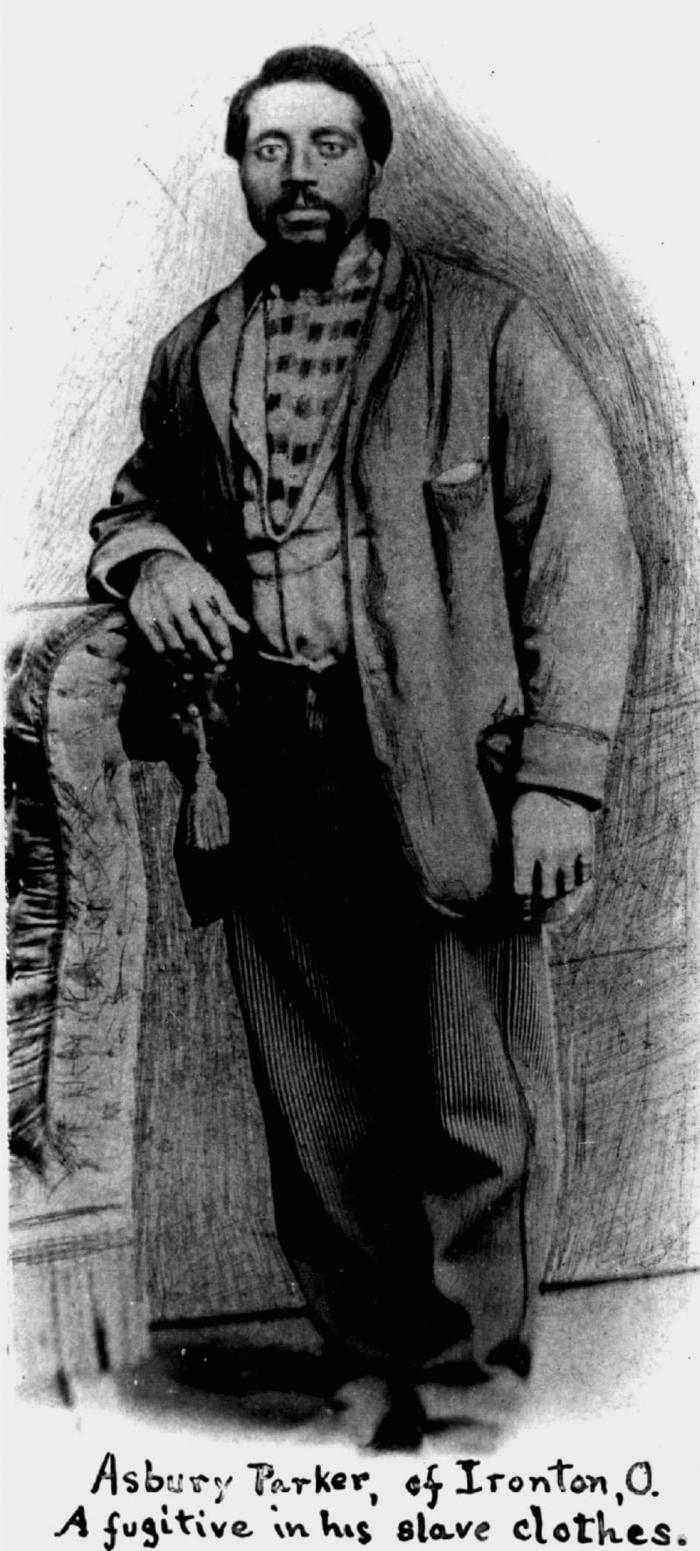
Asbury Parker, wearing the suit of clothes in which he escaped, disguised as a freeman of color.
Courtesy of Wilbur H. Siebert Underground Railroad Collection/Ohio Historical Connection
The last episode that we chronicle — we just had the ceremony, actually this past Friday, on Juneteenth, of Asbury Parker. Just a remarkable man and story, not only as a freedom seeker, but as a conductor. He escaped from Cabell County around 1857 and traveled to Canada through a circuitous route. He would then come back and assist other freedom seekers to escape.
Those are just three stories. There are multitude of stories, and I could regale you with exploits, successful exploits, also some tragic ones.
Adams: One thing I’m struck by when you talk about these stories is, you mentioned Green Bottom Plantation in Cabell County. But you also mentioned three underground railroad sites in Cabell County. It makes sense that plantations and the sites on the underground railroad would be located in the same place, but it feels like it also underscores the danger that comes with this endeavor.
Fain: I will say this, speaking to that point: When we get to Green Bottom Plantation, the slave community was literally located a mile back in the woods, across from Route 2, and it was only one road in and one road out, and so anyone who would attempt to escape from that situation would have faced a daunting challenge. Unquestionably, there were safeguards and strategies and tactics implemented by the slave owners to really, as best they could, stop and prevent anyone from escaping. The fact that we have documented at least these three attempts — these are secretive ventures and networks — so we had a really difficult time finding information within Cabell County to document successful journeys and attempts. The fact that we’ve documented three [sites] doubles — I think it actually more than doubles — the number of sites that exist within West Virginia.
Adams: It sounds like this has been a challenging project but rewarding. Why is it so important to document this secret, uncovered history and to remember these sites?
Fain: For me as a historian, it’s important to share to the community and students that history doesn’t take place solely outside of the region. History is here. Committed folks risk life and limb to do the right thing, to fight the good fight, and that there are lessons in that. So, I come away with just a great sense of inspiration that it just takes one — I mean, literally it just takes one person, a committed person who believes in the righteousness of their cause, who can change the trajectory of history. Our work has basically documented not only the personalities, the efforts. We have documented the geography of freedom seekers and of trails. It is my hope also that folks can then transport their 21st century mindset to a 19th century mindset and to realize that these freedom seekers not only had to have great courage but imagine navigating some of this terrain and trusting in folks that you may not know. Going shoeless through underbrush and swamps with tattered clothing and all types of weather. The hope is to make this something that is visceral, if at all possible. So, it’s not just about an intellectual engagement; it’s about people feeling personally connected to these exploits, these journeys, these efforts.
Cicero Fain is Assistant Provost for Access and Opportunity at Marshall University in Huntington, West Virginia. There’s more about the underground railroad through Appalachia at the Appalachian Freedom Heritage Tour.
Randy Yohe contributed to this story.
Add WVPB as a preferred source on Google to see more from our team
Barbara Kingsolver is one of Appalachia’s foremost writers. She’s written a string of bestsellers, like "The Poisonwood Bible" and "Demon Copperhead," which won her the Pulitzer Prize. Inside Appalachia’s Mason Adams met Kingsolver at her home outside Abingdon, Virginia, to talk art, writing and her latest book, "Partita." We listen to an excerpt from that interview.
For LGBTQ youth in Appalachia, estrangement from their families of origin can be a common and heartbreaking experience. So, some LGBTQ people rely on “chosen family." In Roanoke, Virginia, the culture of ballroom offers the safety and stability of family, along with traditions that are handed down — traditions like vogueing. Mason Adams reported this Folkways story, in collaboration with Brad Kutner and Kelley Libby.