Alert (09/29/2026): Our Parkersburg TV transmitter is still undergoing maintenance and remains temporarily inoperative. We apologize for the inconvenience.
All our programming is available via our TV livestreams on our website and WVPB Passport. Thank you for your patience!
This week, author Silas House returns with a sweeping new novel. Also, some folks say, you have to fake it 'til you make it, even if you're trying to establish a state park. And, the story of the first Mothman sightings as written by a small town journalist in 1966.
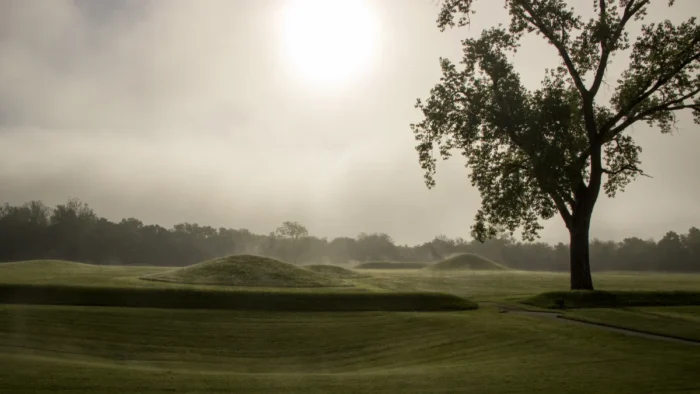
Thousands of years ago, indigenous people created hundreds of earthen monuments in what is now Ohio, Kentucky and West Virginia. Some were burial mounds. Others were curious shapes and designs whose purposes are not entirely understood.
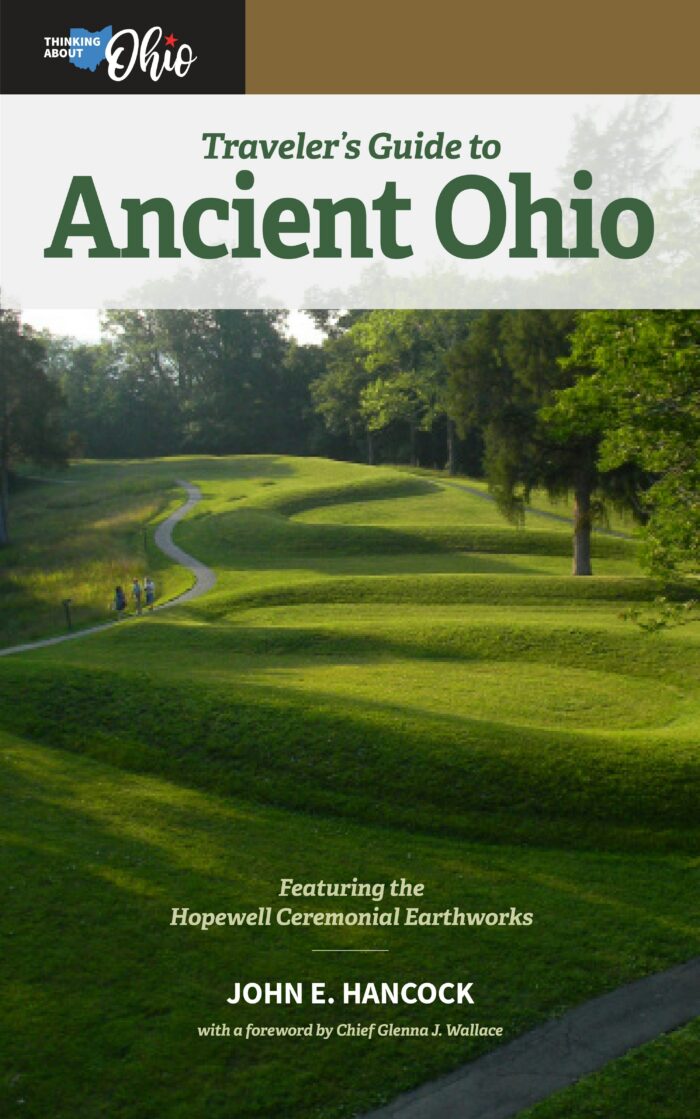
John E. Hancock is a professor of architecture and design at the University of Cincinnati, and he spent years studying these earthworks. Recently, he published Traveler’s Guide to Ancient Ohio, and if you want to visit these ancient sites, it’s a good place to start.
Inside Appalachia Producer Bill Lynch spoke with Hancock about the book.
The transcript below has been lightly edited for clarity.
The cover of Traveler’s Guide to Ancient Ohio by John E. Hancock.
Courtesy of Ohio University Press
Lynch: When did you get interested in the idea of ancient Ohio and the mounds and those designs?
Hancock: That’s a good question, and it’s a good story. I think it’s probably a good story for a lot of people. They have their own version of this.
In my case, I’m an architect and architectural educator.
I was doing the history architecture history courses here at the University of Cincinnati in the architecture school, and I was sort of specializing in the ancient cultures. You know, the Greeks and the Romans and all that usual stuff.
I’d been doing that for about 15 years already, and when, in the mid ’90s somewhere, that’s when a new graduate student came into my office. He said, “I want to do my thesis on the ancient earthworks of Ohio.”
And, of course, I had been living in Cincinnati for 15 years. I just looked at him blankly, and I said, “The what?”
Because just about everybody I talked to after that, [they] didn’t know about these things. I mean, I knew Serpent Mound, but not much beyond that. Then he showed me the 19th century books with all the unbelievable drawings of these spectacular, perfect, huge geometric enclosures up and down the Scioto River and the Miami rivers over here.
I said, “I had no idea.”
So, then I was off and running, you know? I had to go find them and try to figure them out. I had to go learn about them, which means I had to go to archeology conferences, and so on, because those were the only people talking about them. The only people who knew they existed practically were the archeologists and some native people, of course, who saw them very differently than the archeologists did.
I found that interesting, too.
Then, I went to work with some teams of people making exhibits and digital publications about the earthworks, trying to make them more understandable for the public and better appreciated to see them more clearly and to understand different kinds of stories about them and their backgrounds and who made them.
So, that’s how my interest started, and how it began to grow from there.
Lynch: There are quite a few of these things here in West Virginia. We have a couple of mounds. The one I think of the most, other than the one that’s in south Charleston, which is really just down the road from here, is actually in Moundsville. It’s located right across from a prison.
How many of these things are out there and have they all been uncovered or discovered?
Hancock: Well, just speaking about mounds first, most of those come from the culture that’s now called “Adena.” So, that’s about 2500 to 3000 years ago.
There was a map made of Ohio back in about 1914 by a guy named William Mills. He counted 10,000 mounds in Ohio. Kentucky and West Virginia are just as loaded up with those Adena mounds as Ohio is. So, that’s a lot.
William Mills also counted about 500 enclosures, as opposed to a mound. That’s an earth berm that goes around a space. There are about 500 of those. So, that was a lot, and they were pretty well everywhere across the greater Ohio, central Ohio Valley.
Of course, now there aren’t that many, and I don’t cover all of them in my book. I just cover just about all the earthworks — that is, the enclosures — but I try to limit it to the most interesting of the mounds because mounds are kind of everywhere.
From a tourist point of view, they all I’ll start to kind of look alike, unless there’s a story that goes with it, you know what I mean?
Lynch: Is there a feeling that that we have discovered or found all the ones that are out there? Are there some we haven’t found yet?
Hancock: It’s not very likely that there are. I don’t think that there are any that still have a shape to them above the surface that are not known, but there are many left where there are traces under the ground, right? There are remote sensing techniques now that archeologists use that can detect these things, even if they’re not visible on the surface. So, those are still being discovered.
Lynch: With your background in architecture, what surprised you about these things?
Hancock: When I first encountered them, they seemed like a very strange kind of architecture to me, or landscape architecture, you could also call them, of course.
I didn’t know how to interpret them, and we’ve really never seen anything equivalent. That was part of what inspired me to get involved and try to figure these out. I mean, how do we figure out what these things are? And as an architect, as an architectural educator, my big question was what kind of experience are we having in these places? How are we getting human meaning out of them? Or what are our perceptual faculties? How are they struggling to come to terms with these things that are so big and so subtle and so precise all at the same time?
It was a challenge to sort of figure it out and then try to figure out how to share it, to help other people see these things in perhaps in a new way.
Lynch: How long did it take you to kind of assemble this?
Hancock: Well, I’ve been working on this topic for 35 years and other projects, other goals along the way. I said, first of all, we were doing exhibits; some for the park service, some for the Ohio History Connection.
We did a big website called the Ancient Ohio Trail. We sort of put this whole package together as a tourist resource, and then right after that, I got involved in the effort to put eight of these earthworks on the World Heritage list.
I got heavily involved in that and helped with the nomination book.
Then, it was just about when that process was wrapping up, around 2020 or so, that I realized, you know, I really always wanted to make a book. I always wanted to make a travel guide out of this.
That was, I think, partly because in the first half of my career, before that student came in and told me about the ancient earthworks in Ohio, I’d been all over Europe, because that’s the material I had teach here, using the Michelin guides, the Insight guides, and all these other beautiful, illustrated guidebooks.
As I was out traveling across Ohio, finding the earthworks, I realized we’ve got a multi-layer visitor experience here with lots of other interesting things — historic towns, scenic routes and nature preserves.
This is in some ways equivalent to the Dourdan Valley in France, for example. And it needs to have a book, just because I like the books.
So, it was when we were wrapping up the world heritage effort that I realized that after all these other projects, I’m sitting on this big archive of photographs, videos, interviews, computer graphics and site itineraries.
I’m 70 years old. So, I guess I got to get this book out. That was the impetus to finally do the traveler’s guide.
Lynch: To you, what’s the crown jewel? What is the one place you shouldn’t miss if you’re going to go to any of them?
Hancock: The Octagon Earthworks in Newark, Ohio. Okay, not much hesitation there, and maybe this is because I’m wearing my architect hat now. That’s where you can see the grandeur, the precision, and the unbelievable experience of these places.
It’s a little tough to figure out, but it’s all there. It’s well maintained, and it’s just perfect.
That’s also the place where you can stand in certain positions, and you can realize that this is the instrument that they built 2000 years ago, which perfectly calibrates the 18-point, six-year cycle of the movements of the moon in the sky.
Then, right across town, also in Newark, is the Great Circle, a 1200-foot diameter circular wall and ditch, also in very good condition. It’s magnificent sort of prototypical sacred space. So, those are both where I think one might get the most profound sort of spatial architectural experience of what these American Indian ancestors did 2000 years ago.
Lynch: Are you working on anything else?
Hancock: Well, I got another book that came out the same month, on the same topic.
I was kind of central to the creation of the UNESCO World Heritage nomination for the eight Hopewell Ceremonial Earthworks— which, the two in Newark are part of that and the five of them in Ross County, Chillicothe. The National Park manages those. That group also includes Fort Ancient down here, just north of Cincinnati.
Those are the UNESCO-inscribed earthworks now. When we finished the nomination book for UNESCO, it was pretty substantial and a very attractive, big book with lots of nice big photographs and some all-new maps. Everybody who saw this said, “Gee, how can I get a copy of that?”
It looked like a coffee table book, but it was really just a government report, according to a very stringent outline that was the requirement of UNESCO. So, a colleague and I immediately went to work to find a publisher to sort of redo it as a real coffee table book that would be appropriate for a public sale. We convinced the Smithsonian to publish this.
So, that book is also out. It’s called Hopewell Ceremonial Earthworks from Smithsonian Books. Probably most places where they’re going to be selling my traveler’s guide, they’re also going to have this — this larger, glossy coffee table book as a companion piece. People can buy that, too.
Lynch: So, you can have the one for your nightstand and one to impress your guests.
Hancock: Yeah, one for the coffee table and one for the glove box of the car. The travel guide is small, compact, like a good Michelin. It’ll fit in your glove box. So, there you go.
This week, author Silas House returns with a sweeping new novel. Also, some folks say, you have to fake it 'til you make it, even if you're trying to establish a state park. And, the story of the first Mothman sightings as written by a small town journalist in 1966.
The annual West Virginia Book Festival, a free event for book lovers of all ages, will be held on Saturday, Oct. 24, at the at the Charleston Coliseum and Convention Center.
Silas House is a major voice for Appalachia. The Kentucky native has written more than 15 books and served as the state's poet laureate. His latest book is The Tulip Poplars, a sweeping novel about the lives of four people as they navigate friendship and forbidden love throughout the 20th century. Inside Appalachia's Mason Adams spoke with House.