


'Haunted' Town Already Celebrating Spooky Season
Halloween is still several weeks away, but one West Virginia town is already celebrating the season.
Continue Reading Take Me to More NewsAlert (09/29/2026): Our Parkersburg TV transmitter is still undergoing maintenance and remains temporarily inoperative. We apologize for the inconvenience.
All our programming is available via our TV livestreams on our website and WVPB Passport. Thank you for your patience!




To Educate, Inform, and Inspire by Telling West Virginia's Story
Mountain Readers Week will be held Oct. 5-9, 2026! Celebrate and foster a love of reading in children across West Virginia.
Nominate an exceptional West Virginia K-12 teacher today!

On Demand

On Demand

Stream original productions from WVPB

Watch locally produced documentaries & more.

On Demand

On Demand






West Virginia Morning

Inside Appalachia

West Virginia Week

Mountain Stage

Us & Them

The Legislature Today

The Legislature This Week

Send us your comments and questions.

Stream our board meetings.

Check out the latest WVPB news.

Sign up for our newsletter and get weekly updates.

Meet the WVPB staff.

WV Educational Broadcasting Commission, the WVPB Foundation, and the Friends of WVPB.

Come work with us!

Read our annual report and learn how we educate, inform and inspire with your support.

Sponsor impactful and engaging media and entertainment.

Use your IRA to make a gift to WVPB.

Become a member with your gift of $1,000 or more.

Make WVPB part of your legacy.

Manage your membership account.

Learn how you can Protect and Sustain West Virginia Public Broadcasting.

Scavenger. Trash animal. Chicken killer. Hero. People here in Appalachia have lots of feelings when it comes oppossums — or “possums” as some people call them. A town in Harlan County, Kentucky found this out first-hand when they decided to feature a possum on a mural in their downtown.
It was a clear, sunny day in May and Lacy Hale was putting the finishing touches on a mural destined for a brick wall in downtown Harlan, Kentucky.
Panels of mural fabric sprawled across the floor of Lacy’s workspace. She walked barefoot, bent over, creating sweeping brushstrokes of vibrant greens and deep purples.
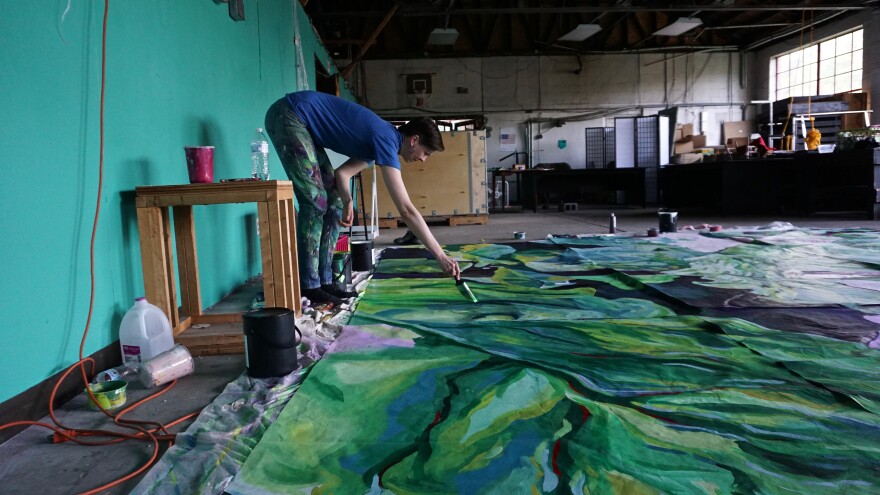
“You know, possums are everywhere. You see them all the time when you’re driving around,” Lacy explained. “They kill ticks, they kill snakes. They’re North America’s only marsupial. So I thought they were super cool animals.”
Lacy worked with high school students and other community partners on the project, which was spearheaded by Southeast Kentucky Community & Technical College’s Appalachian Program. Robert Gipe, a staff member of the Appalachian Program, explained that they sought community input on the mural design. “We did a long community engagement process for several months, and we had people giving us ideas for murals all over the county,” Robert said.

Based on that input, they chose local plants and animals as the mural’s theme. They decided to feature pokeweed as a nod to Harlan’s annual Poke Sallet Festival, which celebrates a dish made from the plant’s leafy greens.
Lacy researched pokeweed and found that it relies on certain animals to spread its seeds.
“One of the biggest proponents of that was the possum, when I was reading about it,” Lacy said. Possums are one of the only mammals that can tolerate the berries’ toxins.
In the mural, a baby possum hangs by its tail from the pokeweed’s purple stem.
‘There Were Just a Lot of Feelings’
This isn’t the first time that possums have been favorably featured in eastern Kentucky’s music and art. For example, WMMT-FM, out of Whitesburg, is fondly nicknamed “Possum Radio.” But not everybody feels so warmly toward these creatures.

When Knott County, Kentucky, named the possum their official animal in 1986, some took offense. In a letter to the editor of the local paper, one reader wrote:
“My personal opinion is that an opossum is a very low and unintelligent animal. A scavenger is a better word. This action insults the intelligence of our county and Appalachian area, which we should all love.”
When Robert showed a draft of the mural to college students in his Appalachian Studies class, the possum caused a bit of a stir.
“They felt that this possum would be perceived as a representation of our community and of them. And that they had had negative associations with possums due to [it] often being found dead in the road and in their trash cans. Maybe its rodent-like nature, that seemed to come up in some of the students’ responses. But there were just a lot of feelings,” Robert said.
When Lacy heard about some of the negative reactions to the possum, she was surprised.
“I was completely shocked because I’ve never really encountered anybody that’s been so vehemently against an animal being in a piece of artwork.”
Lacy learned that people associate possums with negative stereotypes about hillbillies that often appear in popular media. For example, the 1960s television show The Beverly Hillbillies regularly featured bits about eating possum.
‘They’re Resilient’
But increasingly, artists from within the region are turning those negative associations inside out. Artists like Raina Rue, the creative force behind Juniper Moon Folk Arts. Raina’s currently based in Winchester, Kentucky, but hails from Irvine.
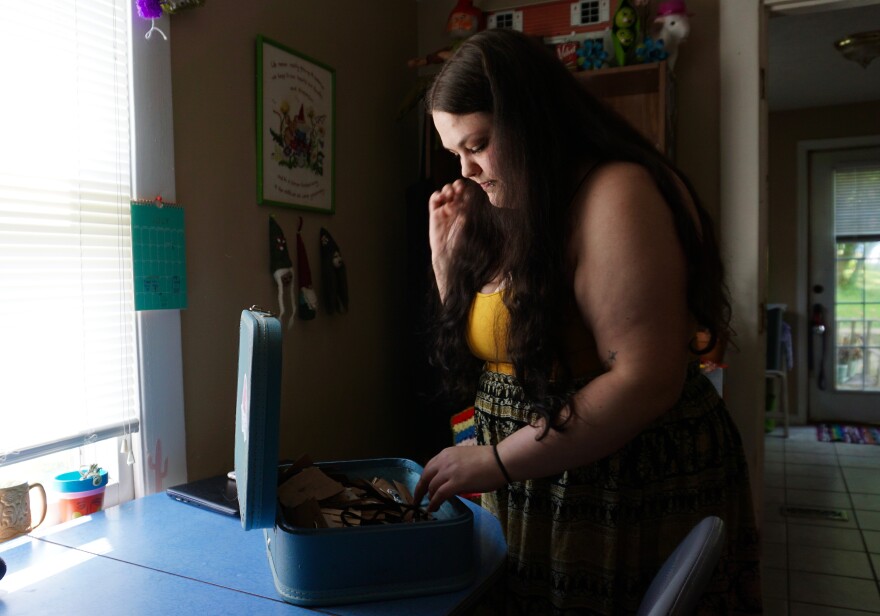
She describes her work as “a weird ‘lil hodgepodge of rural queer art you can wear.” Her pins feature pawpaws, rainbows and morel mushrooms, with phrases like “homegrown in the holler,” and “kudzu queer.”
“My top sellers are my possums. I sell more possums than anything else. Which I love. It makes me so happy,” Raina said.
Some of the possums are cute and cuddly, some look tough and ornery. One hangs from a rainbow flag by its tail, another sports a red bandana around its neck.

Raina’s favorite possum design is her most recent.
“He’s punk and he’s wearing a vest that says homesick on the back and he’s crying and smoking a cigarette in a trashy alley.” Raina calls him the Homesick Possum. “It’s kind of like a little ode to displaced country folk,” Raina said.
It’s also a tribute to Appalachia’s DIY arts and punk communities, some of which are embracing the underdog animal as a kind of mascot.
For Raina, the misunderstood possum is more than just a cute, weird little creature.
“They’re resilient, they don’t need any sort of special surroundings to live in. They can live under a truck, or in the woods in a hole in a tree. And I guess I can relate resiliency, scrappiness, all those things to where I come from and the kind of people that I come from.”
Lacy also hopes more people will begin to think possums are awesome. “I would like to see them appreciated for what they are,” she said.
And her wish seems to be coming true, as possums are popping up on jewelry and T-shirts, as tattoos, in memes that possum fans share on social media, and on the now-colorful wall in downtown Harlan.
As Lacy put it, “Possums are in, possums are it, possums are the thing.”
This story is part of the Inside Appalachia Folkways Reporting Project, a partnership with West Virginia Public Broadcasting’s Inside Appalachia and the theFolklife Program of the West Virginia Humanities Council.
The Folkways Reporting Project is made possible in part with support from Margaret A. Cargill Philanthropies to the West Virignia Public Broadcasting Foundation. Subscribe to the podcast to hear more stores of Appalachian folklife, arts, and culture.
Add WVPB as a preferred source on Google to see more from our team

Halloween is still several weeks away, but one West Virginia town is already celebrating the season.
Continue Reading Take Me to More NewsAluminum plates that helped keep astronauts on the Artemis II rocket safe won the first ever Coolest Thing Made In West Virginia competition.
Continue Reading Take Me to More NewsFor LGBTQ youth in Appalachia, estrangement from their families of origin can be a common and heartbreaking experience. So, some LGBTQ people rely on “chosen family." In Roanoke, Virginia, the culture of ballroom offers the safety and stability of family, along with traditions that are handed down — traditions like vogueing. Mason Adams reported this Folkways story, in collaboration with Brad Kutner and Kelley Libby.
Continue Reading Take Me to More NewsMountain Stage is changing locations for its final two live events of 2026. The Sunday, Nov. 15 show will now take place at the Charleston Theater at the Convention Center, and the Sunday, Dec. 6 show will be held at the Capitol Theater in Downtown Charleston.
Continue Reading Take Me to More News