Alert (09/10/2026): Our Parkersburg TV transmitter is undergoing maintenance for a few days and will not be operational. We apologize for any inconvenience.
All our programming is available via our TV livestreams on our website and WVPB Passport. Thank you for your patience!
This week, one thing about Appalachians: we can get competitive. We’re proud of our local food. Love a good hunt. And enjoy competition with friends. We learn the rules and celebrate our victories. You'll hear these stories and more this week, Inside Appalachia.
These (Quasi) Anonymous Social Media Accounts Are Interjecting Themselves Into W.Va. Politics
Listen
Share this Article
If you’ve been watching West Virginia politics play out on social media this election season, you’ve probably noticed some pretty vitriolic rhetoric. Some of it comes from the usual suspects--like candidates and their parties. But, some of it--it’s not clear where it’s coming from. Not surprisingly, there are those who contribute to the state’s political discourse through the veil of anonymity.
Byrd’s Finger: A Contractor for the Republican Party
When it comes to politics on Twitter, one of the most active accounts in West Virginia is Byrd’s Finger. It’s an obvious reference to the late Democratic senator Robert C. Byrd. But, there’s no question it’s coming from a Republican point of view.
With help from a few others, Byrd’s Finger is operated by Rob Cornelius. Aside from working as a full time sports broadcaster, he’s a contractor of the state Republican Party.
"Our goal is to, quite simply, make sure folks know they are a subject for ridicule. You know, Twitter is honestly a great avenue to make them subject to ridicule, to make them seem ridiculous make them appear to be criminals or buffoons. And that's what I do with that account."<br>--Rob Cornelius, contractor for the West Virginia GOP
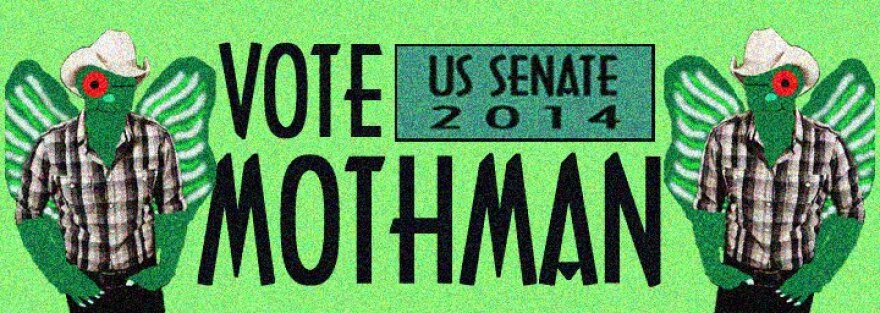
While Cornelius and Byrd’s Finger use vitriol and personal attacks against Democratic candidates, there’s another account that uses satire as their chosen tactic: Mothman for U.S. Senate.
Credit West Virginai, Vote Mothman for U.S. Senate / Facebook
/
Facebook
Of course it’s not really the Mothman—you know, the supernatural legend out of Point Pleasant that’s said to have collapsed the Silver Bridge back in 1967. But, if you look at West Virginia Public Broadcasting’s Facebook page, you’ll see him all over the place. Both there and on Twitter, he argues there’s no difference between U.S. Senate candidates Rep. Shelley Moore Capito and Secretary of State Natalie Tennant. (You’ll notice in the video below, he’s dubbed Tennant’s voice over images of Capito speaking.)
So who’s the person behind the Mothman account? It’s a 34-year old man from Charleston named Jeremy Brannon. I know this because when I tried calling him back a few weeks ago, it went straight to voicemail and the greeting message revealed his real name. (So, sorry, Jeremy.)
Analysis: Scholars and Researchers Explain Anonymous Accounts and Political Discussion
There are, of course, other anonymous (or quasi-anonymous) social media accounts chiming in on West Virginia politics--and it should be of no surprise. While some--like Cornelius and Brannon--find it difficult to remain anonymous online, the tactic is part of a long-standing tradition in American politics, according to Lee Rainie of the Pew Research Center’s Internet Project.
“It’s a pretty common element of politics throughout American history that’s now sort of amped up in an online environment because online tools allow people to do things even more quietly and without identification with their real names if they choose to do that,” he said.
“It was very clear that you had a significant number of folks who were tweeting who were portraying themselves as one thing—as just kind of average, unbiased observers of politics who were tweeting various things–when, in fact, it was very clear they were hired guns,” said Dr. John Parmelee, department chair of communication at the University of North Florida and author of Politics and the Twitter Revolution.
Parmelee also says that word of mouth communication, including on social media, can be as effective as a multimillion dollar TV ad buy.
Add WVPB as a preferred source on Google to see more from our team
In southern Ohio, there’s a musical tradition that goes back nearly 1,000 years and 4,000 miles. For Inside Appalachia, Folkways Reporter Capri Cafaro has this story.
The student-led team that produces the news for WMUL radio at Marshall University learned in August that they won a collegiate Edward R. Murrow award for Outstanding Newscast for the second year in a row.
News Director Eric Douglas sat down in a classroom studio with Marshall's Chuck Bailey, the student news director Emma Johnson, and the Director of the Marshall School of Journalism and Mass Communications Rob Quicke, to learn more.