Alert (March 14, 2026): Due to recent high winds, our radio/TV tower in Bethany is not operational. Our engineers are working to resolve the issue. Alert (March 11, 2026): Our TV translator in Flatwoods is experiencing technical issues. Our engineers are troubleshooting the problem and expect it to be down for a couple days.
Thank you for your patience.
This week, we meet the woman behind the popular TikTok account “Appalachian Forager.” She makes jam from pawpaws and jewelry from coyote teeth. Also, we sit in on a master class in foraging for wild mushrooms. And, when a West Virginia pastor got assigned to a new church, folks tried to warn him.
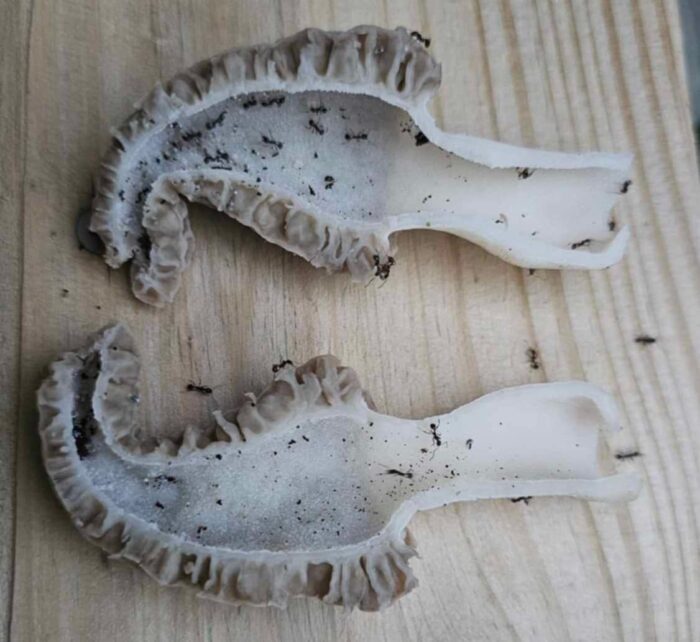
A morel sliced lengthwise will resemble a gutted fish. Note its characteristic hollow stem, a final safety check on whether you have a true morel, and the reason for its nickname of “dry land fish.” Also note that unclean morels can house ants as well as snails. Courtesy Adam Boring.
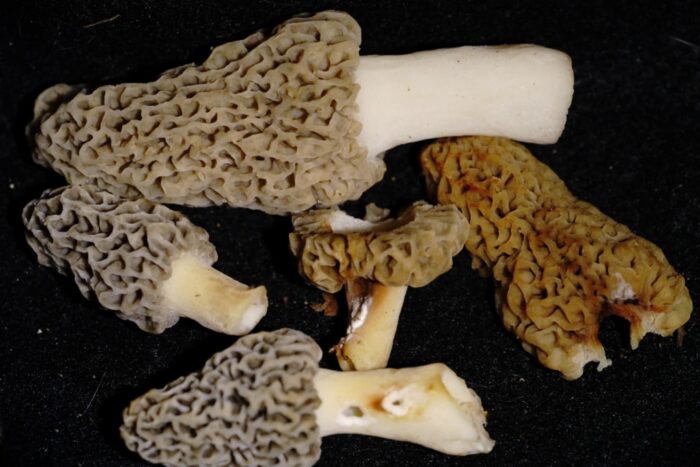
Every spring, morel hunters head to the woods in search of mushrooms that look like little wrinkled Christmas trees. Some folks freeze them for later. And even add them to their holiday menus.
Folkways reporter Wendy Welch spoke with foragers and chefs in Virginia about how to safely harvest and prepare these beloved fungi.
Raising Flood Relief With A River Song
Four months after Haddox appeared on stage at the Southeast Regional Folk Alliance festival in Black Mountain, North Carolina, Hurricane Helene tore through the conference location, where recovery efforts are ongoing. Courtesy Chris Haddox.
In 2016, torrential rains resulted in one of the deadliest floods in West Virginia. It inspired songwriter Chris Haddox, called “O, This River.”
Since Hurricane Helene, Haddox has been using that song to raise money for people in North Carolina affected by Hurricane Helene.
Folkways reporter Connie Bailey Kitts spoke with him about the story behind the song.
Smashing Pumpkins For Science!
The crowd looks on at a package with a parachute falls to the ground at the 35th Annual WVU Pumpkin Drop Oct. 25, 2024. Photo Chris Schulz.
Mason: Just because Halloween is over, doesn’t mean pumpkin season is done. At West Virginia University, the big orange gourds are part of an annual challenge that takes a lot of guts –pumpkin guts.
WVPB’s Chris Schulz had more.
—–
Our theme music is by Matt Jackfert. Other music this week was provided by Christian Lopez, The Appalachian Road Show, Tim Bing, Caleb Caudle, Chris Haddox and John Inghram.
Bill Lynch is our producer. Zander Aloi is our associate producer. Our executive producer is Eric Douglas. Kelley Libby is our editor. Our audio mixer is Patrick Stephens. We had help this week from folkways editor Nicole Musgrave.
You can send us an email: InsideAppalachia@wvpublic.org.
On this West Virginia Week, we take a look at the dramatic ending of the state Legislature’s 2026 regular session, developing data centers and Easter eggs.
This week, we meet the woman behind the popular TikTok account “Appalachian Forager.” She makes jam from pawpaws and jewelry from coyote teeth. Also, we sit in on a master class in foraging for wild mushrooms. And, when a West Virginia pastor got assigned to a new church, folks tried to warn him.
Around this time of the year, some area churches get into the business of selling chocolate Easter eggs. These are the kind of eggs that have some weight to them. But one West Virginia church has become known far and wide for its chocolate eggs.
The West Virginia Department of Agriculture earlier this month issued an advisory to poultry owners about the rising number of avian flu cases in surrounding states. So far, it has infected only a small number of poultry farms in West Virginia. But in nearby Pittsburgh, the number of avian flu cases is high.