This week, a new generation is learning the story behind "Brown Hill," a song by influential bluegrass band The Lost and Found. Also, data centers are changing the landscape, and one project is planning to plow over an extremely rare stand of seed-producing American chestnut trees. And, small food producers embrace digital technology for the humble farm stand.
Celebrating A Tradition Of Poets And Discussing The Resurgence Of Black Lung, Inside Appalachia
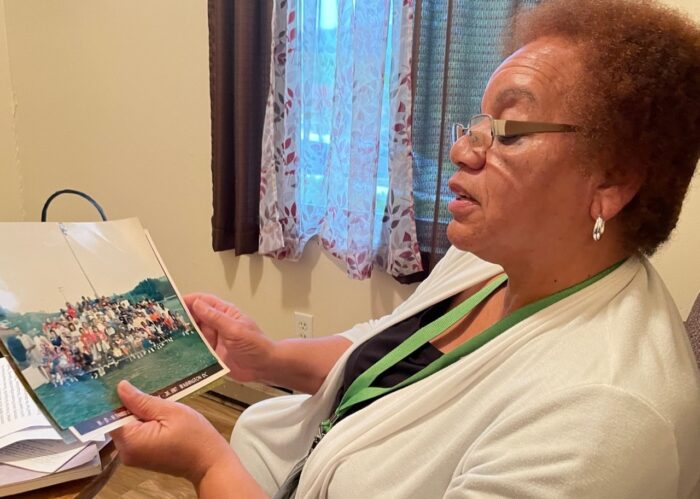
Jeanette Wilson with a picture of a family reunion where her grandfather’s and uncle’s poems were always read and passed down within the family.Connie Kitts/West Virginia Public Broadcasting
Listen
Share this Article
This week, Rev. George Mills Dickerson of Tazewell, Virginia was born in the years after slavery ended. He’s remembered today through his poetry.
And a new wave of black lung disease is ravaging Appalachia. We’ll hear more from a black lung town hall in Whitesburg, Kentucky. Coal miners have their own thoughts about black lung, too.
You’ll hear these stories and more this week, Inside Appalachia.
Celebrating Poetry About 20th Century African American Life
Poetry has been a tradition in Jeanette Wilson’s family for generations. They’ve recited the poems of Wilson’s grandfather and her uncle George for nearly a century. Now, these poems about African American life in southwest Virginia are reaching a wider audience — and connecting the past to the present.
Folkways Reporter Connie Kitts brings us this story.
The Voices Of Black Lung Miners
For years, it looked like black lung disease was on the decline, but a new epidemic has emerged. In 2018, NPR and the PBS program Frontline investigated a resurgence of advanced black lung among coal miners across Appalachia. They found that despite mounting evidence and a stream of warnings, federal regulators and mining companies failed to protect workers.
The result was that thousands of miners were afflicted with an advanced stage of black lung disease — known as Progressive Massive Fibrosis.
We bring this story from the miners themselves, as told to NPR’s Howard Berkes and Ohio Valley ReSource reporter Benny Becker. It was originally broadcast on NPR’s All Things Considered on Jan. 22, 2019. The full documentary Coal’s Deadly Dust is available on pbs.org.
In July, the Appalachian Citizens Law Center hosted a black lung town hall in Whitesburg, Kentucky. The nonprofit law firm invited miners and their families to hear from experts about the current state of black lung disease in Appalachia. One of those experts is Kentucky radiologist James Brandon Crum, who first alerted federal researchers to what they later labeled an epidemic of complicated black lung.
Our theme music is by Matt Jackfert. Other music this week was provided by Jeff Ellis, Charlie McCoy, Southern Culture on the Skids, June Carter Cash, and Tim and Dave Bing
Bill Lynch is our producer. Zander Aloi is our associate producer. Our executive producer is Eric Douglas. Kelley Libby is our editor. Our audio mixer is Patrick Stephens.
You can send us an email: InsideAppalachia@wvpublic.org.
On this West Virginia Week, former governor and longtime U.S. senator Jay Rockefeller has died, West Virginia voted in the general election, and a new anthology explores science fiction and fantasy in Appalachia.
This week, a new generation is learning the story behind "Brown Hill," a song by influential bluegrass band The Lost and Found. Also, data centers are changing the landscape, and one project is planning to plow over an extremely rare stand of seed-producing American chestnut trees. And, small food producers embrace digital technology for the humble farm stand.
These Dreaming Hills is a new horror and science fiction anthology collecting stories from across Appalachia. Inside Appalachia's Bill Lynch spoke with editor Noah Ashley Blooms about the book.
Appalachia is full of ancient cave systems. Some are so deep nobody’s sure where they begin or end. For Inside Appalachia, Folkways Reporter Andrea “river” Peterson explored a once-privately owned underground landscape that recently became a Pennsylvania State Park.