Alert (09/10/2026): Our Parkersburg TV transmitter is undergoing maintenance for a few days and will not be operational. We apologize for any inconvenience.
All our programming is available via our TV livestreams on our website and WVPB Passport. Thank you for your patience!
This week, one thing about Appalachians: we can get competitive. We’re proud of our local food. Love a good hunt. And enjoy competition with friends. We learn the rules and celebrate our victories. You'll hear these stories and more this week, Inside Appalachia.
What happens to a community as coal jobs go away? Here are some things you might expect: many people leave, schools empty, local businesses struggle to keep their lights on. But here’s something that may not come to mind: extra curricular sports go away.
That’s what happened to children in McDowell County over 25 years ago. They lost their local soccer league. And while the thousands of lost coal jobs may not come back, thanks to a 4-H project, and about a dozen volunteers, soccer is making a comeback in McDowell County.
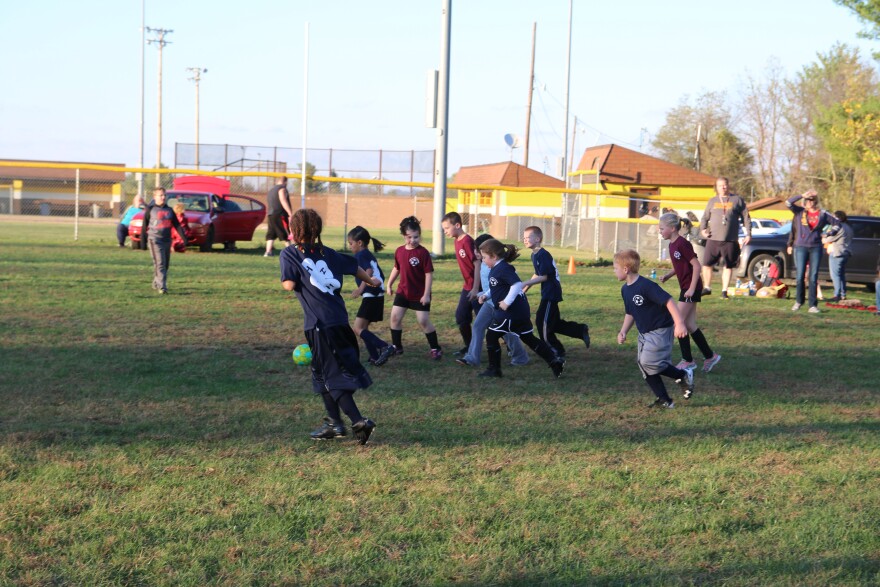
It’s a windy fall day. Two teams of children hurdle towards a green ball. Parents are cheering, and shivering.
9-yr-old Andrew Curry playing goalie at a match in Welch, W.Va.
9-year-old Andrew Curry is watching, waiting for his turn to get back into the game.
“I like that you get to run a lot because I used to play baseball and you didn’t get to do a lot of activity,” says Andrew. He likes to play defense the best. He’s one of 156 elementary students playing soccer this year in McDowell County.
The games are held once a week at Mt. View High School.
Parents and other volunteers coach for free, people like Tom Morsi, a retired coal miner.
“We started a soccer program up here in Welch 26 years ago,” says Morsi. “Jobs started going down, people started leaving, going to other states…and they disbanded. Now a lot of kids that played soccer have kids that play in this soccer league. It’s come full circle.”
Morsi says they want to keep the cost low to make soccer available to any child who wants to play. Parents pay $10, local businesses and funding from West Virginia University’s 4-H program pays for the rest.
Although there is no breakdown of childhood obesity rates by county, here in McDowell, 45% of adults are obese. That’s almost twice the national average, of 28%.
Take McDowell County, where traveling 30 miles through rugged mountains means an hour’s worth of driving. To help parents have an easier time getting their children to soccer practice, the teams mostly practice in makeshift fields in neighborhoods throughout the county.
Places like “church parking lots or old baseball fields that you could turn them into a practice soccer field,” says Nathaniel Smith, another volunteer who’s helped get this soccer league up and running.
Smith says this soccer league is just one example of what’s possible in McDowell, even though times are hard.
“And my hope is…turn some things around, make some things better, and work together.”
Smith says they’d like to see at least two hundred families sign up to play next year. The economy here may be spinning out of control, but he’s not giving up. He hopes they can start middle and high school teams in the next few years. Smith gestures toward the children at play and says, “these kids are the future of McDowell County.”
Add WVPB as a preferred source on Google to see more from our team
Twenty-five years ago, on Sept. 11, 2001, at 8:46 a.m., a hijacked plane hit one of the twin towers at the World Trade Center in New York City, ending for this nation a certain innocence, and the belief that such an attack would never happen on American soil. Maria Young caught up an economics professor from WVU who was on site when the planes hit – and gave an exclusive interview to then-West Virginia Public Broadcasting News Director Beth Vorhees.
There are many events planned across the state to commemorate the 25th anniversary of the Sept. 11 terrorist attacks, including three days of volunteering at Marshall and a 12-hour vigil at WVU.
They love West Virginia. They want to make their future here, but jobs, housing and opportunity can make that choice harder than it sounds. In the first of two Us & Them episodes, Trey Kay talks with young West Virginians trying to decide whether they can put down their own roots in a place they call home.
Economic growth in West Virginia ranks close to the bottom in national rankings. It’s not just losing jobs, it’s also losing young people. In the first of two new Us & Them episodes, host Trey Kay talks with several young adults from the Mountain State asking whether they will stay put or find their future elsewhere.