Alert (09/29/2026): Our Parkersburg TV transmitter is still undergoing maintenance and remains temporarily inoperative. We apologize for the inconvenience.
All our programming is available via our TV livestreams on our website and WVPB Passport. Thank you for your patience!
This week, author Silas House returns with a sweeping new novel. Also, some folks say, you have to fake it 'til you make it, even if you're trying to establish a state park. And, the story of the first Mothman sightings as written by a small town journalist in 1966.
Home » Stories » Coalfield Development Corp. Making Cuts into Unemployment With Saws Edge
Published
Coalfield Development Corp. Making Cuts into Unemployment With Saws Edge
Listen
Share this Article
Since acquiring the old Corbin Factory building in Westmoreland in the summer of 2014, the Coalfield Development Corporation has turned the building, now called West Edge, into a hub of training and opportunity. West Edge has developed a woodworking workshop that’s slowly cutting into the areas unemployment numbers.
Credit Clark Davis / West Virginia Public Broadcasting
/
West Virginia Public Broadcasting
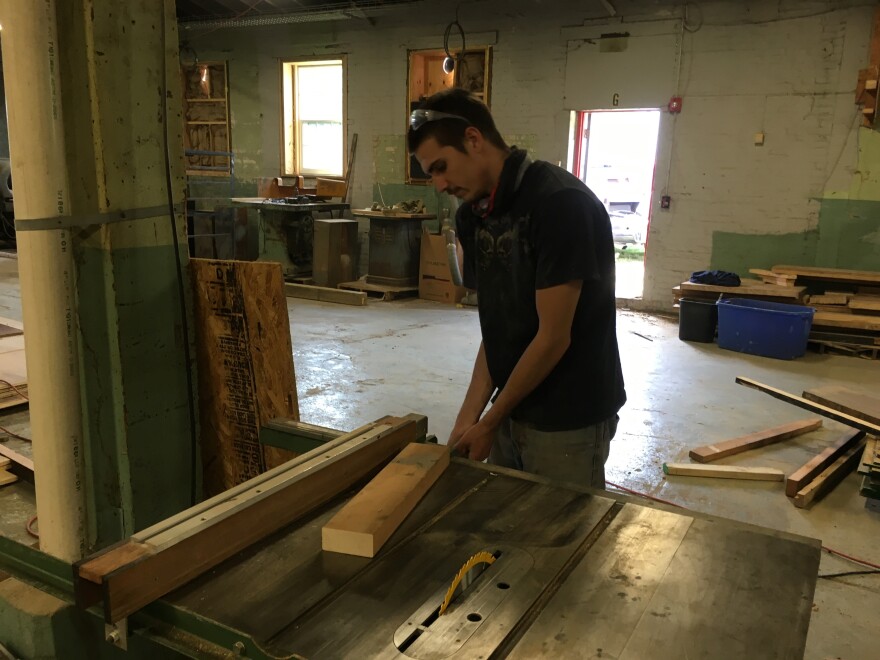
Glen Wilson works in the Saws Edge shop.
Glen Wilson is a former marine corps veteran from Wayne.
“It’s a passion for me, my papa was into. I was woodworking with him when I was 14 years old, he just got me into it and when he passed away, his shop kind of disappeared and I kind of ventured off of it, but my dream’s always been to woodwork,” Wilson said.
Wilson is one of just a few students involved in a program where participants take classes at Mountwest Community and Technical College in Huntington and earn credits and money to work at a woodworking shop at West Edge, called Saws Edge.
“You’re creating something that’s been put on this earth and comes from a tree and you cut it down and make something beautiful out of it, you can see all the texture and the grain out of it,” Wilson said. “There’s wild stuff when you reveal the wood and what you can see in it, it’s just amazing.”
The workshop has been working on projects for about a year now, but is starting to slowly grow. The group takes wood from old buildings in southern West Virginia, that’s reclaimed by a deconstruction team. The team is part of the Coalfield Development Corporation as well. Coalfield Development Corporation is a community based organization working in the southern part of the state.
They started out building and deconstructing homes and now provide other training opportunities at West Edge. The goal is to create job opportunities in southern West Virginia. They’re funded through private donations and grants.
Using donated wood-cutting machines, they take reclaimed wood to make different things for sale in the local market with the hopes that local groups will purchase them. They have an agreement with West Virginia Living Magazine to make home decor pieces, they’re working with local businesses on making desks and they’ve produced pieces for Heritage Farm.
Credit Clark Davis / West Virginia Public Broadcasting
/
West Virginia Public Broadcasting
Ashley Wiles works on a project at Saws Edge.
Deacon Stone is president of Reclaim Appalachia and project director at West Edge. He said it’s a perfect opportunity to expose the students in the workshop to private businesses to help prepare them for the job market.
“It’s important for us and critical for the crew members to have a close interface with the private sector and for them to understand the kind of skills that we’re building here so we can achieve good placements for our crew members,” Stone said.
One of the businesses that has purchased wood and the services of the wood shop is a group called Ackenpucky. The name is an Appalachian slang term meaning a stew of unspecified ingredients or in the construction industry like a caulking or glue substance. They’re a design and construction group that specializes in restaurant and kitchen design.
Logan County native David Seth Cyfers and his wife run Ackenpucky, which is based in Huntington. He says they’ve used Saws Edge to cut down on their workload.
“In the last couple of years we’ve just been buying reclaimed products from them to do the work ourselves, but the design business has picked up to the point where it’s beneficial to us and beneficial to them to collaborate,” Cyfers said.
They’ve purchased reclaimed wood in the past from Saws Edge for projects like the design and construction of Backyard Pizza in Huntington and are working with the group on bar tops made from old bowling alley lanes for a new restaurant called the Peddler.
Credit Clark Davis / West Virginia Public Broadcasting
/
West Virginia Public Broadcasting
Old bowling alley lanes that Ackenpucky intends to use in the bar area at the Peddler.
Ashley Wiles, of Wayne, appreciates what the Saws Edge has done.
“It’s crazy because before I started here I never thought I could do it, but realistically I can,” Wiles said. “I can run most of this equipment, you have to be taught and you just have to do it.”
Other students at the workshop say they’re just hoping to earn more business and more opportunities for Saws Edge.
Add WVPB as a preferred source on Google to see more from our team
This week, author Silas House returns with a sweeping new novel. Also, some folks say, you have to fake it 'til you make it, even if you're trying to establish a state park. And, the story of the first Mothman sightings as written by a small town journalist in 1966.
The annual West Virginia Book Festival, a free event for book lovers of all ages, will be held on Saturday, Oct. 24, at the at the Charleston Coliseum and Convention Center.
Silas House is a major voice for Appalachia. The Kentucky native has written more than 15 books and served as the state's poet laureate. His latest book is The Tulip Poplars, a sweeping novel about the lives of four people as they navigate friendship and forbidden love throughout the 20th century. Inside Appalachia's Mason Adams spoke with House.