


Aluminum Plates For Deep Space Win W.Va. 'Coolest' Contest
Aluminum plates that helped keep astronauts on the Artemis II rocket safe won the first ever Coolest Thing Made In West Virginia competition.
Continue Reading Take Me to More NewsAlert (09/29/2026): Our Parkersburg TV transmitter is still undergoing maintenance and remains temporarily inoperative. We apologize for the inconvenience.
All our programming is available via our TV livestreams on our website and WVPB Passport. Thank you for your patience!




To Educate, Inform, and Inspire by Telling West Virginia's Story

Mountain Readers Week will be held Oct. 5-9, 2026! Celebrate and foster a love of reading in children across West Virginia.

Nominate an exceptional West Virginia K-12 teacher today!

On Demand

On Demand

Stream original productions from WVPB

Watch locally produced documentaries & more.

On Demand

On Demand






West Virginia Morning

Inside Appalachia

West Virginia Week
Mountain Stage

Us & Them

The Legislature Today
The Legislature This Week

Send us your comments and questions.

Stream our board meetings.

Check out the latest WVPB news.

Sign up for our newsletter and get weekly updates.

Meet the WVPB staff.

WV Educational Broadcasting Commission, the WVPB Foundation, and the Friends of WVPB.

Come work with us!

Read our annual report and learn how we educate, inform and inspire with your support.

Sponsor impactful and engaging media and entertainment.

Use your IRA to make a gift to WVPB.

Become a member with your gift of $1,000 or more.

Make WVPB part of your legacy.

Manage your membership account.

Learn how you can Protect and Sustain West Virginia Public Broadcasting.

On a recent chilly Tuesday morning, about 20 people filed along a winding dirt path leading deeper into West Virginia University’s Arboretum in Morgantown.
Armed with binoculars, smartphones and hiking boots, the group had one goal — spot and identify the chittering birds hidden in the trees above.
LeJay Graffious with the Mountaineer Audubon chapter led the bird walk.
“There’s a good local bird singing,” he told the group, pointing high up in a tree nearby. “They do migrate south and come back in the spring, but he’ll nest here. The one that says ‘drink your tea.’ ”
The birders stop and listen. Graffious reveals the bird’s name: the eastern towhee. It is one of hundreds of species making its way through the Ohio Valley during spring migration or making a nest after a long trip home.
Over the next two hours, the birders will excitedly identify dozens of birds including bay-breasted warblers, Swainson’s thrush, and tufted titmouse. Many species are traveling northward from the sun-drenched forests of Central America.
Migratory birds are important ecological and economic drivers. Each year, birders spend an estimated $41 billion on trips and equipment. Birds are the proverbial ‘canary in the coal mine,’ and also literal ones. As ecological indicator species they inform us when environmental conditions have changed.
And for the last 100 years, their status as creatures worth protecting has been enshrined by a U.S. law called the Migratory Bird Treaty Act. The law makes it illegal to hunt, capture, kill, possess, import or export any migratory bird, or its feathers, nests or eggs without a permit.
But at the end of last year, the Trump administration announced a change to how the stalwart environmental law will be enforced. The change has to do with just two words in the law: “incidental take.” Two words may not seem like much, but the small change has big implications for thousands of birds that migrate through and nest in the Ohio Valley. On Thursday, a coalition of conservation groups sued the administration to restore the protections the law had long offered.
Two Little Words
In December, the Interior Department announced the U.S. Fish and Wildlife Service would no longer enforce “incidental take.” That provision of the law refers to when birds are unintentionally killed by something such as a building, power lines, wind turbines or oil and gas ponds. These open pits near and oil and gas operations often contain toxic drilling fluids and trace amounts of oil.

In the past, the agency has, in select cases, issued fines to industry operators, when actions that fall under incidental take kills birds. Often, the agency works with companies to change practices. That may involve installing netting over waste ponds or changing lights on wind turbines so as not to attract as many birds.
Industry Applauds
Many industry groups support Interior’s decision on incidental take. In a statement, the Independent Petroleum Association of America, which represents thousands of independent oil and natural gas producers, said the agency’s previous interpretation of incidental take expanded the law beyond its original intent and placed blame on lawful industries and activities.
Lowell Rothschild, an environmental lawyer with the law firm Bracewell has represented the oil and gas and other natural resource industries for more than 20 years. He said the law’s broad framing — largely a result of the fact that it’s a century old and was crafted to be broad in its scope — poses challenges.
“The Migratory Bird Treaty Act is difficult to comply with and it’s also difficult to equitably administer,” he said.
Conservationists Concerned
The administration’s change prompted immediate backlash from environmental and conservation groups as well as from 17 former agency officials who served under Republican and Democratic administrations. In a letter, they wrote that the new interpretation of the law is “ill-conceived” and “creates a huge loophole” in the law.
Conservation advocates say the ability to leverage fines over incidental take has been instrumental for getting companies to make little changes that may protect thousands of birds.
“While not every case is going to be enforced, I think by having a number of fines and in the past by having that potential, and this baseline level of protection, and potential for enforcement is really what brings these companies to the table and provides a critical amount of leverage,” said Erik Schneider, a policy analyst for Audubon.
A Seminal Law
When the Migratory Bird Treaty Act was signed into law 100 years ago, one of its objectives was to stop the extinction of bird species being hunted for their feathers. At the time, plumage was all the rage in ladies’ hats.
Since then, the law has been credited with saving species like the snowy egret, wood duck and sandhill crane, said Christopher Lituma, an assistant professor and wildlife biologist at WVU.
“It was a seminal law passed 100 years ago that really resulted in a focus on reversing many of these bird population declines,” he said, describing the Act as an “umbrella law” for migratory birds. “It’s an important one because I think it forces entities to be accountable for their actions, at least as it relates to birds.”

The Fish and Wildlife Service does not provide numbers on how often it has taken enforcement action under the law unless a compelled by a public records request, but Audubon keeps a database of cases.
The vast majority of cases brought under the Act have been related to bird deaths in oil pits and tanks, Audubon said. Of the 452 cases the group has tracked, 407 violations, or 90 percent, were related to the oil and gas industry.
The average fine for an oil pit violation is $6,500.
Already, some who work with migratory birds say they may already be seeing the consequences of the change to the law.
‘Drenched’ in Oil
At the Avian Conservation Center of Appalachia, Jesse and Katie Fallon treat and rehabilitate sick and injured birds. The center, which was founded in 2012, is located inside the Cheat Lake Animal Hospital near Morgantown.
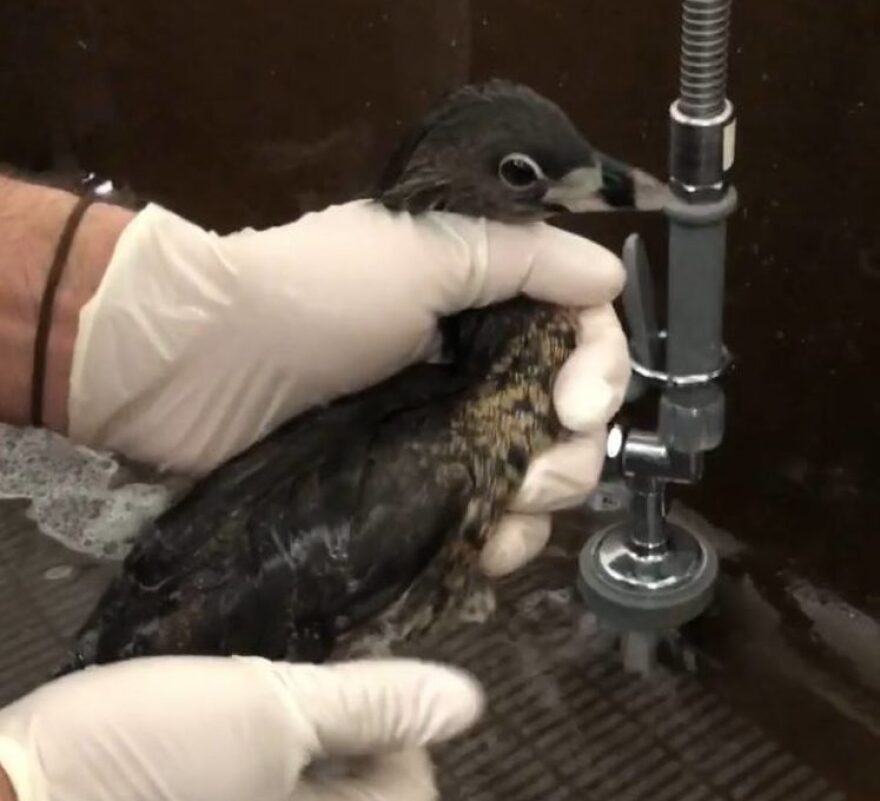
Recently, the Fallons received an oil covered pied-billed grebe. The small, brown migratory bird was fished out of a nearby oil and gas fracking pond.
Grebes are champion swimmers and charismatic little birds.
“My daughter who’s five loves to see pied-billed grebes on the water,” Katie Fallon said. “They just appear to be having so much fun and are so happy out there. She calls them baby dinosaurs.”
Migratory water birds, like grebes, often see ponds near oil and gas operations as just another water source, a place to rest or a potential source of food.
Katie Fallon said when the grebe came in, volunteers immediately noticed it smelled strongly of oil.
“He was just drenched, drenched in it,” she said. “He had several baths with Dawn dish soap that he wasn’t too fond of, us bathing him with the dish soap, but he was happy to float in the water and to try and preen.”
Preening is when birds run their beaks over their feathers trying to clean them off, which causes them to inadvertently ingest some of the material on their feathers.
“And in the case of oil, that’s toxic. So, this bird trying to keep himself clean, he was poisoning himself at the same time,” she said.
Video on the center’s Facebook page showed the grebe seemed to enjoy a nice warm blow dry. But as is the case with most of the birds the Fallons receive from oil and gas operations, within a day the bird had died.
Prior to the change made to the Migratory Bird Treaty Act someone could have been held responsible for the bird’s death.
“By the Migratory Bird Treaty Act being able to be applied toward incidental take that would encourage companies from a financial perspective to cover their ponds,” Jesse Fallon said. “Now, we have to rely essentially on the common sense and conservation mindset of those companies. We don’t have a way to encourage them to help prevent these types of bird deaths.”
It’s hard to quantify the effect enforcement under the Act has had on the numbers of oiled birds.
Audubon says most cases related to oil and gas operations have been in western states. But anecdotally, Fallon says, they’ve seen the impact in northern West Virginia.
“We saw a drop, a temporary drop, when there was enforcement in that regard,” he said. “We’ll see what this year holds.”
A Legal Challenge
On Thursday, May 24, a coalition of national environmental groups, including American Bird Conservancy, Center for Biological Diversity, Defenders of Wildlife, National Audubon Society, National Wildlife Federation, and the Natural Resources Defense Council, filed suit challenging the administration’s changes to the law.
In National Audubon Society v. Department of the Interior, the groups say the Interior Department exceeded its authority and asks the court to tell Interior to “revert to their prior, correct longstanding interpretation and policy.”
In a statement, Audubon’s Vice President for Conservation Sarah Greenberger said the Act was one of the nation’s first conservation laws and has a long record of success. “It defies all facts for the Department of the Interior to suggest that this law is somehow broken when we have a century of evidence that says otherwise,” she said.
Add WVPB as a preferred source on Google to see more from our team

Many of the devices we use in our daily lives run on rechargeable lithium-ion batteries. Be aware that damaged or incorrectly charged batteries can overheat, start a fire, or even explode.
Continue Reading Take Me to More NewsDuring spooky season, popular attention turns toward ghosts and goblins – or if you live in Appalachia – cryptids. For the Appalachia + Mid-South Newsroom, Bill Lynch, producer of Inside Appalachia, brings us the story of the Flatwoods Monster.
Continue Reading Take Me to More NewsA specific style of ballroom dance is helping disenfranchised young people find community in Appalachia. In our latest episode of Inside Appalachia, we explore LGBTQ ballroom culture and community in Roanoke, Virginia. Mason Adams has this excerpt.
Continue Reading Take Me to More NewsThe state of West Virginia was briefly on a federal list of potential nuclear generation sites, but it appears that project is off.
Continue Reading Take Me to More News