Alert (09/29/2026): Our Parkersburg TV transmitter is still undergoing maintenance and remains temporarily inoperative. We apologize for the inconvenience.
All our programming is available via our TV livestreams on our website and WVPB Passport. Thank you for your patience!
This week, ballads tell stories about all kinds of real-life events, but after Hurricane Helene, one group of ballad singers felt some topics were still too raw. Also, the author of a book on ancient Ohio credits a former grad student with introducing him to the region’s mysterious earthworks. And, the legacy of Affrilachian poet Norman Jordan includes a summer camp for teens to study their heritage.
Wildlife Rabies Vaccines To Be Distributed Across West Virginia
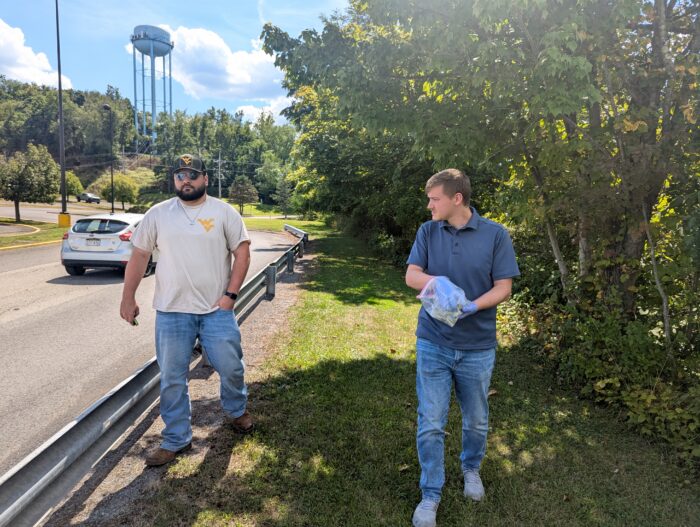
Monongalia County Health Department employees Tristen Nine and Evan Thomas hand distribute oral rabies vaccines for wildlife in Morgantown in 2025.Courtesy of the Monongalia County Health Department
Listen
Share this Article
For the next month, the U.S. Department of Agriculture (USDA) will be airdropping more than 300,000 oral rabies vaccines in 16 counties of West Virginia to inoculate wildlife against the virus. Those counties are: Barber, Brook, Greenbrier, Hancock, Marion, Marshall, Mercer, Monongalia, Monroe, Ohio, Pocahontas, Preston, Randolph, Summers, Taylor, and Upshur.
Baits will be dropped by helicopter along the Ohio River and Northern Panhandle from Aug. 13-18 and more baits will be dropped from airplanes in other rural areas of West Virginia from Aug. 25 to Sept. 4. In a press release, Chelsea Hartley, rabies technician with USDA Animal and Plant Health Inspection Service (APHIS) said those dates are approximate and dependent on weather and other variables.
Rabies is found only in mammals. It attacks the brain and nervous system, ultimately causing death, according to the Centers for Disease Control and Prevention.
MaryWade Burnside, public information officer at Monongalia County Health Department, said the program has been effective in her county.
“We went from 20 cases of rabies total in 2019 to only one or two a year since then,” she said. “This year, 2026, we’ve had no cases of rabies that has been reported to us.”
Early symptoms of rabies in people are similar to other illnesses, such as fever, headache and general weakness and discomfort. As the disease progresses, more specific symptoms include insomnia, anxiety, confusion, slight or partial paralysis, excitation, hallucinations, agitation, hypersalivation (an increase in saliva), difficulty swallowing and fear of water.
Death usually occurs within days of the onset of these symptoms. Individuals who interact with a potentially rabid animal, or with a pet that has interacted with one, should visit a hospital emergency department to determine if treatment is necessary.
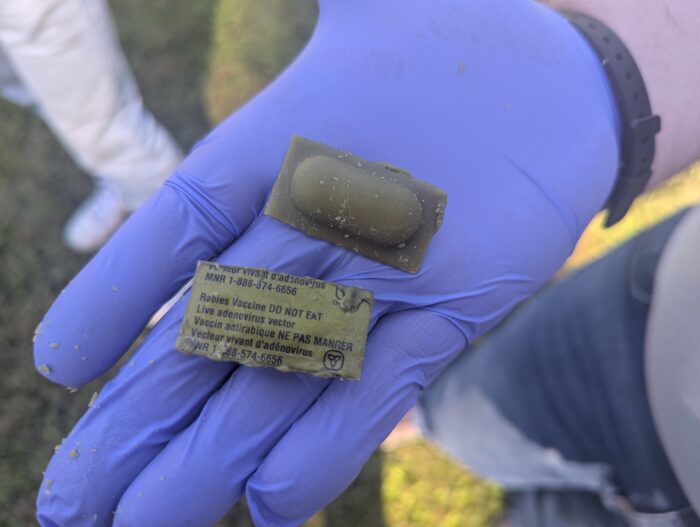
The oral rabies vaccines are covered in a dark green plastic that animals can chew through. Individuals who encounter them are advised to keep pets from eating baits in excess, only handle the baits using a barrier like a glove and wash their hands thoroughly afterwards.
Photo Credit: Courtesy of the Monongalia County Health Department
Burnside said those 2019 cases spurred health officials to reach out to APHIS to renew vaccine baiting in Monongalia County.
“Their goal is to keep rabies from spreading west, but we saw that we were having a big issue in 2019, and so the decision was made to move the airdrop back east to cover Monongalia County,” Burnside said. “They also gave us (oral rabies vaccine) baits that we could use to hand distribute in grassy areas of Morgantown, like parks, the rail trail, around the WVU Coliseum, places like that.”
Seven years later the olive green, rectangular baits are still hand distributed by Burnside’s coworkers. No other West Virginia health departments hand distribute baits around their areas, with other ground baiting operations being conducted by APHIS staff.
“We know from the reaction we get on social media when we post about a rabies case we know this is an issue people really care about and get concerned about,” she said. “Since we started doing the ORV baiting, we get calls or messages asking us to please come put ORV baits in their area, which we cannot do. We get the baits at a specific time of year from the USDA, and they provide a grid of where they are to be distributed.”
Bait distribution takes place this time of year to wait for wildlife born in the spring to be old enough to eat the vaccine.
Burnside said if members of the public encounter baits in their community, to leave them alone and keep an eye on any pets around the baits. If a bait is found on a trail or byway, she said they can be moved to a grassy area while wearing a glove or using another barrier like a tissue and then washing hands thoroughly after.
“They will not hurt animals. If you’re walking a dog on the rail trail and your dog eats one, it will not hurt the dog,” Burnside said. “We do advise people from keeping an eye out on their pets because if they gobble up too many, they might end up throwing up and that obviously concerns the dog owner, which is one of the reasons why we want to get the word out so when people see these out and about, they’ll know what they are.”
According to state code, pets including dogs, cats and ferrets, must be up to date on rabies vaccines.
Add WVPB as a preferred source on Google to see more from our team
On this West Virginia Week, rules are in the works for data centers, lawmakers request a meeting with Flock, and the fate of West Virginia's chestnuts.
When Hurricane Helene tore through western North Carolina in 2024, it took lives and upended communities. A community of ballad singers lost a place where they could share their tradition, but what was lost could be restored.