Alert (09/10/2026): Our Parkersburg TV transmitter is undergoing maintenance for a few days and will not be operational. We apologize for any inconvenience.
All our programming is available via our TV livestreams on our website and WVPB Passport. Thank you for your patience!
This week, one thing about Appalachians: we can get competitive. We’re proud of our local food. Love a good hunt. And enjoy competition with friends. We learn the rules and celebrate our victories. You'll hear these stories and more this week, Inside Appalachia.
Federal Whistleblower Case Links To Fentanyl In W.Va.
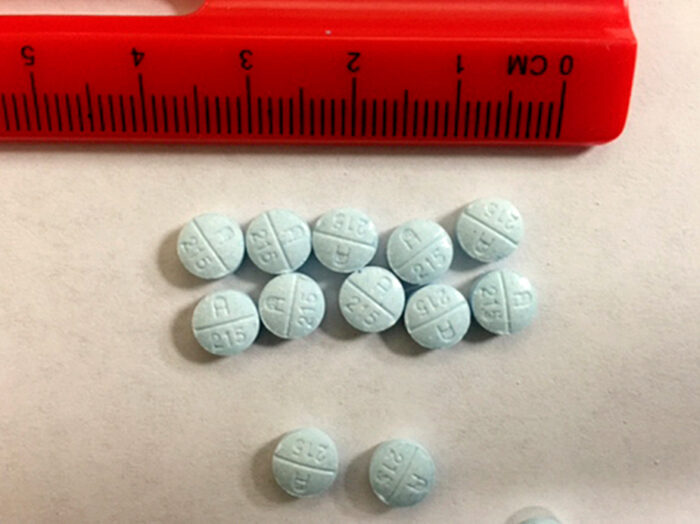
A federal whistleblower claims millions of illegal fentanyl pills made their way into the U.S. and West Virginia while federal drug officials watched to build evidence in higher profile cases. Tommy Farmer/Tennessee Bureau of Investigation/AP
Listen
Share this Article
A West Virginia attorney is representing a Drug Enforcement Administration (DEA) whistleblower who says the agency allowed millions of illegal fentanyl doses into the country. And likely West Virginia.
Del. Tristan Leavitt, R-Kanawha, is the president of Empower Oversight. He describes it as legal aid for whistleblowers in the federal government.
His client, DEA Special Agent David Howell, revealed that the DEA allowed the Sinaloa Cartel to bring millions of doses of lethal fentanyl into the country in 2023 and 2024, mostly across the border into New Mexico. Those pills then headed east.
Howell says the agency let it happen as part of an operation to get the cartel leaders. This was at the direction of the New Mexico U.S. Attorney.
News Director Eric Douglas sat down with Leavitt to discuss the case.
Both of West Virginia’s U.S. attorneys were asked for comment but neither would say whether they would approve this type of investigation. U.S. Attorney Matt Harvey’s office noted that President Trump has designated illicit fentanyl a weapon of mass destruction.
Additional audio from the interview with Tristan Leavitt
This interview has been lightly edited for clarity.
Douglas: Explain to me what you do for a living. What’s your day job?
Leavitt: So I run a nonprofit. I’m the president of Empower Oversight, and we are basically like a legal aid for whistleblowers in the federal government.
Douglas: Is there that much call for that kind of thing?
Leavitt: There’s not necessarily a ton, but from my years of doing congressional investigations, sometimes it was discouraging to see that some of the whistleblowers who had come forward would not have legal counsel, and we were always in need of people to help fill that role.
It wasn’t our responsibility as congressional staff, and you certainly can’t provide them with legal counsel. But we would always be telling whistleblowers, “Hey, you really should consider getting legal counsel. You know, people can get jammed up with their agencies if you ever get into issues of classified information or other things, which Congress is able to receive, but there are real restrictions around it.”
Now that I run Empower and the taxpayer privacy laws are very strict, as they should be, and so there’s just a lot of legal guidance that is important for those who are within the executive branch who want to provide information to Congress, and our kind of additional filter as a nonprofit of folks who worked for Congress previously is knowing what types of things congressional committees might actually be interested in.
Both Empower’s founder Jason Foster and I had worked for Senator Chuck Grassley, who is considered to be kind of the godfather of modern whistleblower protections, and so conducting a lot of different investigations. But then I went from there, and after the House Oversight Committee, I helped to lead the two main agencies in the federal government that work to protect federal employee whistleblowers.
Douglas: You’re representing a whistleblower who’s a former DEA agent. Is that my understanding?
Leavitt: He’s still in the DEA. And he actually came to us specifically because we had investigated Operation Fast and Furious 15 years ago. He saw the clear parallels here. That was an ATF investigation involving the trafficking of firearms by the Sinaloa cartel. This is a DEA investigation involving the trafficking of fentanyl by the Sinaloa cartel.
In both cases, they had federal wiretaps, and in both cases, there was a novel strategy that was employed, saying, “Hey, we know these are very dangerous, but we’re going to try and catch the bigger fish. We want to make the big case, and we don’t want to burn our wire. But because of that, we’re just going to sit by and watch.”
And it wasn’t just that they had general awareness that this stuff was flowing. In both cases, because of their wiretaps, they knew when and where, and often how much, and they were often there on surveillance, watching it get moved from one vehicle to another, knowing that this was happening, but in both cases sitting back and allowing it to happen.
Douglas: Give me a scale. I mean, a couple thousand pills, a couple tons?
Leavitt: I’ll answer that if I can in two portions. One, Special Agent David Howell, our whistleblower client, first became aware of these tactics on cases that were involving in the thousands of pills. So he seized 6,000 fentanyl pills and was chastised by the U.S. Attorney’s office. There is a protocol that was adopted within the Justice Department after Fast and Furious. It said “If you become aware of firearms trafficking, you’ve got to stop it. Can’t just sit back.”
At the beginning of the Trump administration, they developed a similar one for fentanyl, saying, “It’s one thing to watch a load of marijuana or of cocaine, but with fentanyl, it’s deadly enough. You need to stop it. You need to seize it if you see it. If you become aware of where it’s being stored, you need to get a search warrant.”
So, Special Agent Howell was aware of those protocols. When he was chastised for 6,000 pills he quickly said, “Well, this is what we were trained to do. This is in these fentanyl protocols.” And the New Mexico Attorney’s Office said, “No, we want to let it develop, see where this goes.”
And so, in the course of the summer of 2023, he saw more and more. He helped on a different agent’s case where they saw 75,000 pills. They said, “No, the U.S. Attorney’s office wants us to just let it go.”
This is all in Albuquerque, New Mexico. So for him personally, he’s on these cases that are over 100,000 pills. After he blows the whistle, that kind of creates a whole challenge of its own within the DEA and the Justice Department. Ultimately, there is a larger case, and when this story broke, an AP reporter helped to uncover a second whistleblower within the DEA who said, “We became aware in the summer of 2024 of someone who was moving 3 million pills a month, and we didn’t stop it.”
And that case, he said, could have been stopped six months earlier than it was. It ultimately was taken down at the beginning of the Trump administration. So May of 2025, the DEA touts that it’s the largest seizure of fentanyl pills in their history -- 3 million pills in Albuquerque -- and again, the second whistleblower is saying over six months that amount was moving every single month, and we just sat by and didn’t stop it.
Douglas: They’re touting 3 million pills, but they saw 18 million pills go out the door, and they didn’t do anything about it?
Leavitt: Potentially, yes. I mean, again, I don’t represent that second whistleblower, but these are the amounts that they were aware of on the wiretap. And one thing that I think is really significant for the public to understand is that this is not just a New Mexico problem.
New Mexico authorities are rightly outraged. The governor held a whole press conference. Their entire congressional delegation, many, many people are calling for accountability, and the attorney general for New Mexico has even opened a criminal investigation into federal law enforcement.
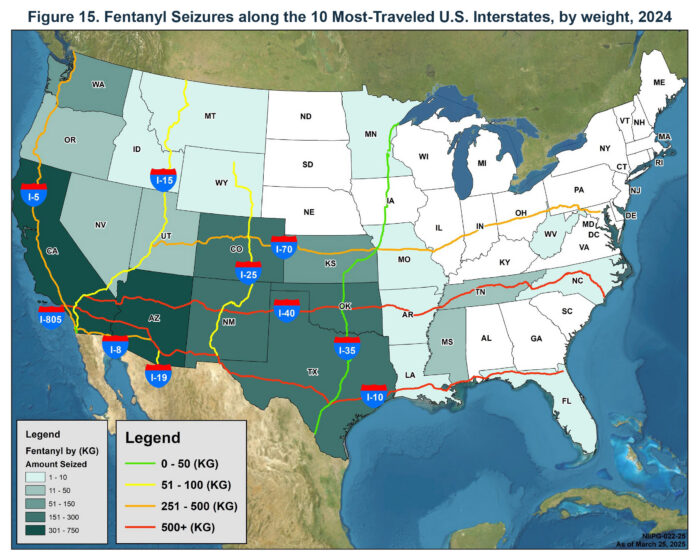
However, Albuquerque is just a gateway. That and El Paso are the two biggest routes for fentanyl to come into the U.S. The vast majority of fentanyl comes through the southern border. None of it’s manufactured here virtually, and so once fentanyl gets up to those corridors, those interstates going east and west, it gets all over the country.
Photo Credit: 2025 National Drug Threat Assessment.Full document.
So here in West Virginia, where in 2023 we had the highest number of opioid overdoses, and they break those numbers out to show that we have the largest number of fentanyl overdoses that year as well. 2024 again, the highest in the nation on opioid overdoses. They haven’t broken out the fentanyl numbers yet.
Douglas: There’s a real possibility that West Virginia was one of the consumers of this fentanyl that was being trafficked through New Mexico, that was just ravaging communities. But you don’t have any direct connection?
Leavitt: There’s no way to know. The DEA has been very clear that the fentanyl we see primarily comes from the Sinaloa cartel, and that’s who was working through New Mexico. That’s what these cases were all trafficking and particularly this very large case investigating a man named Heriberto Salazar Amaya, where they had the very largest seizure. That was the Sinaloa cartel. So I mean there are maps that the DEA puts out that show the real kind of flow through the interstates, and they show where the fentanyl is most significant.
West Virginia is an outlier for those that are around us with the amount of fentanyl, but unlike a firearm, it doesn’t have a serial number. There’s no way to trace directly where a specific pill of fentanyl comes from.
Douglas: What’s next for you and this whistleblower? Where does this go?
Leavitt: There are a couple of different things that we are trying to accomplish. First of all, he’s just very happy that the public has been made aware of this for a long time. As he kind of battled internally, he kept saying, “Look, if the public were aware of this, they would not have the same laissez-faire attitude about it that you do. The public would be outraged seeing, again, the human toll this has taken on our communities.” And the U.S. Attorney’s office just did not seem to understand that, to register that at all.
I think there is still more investigating to be done. I also think it’s just important as soon as possible that there will be a change in policy. And I mentioned that at the beginning of the Trump administration they adopted a protocol saying fentanyl is so deadly we’re not going to treat it like other drugs.
At first, when Special Agent Howell blew the whistle in New Mexico, he was continuing to receive from Justice Department headquarters reinforcement of the 2019 guidance, saying, “Hey, it looks like you’ve got a case. You know, you’ve got 6,000 pills. It seems like quite a bit of fentanyl.” Of course, it was magnitudes higher down the line. But asking, you know, are you doing everything you can to seize? And again, he had a real kind of battle with the local U.S. Attorney’s office, who was telling DC headquarters, “Yeah, we’re doing everything we need to.” But then privately was telling him, “Don’t seize. We’re going to make our bigger case. We have discretion here.” But after he came forward and filed a whistleblower complaint with the Office of Special Counsel that I had previously led, the Justice Department headquarters changed their policy to allow discretion to say, “We’re going to let U.S. Attorneys’ offices make this call on their own,” and that’s a policy that we think needs to be reversed.
Both Fast and Furious, and this case, have shown that, again, local U.S. Attorneys who think they’re going to make a big case and a name for themselves doesn’t create good incentives. If they are aware on a wiretap that these kinds of things are happening in the community with these materials that are so deadly, they should be required to do everything that they can to take them down.
It’s not going to be perfect, of course, and the policy acknowledged that. It just said “Do everything that you reasonably can,” but that’s a policy change that I think can and should happen, especially for an administration that has declared fentanyl a weapon of mass destruction. And at the same time, there was no actual change within the DEA in terms of how these cases should be run,
What we don’t have insight into, because I only represent this agent in New Mexico, is how widely this tactic has been used. At first, it seems like New Mexico was a clear outlier. After the Biden administration kind of opened the doors, it’s unclear whether others said, “Oh, we’re allowed to do this. Let’s give it a try,” because of the pretty singular focus on fentanyl from a number of people.
I think that there is not likely to have been a lot of people higher within the DEA that would have thought this was a good idea, or within the Justice Department. So this is likely a policy that they weren’t aware was kind of sitting there still.
But again, at the end of the day, local investigations are driven by local officials. There’s not a Trump-appointed U.S. Attorney in New Mexico. It’s still the first assistant U.S. attorney who was there through all the Biden administration as they were pushing this tactic. It’s the same AUSAs and it’s the same New Mexico DEA leadership that has retaliated against Special Agent Howell for coming forward.
Douglas: What’s going on for your whistleblower now? What is he facing?
Leavitt: After he indicated that he intended to file and did file a whistleblower complaint, they took him off of cases, saying, “We’re going to refuse to bring your cases. We’re not going to charge any of these people, and we’re not going to let you testify.” His supervisors literally told him the U.S. attorney’s office told them, “We’re not going to let him testify” because they’re afraid you might tell the truth about what’s happening in these cases. So that really sidelines your career as a federal agent.
He has been detailing to other agencies. If he can’t run his own cases, he can help do sometimes surveillance and other things. But we are seeking to get him reinstated fully as an agent, and to have the ability to run cases and to testify, because the only thing that he did wrong here was to tell the truth.
The following are two letters Leavitt sent to the DOJ Office of Inspector General regarding this case on Wednesday, July 15.
U.S. Secretary of Education Linda McMahon told media in Cabell County she wants to transition federal education funding to a block grant model and eliminate the U.S. Department of Education completely.
U.S. Sen. Shelley Moore Capito is a co-sponsor of legislation she said would help protect athletes and bring college athletics back to what they were meant to be.
The West Virginia Council for Community and Technical College Education has secured a $15 million federal Educational Opportunity Centers grant, according to a press release from Gov. Patrick Morrisey.