


Room With A View?
Steel stairs lead to the top of the Red Oak Fire Tower where there's a 14-foot square cabin with panoramic windows and a metal catwalk. There's electricity, but no water.
Continue Reading Take Me to More NewsAlert (09/29/2026): Our Parkersburg TV transmitter is still undergoing maintenance and remains temporarily inoperative. We apologize for the inconvenience.
All our programming is available via our TV livestreams on our website and WVPB Passport. Thank you for your patience!




To Educate, Inform, and Inspire by Telling West Virginia's Story

Mountain Readers Week will be held Oct. 5-9, 2026! Celebrate and foster a love of reading in children across West Virginia.

Nominate an exceptional West Virginia K-12 teacher today!

On Demand

On Demand

Stream original productions from WVPB

Watch locally produced documentaries & more.

On Demand

On Demand






West Virginia Morning

Inside Appalachia

West Virginia Week

Mountain Stage

Us & Them

The Legislature Today

The Legislature This Week

Send us your comments and questions.

Stream our board meetings.

Check out the latest WVPB news.

Sign up for our newsletter and get weekly updates.

Meet the WVPB staff.

WV Educational Broadcasting Commission, the WVPB Foundation, and the Friends of WVPB.

Come work with us!

Read our annual report and learn how we educate, inform and inspire with your support.

Sponsor impactful and engaging media and entertainment.

Use your IRA to make a gift to WVPB.

Become a member with your gift of $1,000 or more.

Make WVPB part of your legacy.

Manage your membership account.

Learn how you can Protect and Sustain West Virginia Public Broadcasting.
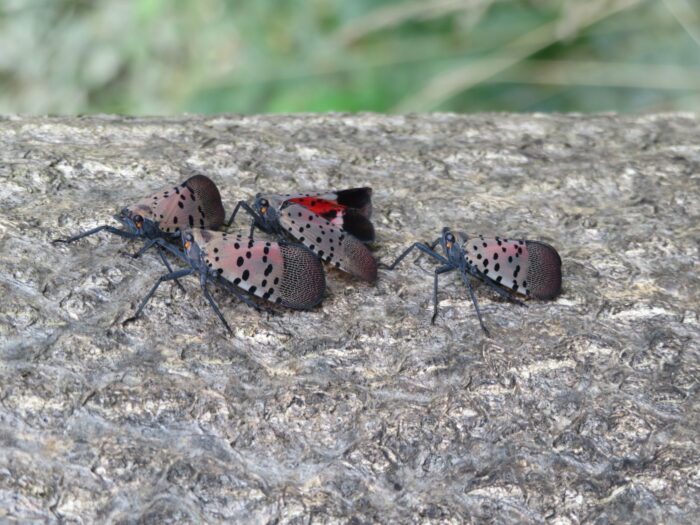
There are many insects that threaten West Virginia’s agriculture and bother us when we’re trying to enjoy time outdoors. But with its distinctive Dalmatian pattern and splash of red, the spotted lanternfly stands out for its ability to threaten dozens of plants, commercial and domestic.
Chris Schulz spoke with WVU Extension entomologist Carlos Quesada to learn more about the insect and how to stop its spread. It’s a prescient issue, as the state Department of Agriculture announced Tuesday that Kanawha County has been added to the list of West Virginia counties where spotted lanternflies have been detected.
This interview has been lightly edited for clarity.
Schulz: What is a spotted lanternfly? It’s not a moth, right? I know what a fly is, but a lanternfly? So what is a spotted lanternfly?
Quesada: Well, thank you for clarifying that. So that is basically a common name that whoever chose it probably was not an entomologist because you are right. It’s not a fly; it is a Hemiptera.
Just to be a little broader, spotted lanternfly is an invasive species that was accidentally brought from Asia. It was first detected in Pennsylvania and then in West Virginia. It was first detected in 2019. Since then, we have detected these insects in 20 different counties in West Virginia. This is an invasive pest that belongs to the order Hemiptera.
Something that is very unique about this order is that they have a sucking mouth part. So that sucking mouth part, just imagine something like a straw, they introduce their mouth part into the plant tissue, and they suck that fluid in the plants.
Schulz: What is it about the spotted lanternfly that makes it a pest? How is it impacting us in West Virginia to make it an undesirable insect?
Quesada: This insect is considered a pest because it can reduce a plant’s health or can in some cases kill a plant. So, this insect can actually feed on over 70 species of plants, and some of the plants can be important crops in West Virginia, such as hops, stone fruit trees, grapes are very susceptible to these insects. We have seen a lot of grape fields just killed by these insects, but it can also attack or feed on important hardwood trees, such as black walnuts or willows, maple trees.
When this insect attacks these trees it can create die-back, or it can reduce the growth of those trees, or in some cases can kill it. That affects it directly. Indirectly, this insect also produces honeydew. So honeydew is an insect product that is very rich in sugar and which attracts wasps, such as European hornet, or yellow jackets. Homeowners don’t like those types of wasps, nobody wants those wasps very close to their patio, especially if you are hanging out outside.
Another way that these insects attack plants indirectly is the honeydew I mentioned that they produce a fungus that is called sooty mold. It’s just a black fungus that is created on top of the leaves, this stops a little bit of photosynthesis from the plants. So in that way, if there is no photosynthesis on the plants, then the plants don’t have food, right? And in addition to that, we can have furniture at the bottom of those trees, so that honeydew can get on that furniture, and that fungus I just mentioned can also form on that furniture, and people really hate that. So that’s another way that it can be very inconvenient for homeowners.
Schulz: So, as you say, you know these are obviously impacting people in their gardens, in their outdoor spaces. What can West Virginians do to help reduce or mitigate this invasion?
Quesada: That’s a great question. One of the most important parts to mitigate this invasion is by stopping their spread. I like to give an example: this pest was detected in Pennsylvania, and then it was detected in Indiana, but not in Ohio. Now it’s in Ohio, but it was detected first in Indiana because we, as humans, moved it there. So by stopping their movement, it is a very important service of the community that we can do.
To do that, if you have a spotted lanternfly in your home, and you’re planning to move anything from your patio to another state or another county, you should double check that you’re not bringing these insects. And when I say that insect, it can be eggs, nymphs or adult stage. That being said, these insects can lay eggs on any flat surface. We have seen eggs on rocks. We have seen eggs on tires. We have seen eggs on poles. We have seen eggs on the trees, so anything that is on your patio can have eggs. Another thing is if you don’t have them in your house, but you go to a part of the town where you have them, and you park under a tree or in the parking lot where you can see them, you should close your windows and make sure that you’re not moving this insect from one place to another. That is just stopping the spread.
Now, if you have them in your garden and you don’t like them, you have basically two options, non-chemical and chemical. So the non-chemical could be things like just smash them, right? Another non-chemical could be a trap. There are two type of traps. Spotted lanternfly have a behavior that they like to go up and down on the tree, and that specific behavior is used to trap them. One is by sticky bands, and another way is by placing a trap that is called a spotted lanternfly circle trap. We recommend spotted lanternfly circle traps because it does not affect other organisms. So whereas the sticky bands unfortunately can also trap not only other insects, but also other small animals. So that is the non-chemical option.
The chemical options you can apply an insecticide to your plants, or you can hire your landscaping group to apply a pesticide on your garden.
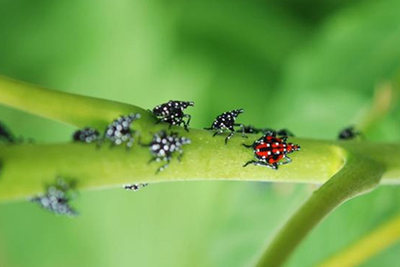
Schulz: How can we identify a spotted lanternfly. I know that they are coming into maturity right now, but there are some other phases of life that look different from where they get their name. So how would somebody be able to identify a spotted lanternfly, both fully mature and also potentially as a nymph, for example?
Quesada: These insects have an incomplete metamorphosis. That means that they have egg, nymph, and adult stages. So the nymph stage is divided into four different instars (growth stages). So the first, second, and third instars are black with white spots. The fourth instar just before they become adults, is red and has some white dots. And then as an adult they have wings that have black spots, and on the wings they have red, black, and white.
That is also another thing about this insect is it has a good size as an adult, so it’s about an inch, and although it’s very fast when they want to be, usually they will land onto your body, and they don’t get scared very easily. So they can be on your body for a long time, but then after that, they will jump or fly very quickly. But they can stay on you for a long time. So it’s very easy for you to see the insects.
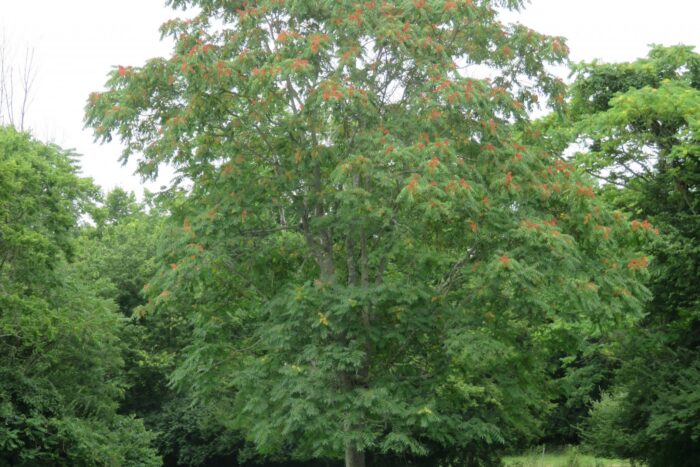
Schulz: Another thing I wanted to ask you about was the relationship between spotted lanternflies and trees of heaven. Another invasive species. Is that something that landowners in particular should be looking for, is tree management to achieve spotted lanternfly management?
Quesada: So, a Tree of Heaven is actually an invasive tree that was introduced a long time ago, now it’s in many different states here in U.S. They both are originally from Asia, and these insects prefer to feed on Tree of Heaven when possible. One of the best management techniques that the government or the Department of Agriculture is doing to manage this lanternfly is that, because they prefer to feed on these trees, then they cut most of the tree among a specific area, and then they apply insecticide to that tree. Once spotted lanternfly are adults, if they see or if they smell this tree close by, they will prefer to feed on that tree over other trees. So, at the end, if this tree has been applied with insecticide, then they will die when they come and feed on that tree.
As a homeowner, what you can do is just try to remove those trees, one because they are invasive and two because there is some research that has shown that these insects can easily complete their life cycle on other trees or plants. However, if they are feeding on Tree of Heaven, they may have a better reproduction, or they may have a better survival. So that’s that reason we recommend to remove that Tree of Heaven.
Add WVPB as a preferred source on Google to see more from our team

This week, a new memoir explores the struggle to stay in Appalachia and the struggle to leave. Also, an exhibit in Kings Mountain, North Carolina, documents the contributions of the Catawba Nation to the American Revolutionary War. And, grab some sunscreen as we make a visit to the Nelsonville Music Festival in Ohio.
Continue Reading Take Me to More NewsThere are many insects that threaten West Virginia's agriculture and bother us when we're trying to enjoy time outdoors. But with its distinctive Dalmatian pattern and splash of red, the spotted lanternfly stands out for its ability to threaten dozens of plants, commercial and domestic. We hear from WVU Extension entomologist Carlos Quesada to learn more about the insect and how to stop its spread.
Continue Reading Take Me to More NewsThroughout the Southern United States, you’ll often find three-pronged leaves with hairy vines swallowing entire sections of forests. It can be a beautiful sight at first glance. But the invasive plant causes persistent ecological problems in the region. We look at the efforts to tackle the ‘vine that ate the south.’
Continue Reading Take Me to More NewsMillions of pumpkins are used as decorations each year, and keeping them out of landfills can help stop the creation of tons of greenhouse gasses.
Continue Reading Take Me to More News