On this week’s encore broadcast of Mountain Stage, CBS Sunday Morning correspondent Conor Knighton joins us as guest host to welcome The Baseball Project, The Minus 5, Bob Mould, Chris Stamey, and Loose Cattle.
Flu cases in West Virginia are lower than those in surrounding states, but starting to tick up as the airborne respiratory illness spreads to more rural communities. Public Domain Pictures
Listen
Share this Article
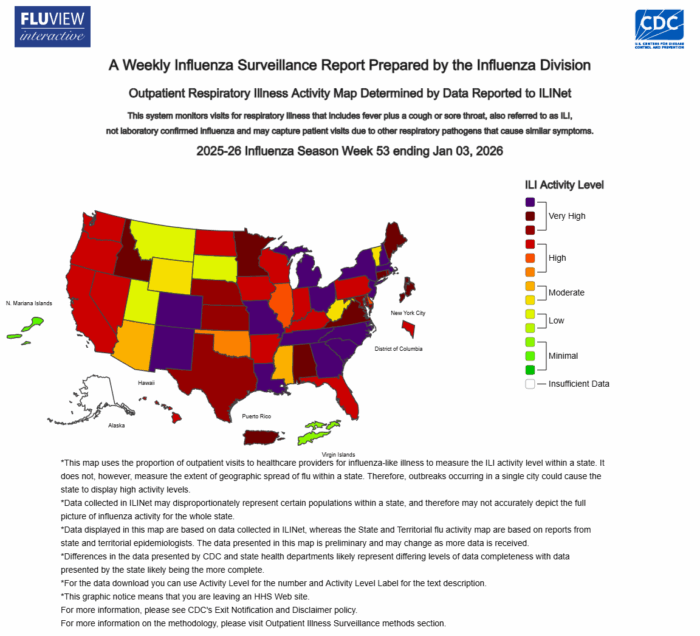
If you look at the Centers for Disease Control and Prevention’s most recent color-coded map of influenza cases nationwide, West Virginia looks like an island of bright yellow surrounded by states colored in dark red and blue – indicating all the states near this one are in the throes of a high or very high outbreak.
It’s part of the largest flu outbreak the nation has seen in 25 years.
So far, West Virginia is only showing a low-to-moderate number of cases.
To get to another state with similar numbers you’d have to drive 800 miles to Vermont – another rural state that currently has low infection rates.
Unfortunately those numbers are not likely to last, Dr. Steven Eshenaur, public health officer for the Kanawha-Charleston Health Department, said.
“Because of our rural nature, you don’t have as many people in a concentrated area, so it’s a little slower to ramp up with people living farther apart and not necessarily in a lot of tight places, the way it is in larger cities,” Eshenaur said.
So contagious respiratory diseases – like the flu – may take longer to spread to West Virginia. But it does tend to get here, eventually.
“Traditionally, if we see a spike of flu in the country about a week or two later, we’ll start to experience that rise as well. And we’ve actually started to notice that now in Kanawha County, we now have a flu and covid outbreak,” he said.
Doctors in the Parkersburg area report a similar uptick there in recent days. “We see all three of the major viral illnesses, flu, Covid, RSV, we see all those this time of year, especially after the holidays, when everybody gets together, but the flu is really the predominant element we’re seeing now,” said Dr. Kane Maiers, associate medical director of UPMC-GoHealth Urgent Care.
The issue, Maiers said, isn’t the cold, damp weather. It’s the proximity to other people.
“Viruses love to spread person to person. They love it when people congregate and when people are in close proximity to one another,” Maiers said.
“And if you think about it, in the wintertime, whenever it’s colder, what do we do? We’re indoors more. We’re doing more indoor activities. We’re spending more time inside our houses with other people. We get together during the holidays.” he said.
Last week, just as the flu was ramping up nationwide, the CDC removed the flu shot and several others from its list of recommended childhood vaccines – something Eshenaur said doesn’t seem to make a lot of sense.
“We find that very strange, especially the timing. We’re at a time when we are seeing the most flu that we’ve seen in 25 years,” Eshenaur said.
Both doctors recommend the vaccine for most patients, unless there are contraindications that should be discussed with their primary care physicians. Maeirs said some patients are especially vulnerable to the flu.
“Folks that are very young, the very old, pregnant women, people with coexisting health problems like heart disease, asthma, they are all more likely to have severe complications from the flu,” he said.
“So if they can get the vaccine, they’ll get the most benefit from it.”
Other ways to protect yourself include standard steps like avoiding big crowds and watching for symptoms in those you’re closest to.
“If you’re going to be around sick people, you may want a mask to help protect yourself, because flu can be spread through airborne. You will want to use hand sanitizer – that’s really important to help prevent transmission,” Eshenaur said.
Patients can still be contagious, even after 48 hours. But if your fever’s gone and your symptoms are improving, chances are, it’s okay for you to be out and about without risking spreading the disease. However, if your symptoms worsen, there are some signs that you should not ignore.
“Alarming symptoms are any fever that does not come down when you take medicine, like Tylenol or ibuprofen,” said Maiers.
“So you take the medicine and the fever persists. If you’re having shortness of breath, if you have difficulty breathing when you lie down, if you have any chest pain, those would all be reasons to be seen immediately,” he added.
Both doctors said if West Virginians can learn from their surrounding states, practice safe distancing and take other precautions, it’s possible we can avoid the high levels of flu other states are now experiencing.
Add WVPB as a preferred source on Google to see more from our team
Much of West Virginia remains under a flood watch through 8 a.m. Sunday. The National Weather Service predicts multiple thunderstorms, some of them severe, across the state.
Many West Virginians have trouble with their teeth. In fact, there’s a big gap between the folks who can reliably access an affordable dentist and those who can’t.
That’s no surprise when ha...