Each year, the West Virginia Legislature passes bills to align definitions and rules in state tax code with federal rules. This year’s bills brought the state up to tax changes passed on the One Big Beautiful Bill (HR 1), passed by the U.S. Congress last summer.
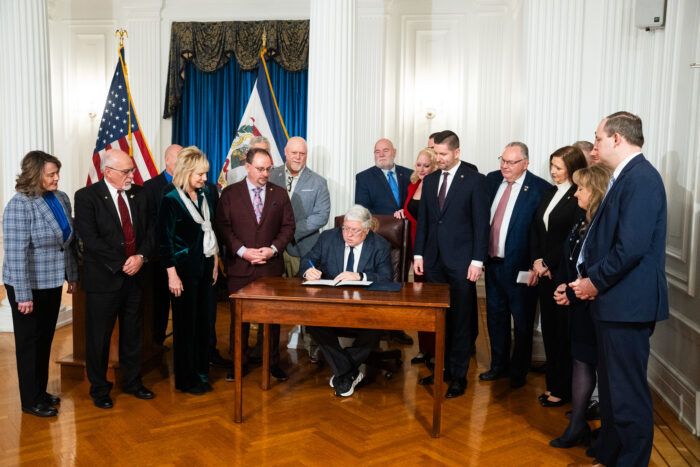
Gov. Patrick Morrisey signed Senate Bills 393 and 400 in a ceremony in the governor’s office.
“Today we take the first step in what President Trump was trying to do by conforming West Virginia code to those federal provisions,” Morrisey said. “All of the permanent provisions, maybe with a slight exception or two, are going to be incorporated into West Virginia code.”
Morrisey highlighted the bills for their state tax repercussions. He noted the deduction on charitable giving is now $1,000 for those filing singly and the Child and Dependent Care Credit goes from 35% to 50%.
“You’re going to get the full benefit of federal tax relief without the confusion, the duplication and anything left behind. You want to, when you’re doing your taxes, have similar interpretations as much as you can now for the average West Virginia family,” Morrisey said. “That means when you give to your church, your local food bank – we know how many people gave to that last year, very important – or school fundraiser, you’re now able to deduct up to $1,000 if you file single or $2,000 if you file jointly.”
The conforming bill also enhances the Child and Dependent Care Credit. The 2026 minimum credit increases from 35% to 50% for qualifying expenses, Flexible Spending Account limits for childcare go from $5,000 to $7,500.
The legislation also restores 100% bonus depreciation for new equipment and qualified property. The business interest deduction increases Small Business Investment expenses to $2.5 million, and creates temporary 100% depreciation for new manufacturing facilities built in the United States.
“If you build it here, if you manufacture it here, if you create jobs here, West Virginia’s tax code is going to support you,” Morrisey said.
Morrisey has often said West Virginia needs to change its tax structure to compete with surrounding states.
“Let me say that all states are not following this lead. We know that in Pennsylvania, they opted not to. Other states are opting not to as well,” Morrisey said. “That gives us a competitive advantage. That’s what we’re always looking for. What can we do that’s better than the other states that we touch? When we do that, we’re going to really succeed economically.”