


The Old Louisville Demon Leaper’s Mischief In One Of America’s Largest Victorian Neighborhoods
In the late 1800s, tales of a creature that bounds between rooftops emerged in Old Louisville — The Demon Leaper.
Continue Reading Take Me to More NewsAlert (09/29/2026): Our Parkersburg TV transmitter is still undergoing maintenance and remains temporarily inoperative. We apologize for the inconvenience.
All our programming is available via our TV livestreams on our website and WVPB Passport. Thank you for your patience!




To Educate, Inform, and Inspire by Telling West Virginia's Story

Mountain Readers 2026 has concluded! Please fill out our volunteer post-survey.

Nominate an exceptional West Virginia K-12 teacher today!

On Demand

On Demand

Stream original productions from WVPB

Watch locally produced documentaries & more.

On Demand

On Demand




West Virginia Morning

Inside Appalachia
West Virginia Week
Mountain Stage
Us & Them

The Legislature Today
The Legislature This Week

Send us your comments and questions.

Stream our board meetings.

Check out the latest WVPB news.

Sign up for our newsletter and get weekly updates.

Meet the WVPB staff.

WV Educational Broadcasting Commission, the WVPB Foundation, and the Friends of WVPB.

Come work with us!

Read our annual report and learn how we educate, inform and inspire with your support.

Sponsor impactful and engaging media and entertainment.

Use your IRA to make a gift to WVPB.

Become a member with your gift of $1,000 or more.

Make WVPB part of your legacy.

Manage your membership account.

Learn how you can Protect and Sustain West Virginia Public Broadcasting.
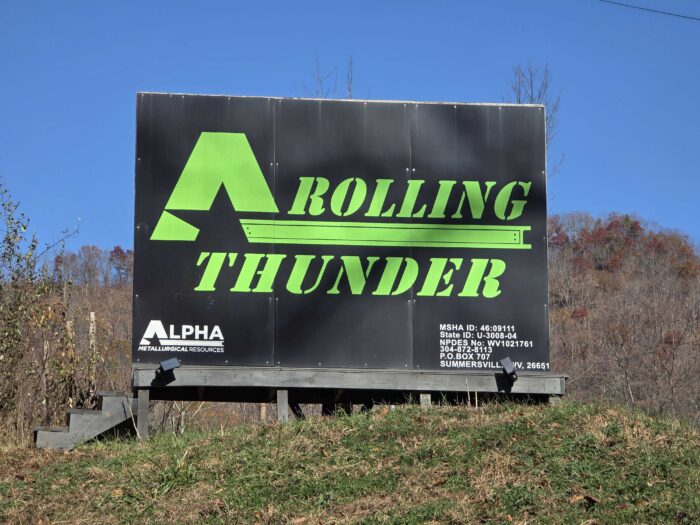
The Mine Safety and Health Administration (MSHA) has released their final report on the mining accident that killed Steven Lipscomb, a 42-year-old section foreman with over 19 years of mining experience, on Nov. 8, 2025. He died in the Rolling Thunder Mine when it filled rapidly with water after miners broke into an adjacent abandoned mine.

There was a five-day search including divers and cavers used to search in zero visibility. Lipscomb was found on Nov. 13, 2025, after the water levels were pumped down.
According to the report from MSHA, the accident occurred because the mine operator did not have an accurate map identifying the adjacent mine. Additionally, the mine operator did not follow the approved alternate drill plan to allow safe development of the active mine.
The mine is operated by Aracoma Coal Company, a subsidiary of Alpha Metallurgical Resources. MSHA completed the last regular inspection at Rolling Thunder in September 2025. A regular inspection was ongoing when the accident occurred, but no MSHA inspectors were on-site at the time.
The Rolling Thunder Mine is located next to the abandoned Mountain State Mine.
The last known map of that mine was produced on Feb. 22, 1945. Investigators determined that the map of the Mountain State Mine was not accurate, saying it was 500 feet away from the mining location. Not having an accurate mine map identifying the boundaries of the abandoned Mountain State Mine contributed to the accident.
Since the Mountain State Mine was developed when mines frequently mined past the boundaries shown on mine maps, MSHA required Rolling Thunder Mine to maintain a 1,000-foot distance from the last known extents of Mountain State Mine. To receive approval for mining inside of the 1,000-foot perimeter, Rolling Thunder Mine submitted an alternate drill plan to MSHA that would allow the mine to drill directional holes in advance of mining to verify the absence of the adjacent mine works.
The mine operator submitted an alternate drill plan that allowed the mine operator to drill three horizontal Abandoned Mine Verification (AMV) directional holes from three locations around the suspected location of the Mountain State Mine. After using the directional holes to verify the absence of Mountain State Mine, the plan allowed the mine operator to continue within the 1,000-foot perimeter while still adhering to the 200-foot No Mining Safety Barrier.
The holes were drilled improperly, penetrating downward into a different coal seam that was not mined in the Mountain State Mine.
Four citations were issued for the mine owner Nicholas-Contura, LLC.
Add WVPB as a preferred source on Google to see more from our team

Secretary of State Kris Warner has announced that 66,855 ballots have been cast across the state in absentee voting and the first four days of early voting.
Continue Reading Take Me to More NewsNearly $1.4 million in funds from the state's Rural Health Transformation Program will be used to help replace a mobile cancer screening unit that serves rural communities.
Continue Reading Take Me to More NewsOn this West Virginia Week, our voter's guide is out, and it has all the information you need to know about the upcoming general election in the state. Also, another lawsuit targets the state's public school funding formula. And, a million dollar giant troll is making its way to the woods of West Virginia.
Continue Reading Take Me to More NewsPeople can drop off medications that are no longer being used at more than 65 National Prescription Drug Take Back Day locations across the state.
Continue Reading Take Me to More News