


'Haunted' Town Already Celebrating Spooky Season
Halloween is still several weeks away, but one West Virginia town is already celebrating the season.
Continue Reading Take Me to More NewsAlert (09/29/2026): Our Parkersburg TV transmitter is still undergoing maintenance and remains temporarily inoperative. We apologize for the inconvenience.
All our programming is available via our TV livestreams on our website and WVPB Passport. Thank you for your patience!




To Educate, Inform, and Inspire by Telling West Virginia's Story

Mountain Readers Week will be held Oct. 5-9, 2026! Celebrate and foster a love of reading in children across West Virginia.

Nominate an exceptional West Virginia K-12 teacher today!

On Demand

On Demand

Stream original productions from WVPB

Watch locally produced documentaries & more.

On Demand

On Demand






West Virginia Morning

Inside Appalachia

West Virginia Week

Mountain Stage

Us & Them

The Legislature Today

The Legislature This Week

Send us your comments and questions.

Stream our board meetings.

Check out the latest WVPB news.

Sign up for our newsletter and get weekly updates.

Meet the WVPB staff.

WV Educational Broadcasting Commission, the WVPB Foundation, and the Friends of WVPB.

Come work with us!

Read our annual report and learn how we educate, inform and inspire with your support.

Sponsor impactful and engaging media and entertainment.

Use your IRA to make a gift to WVPB.

Become a member with your gift of $1,000 or more.

Make WVPB part of your legacy.

Manage your membership account.

Learn how you can Protect and Sustain West Virginia Public Broadcasting.
This story was originally published by WKU, as part of the Appalachia + Mid-South Newsroom‘s Signal Species series.
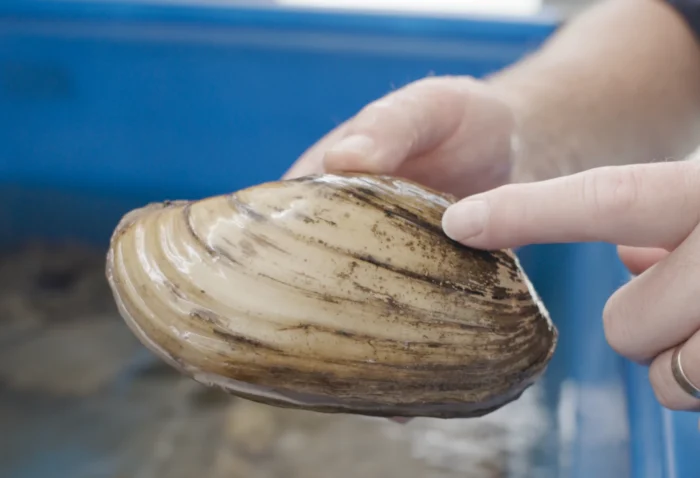
Many people looking to escape the heat in Kentucky and the surrounding region may spend their summer weekends wading through rivers and streams, and they’ll likely swim over numerous freshwater mussels buried in the shallow sand below.
Though small, these mollusks play a critical role in the cleanliness and health of waterways.
“A mile of the Ohio River might have millions of mussels,” said Monte McGregor, director of the Kentucky Department of Fish and Wildlife’s Center for Mollusk Conservation. “They’re filter feeders, and they function in that capacity to clean our waters. So healthy streams need healthy mussels.”
But mussel populations have declined over the years, with about two-thirds of species in North America at risk.
Researchers are investigating the complex causes behind the drop, which some say reflects a larger pattern of land and waterway alterations, habitat damage and pollution.
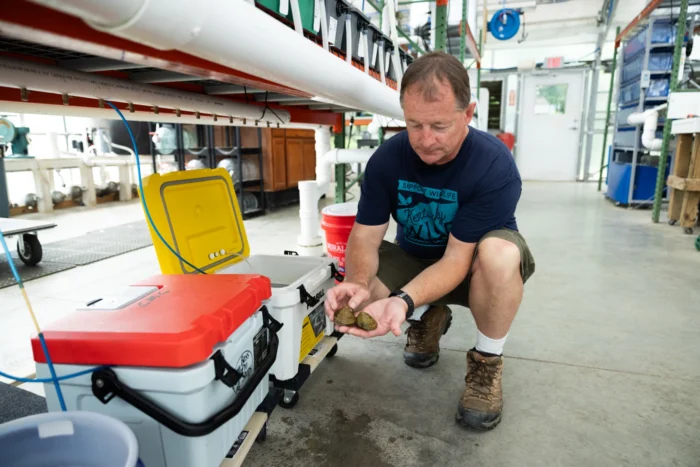
Freshwater mussels constantly pump water in and out of their bodies to eat and breathe. One adult is capable of filtering around 12 gallons of water a day, removing pollutants, sediment and bacteria along the way.
This process — along with serving as food for fish and other animals — makes mussels particularly important to their ecosystems. Their absence could ultimately lead to a chain reaction that has adverse effects on a broader set of wildlife.
That’s why McGregor and his team in Frankfort, along with dozens of other facilities across the region, are working to restore mussels.
“Our goal is to get populations established so they can recruit naturally on their own, instead of continuing to decline at a rate where they won’t come back,” McGregor said. “We think a lot of places have improved enough to support the population.”
North America has about 300 freshwater mussel species, with Kentucky and neighboring states boasting significant biodiversity.
Kentucky and Tennessee are home to more than 100 species, with about 65 species found in West Virginia.
“The best populations of freshwater mussels in the world are right here in the southeastern United States,” McGregor said. “Right here near Western Kentucky University in the Green River, in particular, [there are] 75 species — almost 10% of the world’s species.”
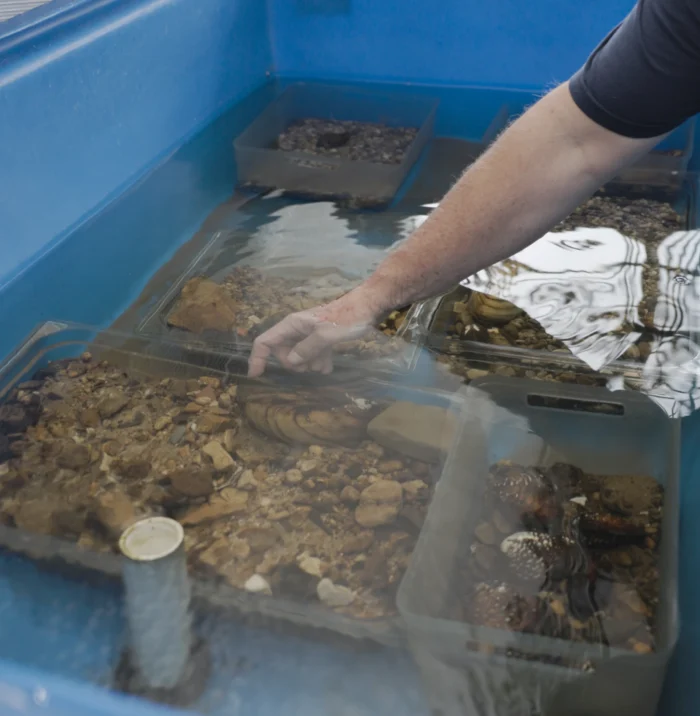
But not all of these mollusks are thriving. In Kentucky, 36 species are considered rare or endangered and about 20 have disappeared entirely.
There’s no easy fix once a species of mussel sees a large decline. McGregor said it can take years to find, breed, grow, redistribute and track populations. He calls the effort “the long game,” and his team prioritizes certain species to target their work.
“Some species, even though they may be endangered, may be OK and thriving in some places, so those are not as critically rare,” he said. “The ones that we’re trying to work with are species like the ring pink, which we’ve been looking for over 20 years and have only found four. And we’ve not found any gravid females at all.”
Without a gravid — meaning pregnant — ring pink, McGregor’s team is unable to produce offspring to help stabilize the wild population.
Another species of particular interest is the cat’s paw, which was thought to be extinct in the 1990s.
“A researcher in Ohio found one population with just a few animals, and it took us five years to find enough females to be able to capture enough to raise them,” McGregor said. “We have released over 15,000 of this species since 2014 at about 16 different sites in four states.”
Environmental factors can deter the reintroduction of mussels to the wild, including human activities that date back more than a century.
Water pollution and toxic spills, including oil products and pesticides, have heavily impacted populations.
“The water quality was bad for a while,” McGregor said. “Maybe it’s improved now over the last 50 years, but the animals are so low and few in numbers that they can’t reproduce. Just think of the probability that if there’s just a few mussels out there and hardly any fish, then the chances of them getting together and completing their life cycle is very low.”
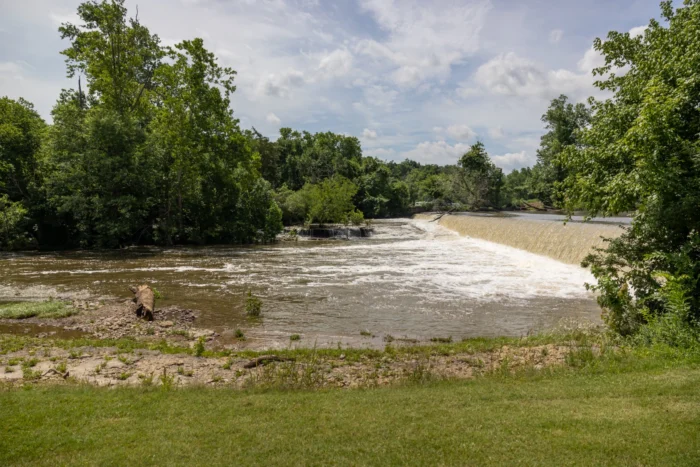
Humans have also disrupted aquatic wildlife by altering waterways and the land around them, including through the construction of dams. These structures can restrict the movement of fish, which play a major role in mussels’ reproduction.
Female mussels use a lure resembling common prey for fish to attract a host, including species like the northern creek chub, largescale stoneroller and the blackspotted topminnow. When a host fish strikes, the mussels shoot out larvae that live on the fish for a few weeks before dropping off elsewhere in the stream when they’re mature enough.
“If that host is eliminated from that waterway, the mussels can’t reproduce effectively, and then you get aging populations with no recruitment,” said Steven Price, a professor of stream and riparian ecology at the University of Kentucky. “So that’s one of the obvious reasons: We modified our waterways, and that has caused the decline of many species.”
The Green River, a major tributary of the Ohio River, is one of the most biologically diverse systems in the world. In recent years, conservation efforts have focused on removing dams from the river to allow fish to migrate freely.
But areas with relatively good water quality and no human modifications are also seeing populations dwindle, leaving researchers to question what hidden factors are at play.
“We’re still noticing many species declining or disappearing from these sites,” Price said. “And the answer to why that’s happening is not super obvious. It’s still a mystery in many ways.”
Price said researchers are attempting to find the “smoking gun” behind population decreases, though the answer is likely more complicated than any single source.
“It would be easy if it was just cut-and-dry,” he said. “But of course, we’re doing science in the field, in our streams and rivers. And when you’re an ecologist, you know that oftentimes there just isn’t one answer.”
Rather, it could be a combination of reasons, including invasive species like the Corbicula.
If they start to densely populate new ecosystems, they can outcompete native species like mussels.
“We see, especially in some of our warmer waters, that Corbicula influences recruitment and the food resources available for our native species to persist,” Price said. “But that’s just one of many potential factors that could be responsible for their decline.”
Researchers like Price and McGregor with Kentucky Fish and Wildlife hope to fill in gaps in knowledge over the next several years, and in doing so, better preserve native ecosystems across the country.
“I don’t think we ever want to lose an animal to extinction,” McGregor said. “If we can step in and prevent that from happening, then we might not realize the benefit of it now, but maybe there’s something that later on we will learn from mussels.”
This story is part of our Signal Species series exploring how the region’s flora and fauna are adapting to a changing climate. It was produced by the Appalachia + Mid-South Newsroom, a collaboration between West Virginia Public Broadcasting, WPLN and WUOT in Tennessee, LPM, WEKU, WKMS and WKU Public Radio in Kentucky, and NPR. Sign up for the weekly Porch Light newsletter here for news from around the region.
Add WVPB as a preferred source on Google to see more from our team

The Public Service Commission of West Virginia wants to ensure that if discontinuation of the current landline system is approved, an adequate service will be continue to be available to both new and existing customers.
Continue Reading Take Me to More NewsDirect-to-consumer tests like full-body scans are marketed as a way to catch diseases early and establish a baseline. But there are financial, physical and psychological risks to all medical tests — and in some cases, not getting a test could be better for your health. From the Appalachia + Mid-South Newsroom, HealthQ hosts Cara Anthony and Blake Farmer speak with UCSF Cardiologist Dr. Rita Redberg.
Continue Reading Take Me to More NewsMany of the devices we use in our daily lives run on rechargeable lithium-ion batteries. Be aware that damaged or incorrectly charged batteries can overheat, start a fire, or even explode.
Continue Reading Take Me to More NewsMany cryptids are said to lurk in the shadows of Appalachia, including West Virginia’s Flatwoods Monster.
Continue Reading Take Me to More News