


Fourth Annual Women Warriors Summit To Feature High Profile Speakers
The fourth annual Women Warriors Summit will take place at the Marshall Health Network Arena in Huntington on Friday, Oct. 23, 2026.
Continue Reading Take Me to More NewsAlert (09/29/2026): Our Parkersburg TV transmitter is still undergoing maintenance and remains temporarily inoperative. We apologize for the inconvenience.
All our programming is available via our TV livestreams on our website and WVPB Passport. Thank you for your patience!




To Educate, Inform, and Inspire by Telling West Virginia's Story

Mountain Readers 2026 has concluded! Please fill out our volunteer post-survey.
Nominate an exceptional West Virginia K-12 teacher today!

On Demand

On Demand

Stream original productions from WVPB

Watch locally produced documentaries & more.

On Demand

On Demand






West Virginia Morning

Inside Appalachia

West Virginia Week

Mountain Stage

Us & Them

The Legislature Today

The Legislature This Week

Send us your comments and questions.

Stream our board meetings.

Check out the latest WVPB news.

Sign up for our newsletter and get weekly updates.

Meet the WVPB staff.

WV Educational Broadcasting Commission, the WVPB Foundation, and the Friends of WVPB.

Come work with us!

Read our annual report and learn how we educate, inform and inspire with your support.

Sponsor impactful and engaging media and entertainment.

Use your IRA to make a gift to WVPB.

Become a member with your gift of $1,000 or more.

Make WVPB part of your legacy.

Manage your membership account.

Learn how you can Protect and Sustain West Virginia Public Broadcasting.
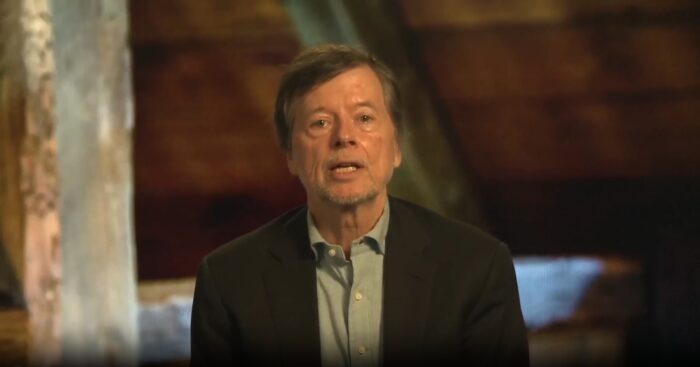
In a video released Friday morning, Ken Burns said he was “gravely worried” about the 260-mile power line “that’s going to plow through much of West Virginia, including historic Jefferson County and the lower Shenandoah Valley.”
He added that data center power line fights are being waged all across America but there’s no more important fight than Valley Link.
“Every step along the proposed power line is sacred ground. If Valley Link is allowed to go forward, it will damage our history in ways that can never be undone,” Burns said. “To desecrate this land and destroy countless farms and homes by building a massive 765 kilovolt power line is unthinkable, particularly in the year when we commemorate our 250th anniversary as a nation.”
The Valley North project, first proposed by regional energy grid manager PJM, would construct 200 miles of power transmission lines through central West Virginia connecting the John E. Amos Power Plant to substations in Maryland. Developer Valley Link is a joint venture of Transource, Dominion Energy and FirstEnergy Transmission.
Burns, known for his expansive documentaries on topics ranging from jazz music to baseball and most recently the American Revolution, expressed his love for Jefferson County and the Shenandoah Valley, calling the region the center of our shared national history.
Shepherdstown is recognized as a founding location for the U.S. Army when the The Beeline March departed from there in 1775, and George Washington was a prominent landowner in the county and a frequent visitor. Charles Town is named for his brother, and nearly 80 members of the Washington family are buried in the Zion Episcopal Church Cemetery. The county is also home to 25 Civil War battlefields and the arsenal in Harpers Ferry was the target of John Brown’s raid.
“Soldiers from Shepherdstown were among the first to join George Washington in the Revolution. Civil War battles were fought here,” he said. “I’m proud to be on the side of farmers and history lovers, and I’m urging you to add your voice to this important and urgent cause. Say no to Valley Link.”
“Say No To Valley Link” is the name of the organization that put out the video. Organizer Dan McGinn calls it a grassroots movement of neighbors, farmers and citizens outraged by a transmission line he said will only benefit data centers in Loudon County, Virginia.
“It is one of the wealthiest counties in the country. Why would you ask average West Virginians to pay for their data centers? Why aren’t they building a power plant in Virginia?” McGinn said. “Build your own power plant, bulldoze your own farms and pay your own bills.”
McGinn said he believes the Valley North proposal has made several errors and he and his neighbors aren’t interested in paying the $650 million in utility increases the project is estimated to incur.
“It doesn’t make economic sense, the layout doesn’t make sense,” he said. “At the very least, they need to go back to the drawing board.”
Add WVPB as a preferred source on Google to see more from our team

The West Virginia Mine Wars Museum is getting a sizable donation from retired union leader Cecil Roberts.
Continue Reading Take Me to More NewsKentucky regulators have given Kentucky Power the go-ahead to build a new cooling tower at its Mitchell coal plant in West Virginia.
Continue Reading Take Me to More NewsAs people take a greater number of medications across years or decades, experts say the risk for adverse drug interactions increases. One way to advocate for yourself? Keep a list of your meds handy. We listen to the latest story from health series, HealthQ, a collaboration between Nashville Public Radio and KFF Health News, with reporters Cara Anthony and Blake Farmer.
Continue Reading Take Me to More NewsThe Public Service Commission of West Virginia (PSC) has filed draft rules for supplying energy to data centers. One expert says this version is much better than the first draft.
Continue Reading Take Me to More News