Alert (09/29/2026): Our Parkersburg TV transmitter is still undergoing maintenance and remains temporarily inoperative. We apologize for the inconvenience.
All our programming is available via our TV livestreams on our website and WVPB Passport. Thank you for your patience!
Our premiere fall broadcast season of Mountain Stage continues this week when host Kathy Mattea welcomes Tony Trischka’s EarlJam featuring Michael Daves, Buffalo Wabs & The Price Hill Hustle, Jack Barksdale, and Sarah Borges.
Bird Friendly Windows, Lighting Can Make Migration Safer, Say Conservationists
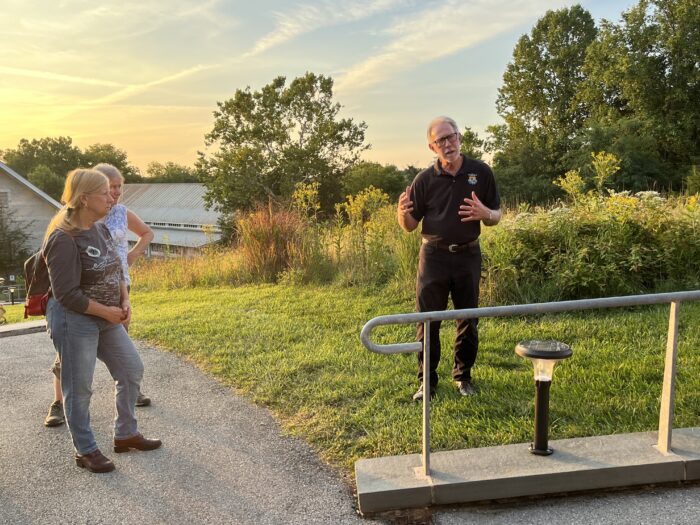
Randy Robinson, an outreach coordinator at the National Conservation Training Center in Shepherdstown, shows off bird-friendly outdoor lighting that has been installed at the facility.
Jack Walker/West Virginia Public Broadcasting
Listen
Share this Article
As the sun set Thursday, an estimated 218 million birds across the continental United States began a journey southward.
Many people are familiar with migration, a process by which birds and other animal species ward off the winter by traveling toward food and warmth. But fewer people know that many birds never reach their destination.
“We’ve lost a lot of birds in our lifetimes,” said Joelle Gehring, a biologist with the U.S. Fish and Wildlife Service who studies bird migration. Gehring visited her agency’s National Conservation Training Center in Shepherdstown for a talk on bird conservation Thursday evening.
In 2019, the Cornell Lab of Ornithology found that the U.S. and Canada bird population has declined by roughly 3 billion since 1970, a loss of about 30 percent. In large part, Gehring said, the culprit is human development.
Many bird species are drawn to light, which means bright urban areas can steer them off their migratory course. Plus, more homes and buildings built across the country bring more sites for deadly collisions — especially from windows and glass, which birds generally do not recognize as a barrier.
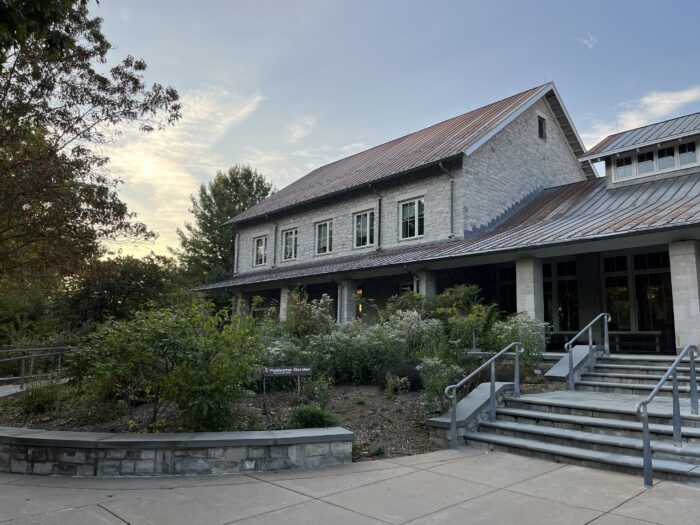
The upper level of this building at the National Conservation Training Center in Shepherdstown has window coverings that appear opaque from the outside but translucent from the inside.
Photo Credit: Jack Walker/West Virginia Public Broadcasting
Covering windows and glass
Gehring said a common misconception is that tall buildings with lots of glass, like skyscrapers, cause most bird crashes. In fact, Gehring said more than 99 percent of collisions occur at low-rise buildings, like the numerous residential structures in any given town or city.
“When I first started thinking about this issue, I thought, ‘This is a tall building issue, right? This is (about) the skyscrapers in New York City. This doesn’t really apply to me as a homeowner,’” she said. “But it does. It applies to all of us.”
For starters, Gehring said residents can partially cover windows around their home to make them safer for birds but still usable. This could mean hanging paracord curtains over window frames, which tells birds not to dart straight into them.
If paracord is not aesthetically to taste for some residents, Gehring said there are also stickers that can be applied to windows that appear opaque from the outside but translucent from the inside.
This lets people indoors see through them, and also tells birds a barrier lies ahead — not the garden they see in the window’s reflection.
Or, instead of covering a window entirely, residents can place small, opaque stickers on their windows on a two-inch grid pattern. These stickers tell birds to slow down because they might be unable to fit if they fly straight ahead.
Opaque stickers placed on a window in a two-inch grid pattern tell birds a barrier they might not fit through lies ahead.
Photo Credit: Jack Walker/West Virginia Public Broadcasting
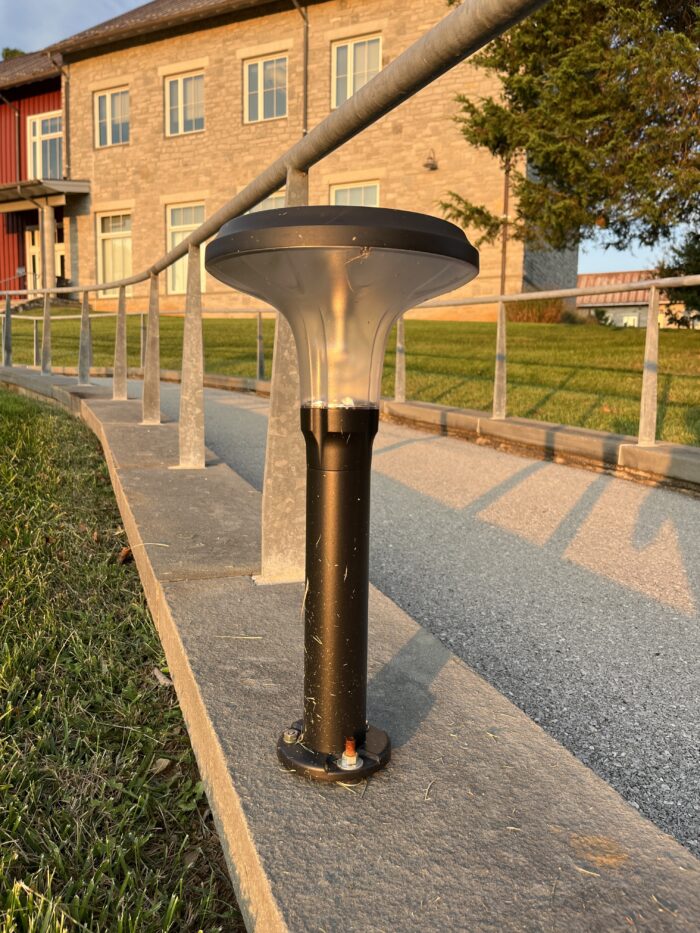
The training center uses short, low-intensity and downward-facing outdoor lighting fixtures to reduce light pollution.
Photo Credit: Jack Walker/West Virginia Public Broadcasting
For some households, modifying window structures may not be necessary at all. Screens placed on the outside of windows already pose a visual barrier that prevents collision.
Regardless of each resident’s approach, Gehring said taking any step toward covering a window, so long as it is done from its outer side, can make a difference in protecting birds. “Treating that glass to reduce bird collisions is incredibly important,” she said.
Reducing light pollution
As for lighting, Gehring said using lower-intensity, yellow-toned bulbs is less disruptive to migration, and causes less light pollution overall. So is using lighting structures that point toward the ground, not into the sky.
Plus, Gehring said residents and communities can consider simply using outdoor lighting less often, which can reduce both energy costs and light pollution.
During Thursday’s event, Randy Robinson, an outreach coordinator who works at the training center in Shepherdstown, showed attendees how these techniques are being used at the local facility.
By the spring, staff at the National Conservation Training Center in Shepherdstown hope to treat all windows on site to ensure bird do not fly into them.
Photo Credit: Jack Walker/West Virginia Public Broadcasting
A growing number of windows now bear stickers or other coverings, and knee-high lights line the center’s many pathways. These low-to-the-ground structures light areas of interest for people walking by without brightening the area too much.
“It’s solar lighting, but it’s aimed at the ground so we don’t have light escaping and causing light pollution,” he said.
Robinson said the training center is currently working to cover all windows across its buildings. The facility began first with its higher-risk areas, like its largest windows, but hopes to use bird-safe infrastructure across the campus to serve as an example to the local community.
“Hopefully by spring, all of these windows are going to be done over the entire surface,” he said. “You’ve got to have it covering everything.”
For more information on how to make buildings and lighting safer for migratory birds, visit the United States Fish and Wildlife Service website.
Add WVPB as a preferred source on Google to see more from our team
Many of the devices we use in our daily lives run on rechargeable lithium-ion batteries. Be aware that damaged or incorrectly charged batteries can overheat, start a fire, or even explode.
During spooky season, popular attention turns toward ghosts and goblins – or if you live in Appalachia – cryptids. For the Appalachia + Mid-South Newsroom, Bill Lynch, producer of Inside Appalachia, brings us the story of the Flatwoods Monster.
A specific style of ballroom dance is helping disenfranchised young people find community in Appalachia. In our latest episode of Inside Appalachia, we explore LGBTQ ballroom culture and community in Roanoke, Virginia. Mason Adams has this excerpt.
The commission established a daily schedule for the testimony of the approximately 74 persons who may appear to testify, including representatives from developer NextEra and private citizens.