Alert (09/29/2026): Our Parkersburg TV transmitter is still undergoing maintenance and remains temporarily inoperative. We apologize for the inconvenience.
All our programming is available via our TV livestreams on our website and WVPB Passport. Thank you for your patience!
This week, Barbara Kingsolver’s new novel takes on issues of class and classical music. Also, kudzu warriors band together to fend off invasive plants and take back the land. And, it’s pawpaw season, but a new bug could be harming the trees.
Diseases like white-nose syndrome and climate change have caused mass population loss among bat species, and the consequences could be costly.
Bats are the subject of many myths and legends, usually portrayed in a negative light. And that’s a problem. The services they perform for their ecosystems and humans are often overlooked, as are the challenges they face from climate change and invasive disease.
To learn more about bat populations, researchers must first find their caves. Even when they live within earshot of a paved road, getting to their front porch takes some work.
Alex Silvis, the endangered species coordinator for the West Virginia Division of Natural Resources, described a location just outside Franklin, West Virginia, as the “easiest” location for a spring bat count.
Easiest is relative, of course, as getting to the cave involved a short hike to the bottom of the mountain, then another roughly 75 yards up an almost vertical hillside.
“Over the span of about an hour and a half, we’re expecting to see around 1,200 bats come out of this cave,” Silvis said.
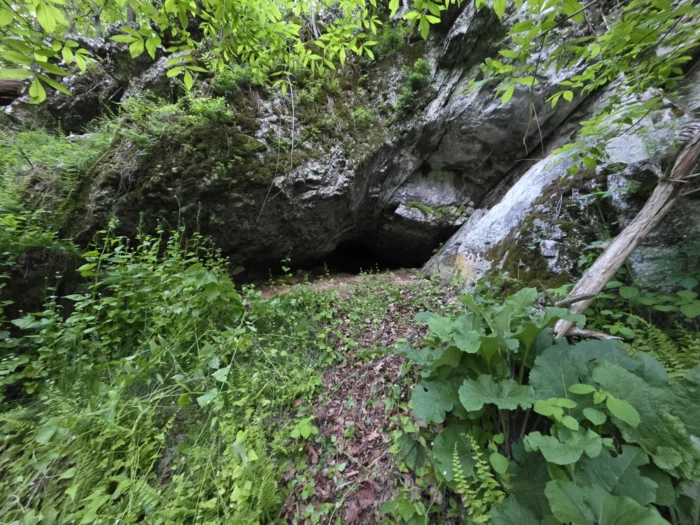
The cave entrance is relatively small, no more than about 7 feet across and 2 feet high. But it hides a space that opens up considerably.
“There is a room in this cave that’s about 800 feet long,” Silvis said. “You wouldn’t know it by the size of this particular entrance, but essentially the whole of the side of this mountain is basically underlain by cave passage.”
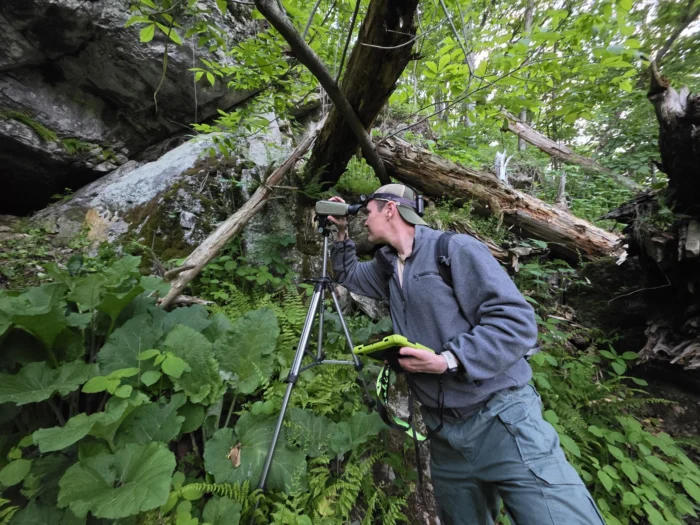
Alex Silvis, the endangered species coordinator for the West Virginia Division of Natural Resources, looks for bats at a cave near the town of Franklin.
Photo Credit: Eric Douglas/West Virginia Public Broadcasting
“One of the big problems facing bats is white-nose syndrome, and that’s now a national and international issue,” Silvis said.
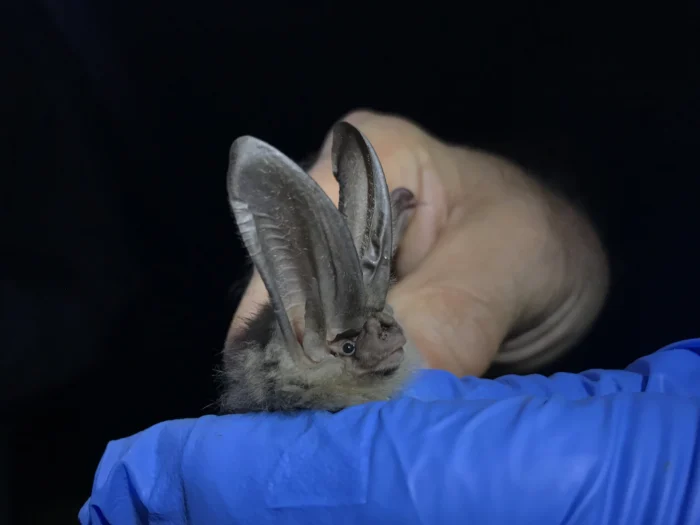
White-nose syndrome was first detected in the United States in 2006, with the fungus that causes the disease originating in Europe and Asia. Though it hasn’t affected Virginia big-eared bats, it’s had devastating effects on other species, killing nearly 6 million bats.
“White-nose syndrome has resulted in the deaths of over 99% of some of our different species of bats, so that’s a huge threat,” Silvis said.
“Humidity and the temperature are both very important for the bat cave,” Silvis said. “They really want specific temperature and humidity ranges, and if you get outside of those, we don’t have the bats.”
The small entrance of a cave that Virginia big-eared bats call home.
Photo Credit: Eric Douglas/West Virginia Public Broadcasting
The Costs Of A Declining Bat Population
Bats provide many benefits most people may not be aware of. And population loss could have major implications for farmers.
“There was a study some years ago that estimated that insect pest control provided by bats, the economic value of that was over $8 billion,” Silvis said. “It is a significant benefit to have bats for just insect control alone.”
John Moredock, the hemp program coordinator for the West Virginia Department of Agriculture, agreed with Silvis, noting that the agriculture industry in West Virginia alone is worth $800 million dollars.
He said bats prey on bugs that damage crops.
“They could eat up to 1,000 moths in an evening, and then each female moth has the capability of laying thousands of eggs,” he said. “Twenty to 50% more agricultural insect pests were found in agricultural fields that had no bats present.”
Those additional pests come at a cost, both in the expense for pesticides and in the loss of crops.
Moredock said a healthy farm starts with water. Preserving water quality is crucial to helping preserve bat populations.
“The reason why a lot of pesticides can be toxic to mammals is because some of those modes of killing the insect … our nerves and bats’ nerves are susceptible to it as well,” he said. “If that’s your food that you’re consuming and it is covered with pesticides, that’s getting into your own system and impacting the health of that bat as well.”
The process becomes a cycle as farmers spray more insecticides at greater cost, which then kill the birds and bats that would naturally eat the crop pests.
“The ecosystem is incredibly linked to one another in very complex ways,” Moredock said. “One small change has big implications across many different areas of an ecosystem, many that are hard to predict. Like the butterfly effect, but maybe it’s better to call it the moth effect.”
Back near Franklin, Silvis said this site is a maternity cave — one of 11 his team monitors each year. Male and female Virginia big-eared bats roost separately. They hadn’t begun to give birth yet, so he could get a solid count on the number of females present.
Silvis set up an infrared camera attached to a tablet. The bats don’t begin leaving the cave until after sunset, making them impossible to see with the naked eye.
For nearly two hours, Silvis counted the bats in batches of five at a time, voicing them into an audio recorder in five-minute increments.
In total,Silvis tallied more than 1,500 bats, up 150 from the same location last year. That’s a good indicator for the health of this particular colony. But challenges from climate change, pesticides and disease will continue putting bats at further risk of population loss in the coming years, and humans stand to lose more without them.
On this West Virginia Week, a mine operation in Kanawha County gets a WARN Notice, three Wyoming County Schools will remain closed until next week, and we learn the origins of the Flatwoods Monster.
One hundred nine miners and operators at the Panther Creek Mine in Eskdale, in southeastern Kanawha County, are slated to lose their jobs just before Christmas.
The Public Service Commission of West Virginia wants to ensure that if discontinuation of the current landline system is approved, an adequate service will be continue to be available to both new and existing customers.