Alert (09/29/2026): Our Parkersburg TV transmitter is still undergoing maintenance and remains temporarily inoperative. We apologize for the inconvenience.
All our programming is available via our TV livestreams on our website and WVPB Passport. Thank you for your patience!
The annual West Virginia Book Festival, a free event for book lovers of all ages, will be held at the Oct. 24 at the at the Charleston Coliseum and Convention Center.
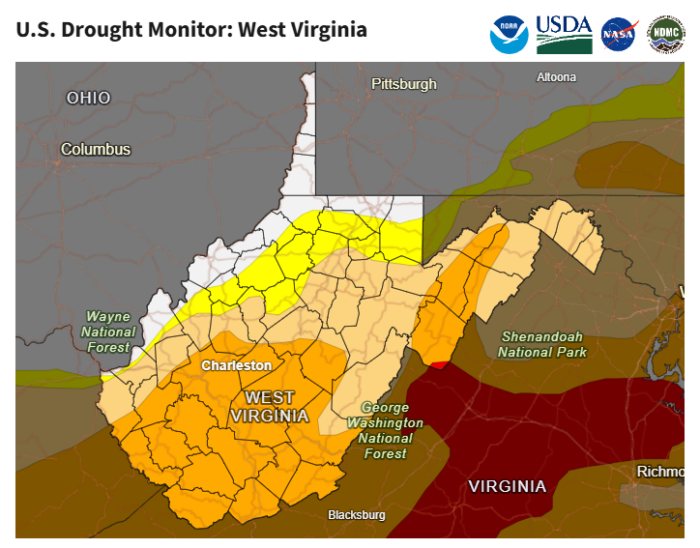
Despite recent rainy weather, most of West Virginia remains under drought or near-drought conditions.U.S. Drought Map
Listen
Share this Article
Despite the recent soggy weather, most of West Virginia remains under drought conditions.
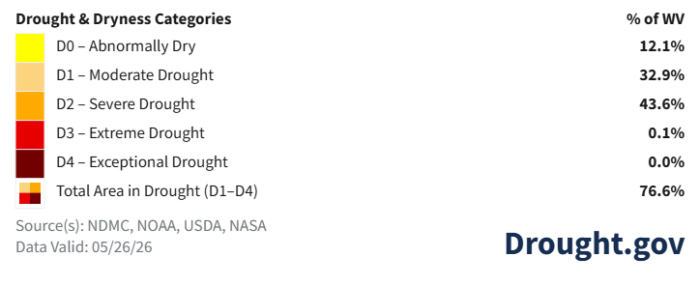
According to the federal U.S. Drought Monitor, 12.1% of the state is abnormally dry, with 32.9% of West Virginia being categorized as under moderate drought conditions and 43.6% under severe drought conditions.
Courtesy U.S. Drought Map
The report is updated each Thursday by a group of federal offices including the National Oceanic and Atmospheric Administration, U.S. Department of Agriculture, National Aeronautics and Space Administration and National Drought Mitigation Center.
The four inches of rain West Virginia has received in May make it the wettest month of the year so far.
But Joe Curtis, a meteorologist for the National Weather Service, says it’s not enough.
“That’s something that we’re going to have to look at, but it is going to help,” he said. “But unfortunately, it doesn’t look like it’s going to be enough to completely erase it.”
Rainfall over the past week has improved conditions in much of the state, with the north central region, the Eastern Panhandle and the southeastern corner improving one drought category. The Ohio River Valley including the Northern Panhandle is the only region of the state to not be under any dryness category.
From January to April, West Virginia has experienced its 10th driest start to the year since official records began in 1895.
Add WVPB as a preferred source on Google to see more from our team
West Virginia Attorney General JB McCuskey has launched a broad investigation into many of the state's leading environmental groups, demanding a decade of internal records involving their fundraising and climate change advocacy as part of a probe into “alleged unfair or deceptive acts."
Silas House is a major voice for Appalachia. The Kentucky native has written more than 15 books and served as the state's poet laureate. His latest book is The Tulip Poplars, a sweeping novel about the lives of four people as they navigate friendship and forbidden love throughout the 20th century. Inside Appalachia's Mason Adams spoke with House.