


Two W.Va. Turkeys To Be Pardoned By Trump
Two white-feathered birds from a Pendleton County, W.Va. farm have been selected for the traditional White House pardon.
Continue Reading Take Me to More News



To Educate, Inform, and Inspire by Telling West Virginia's Story

Mountain Readers 2026 has concluded! Check out our classroom resources.

Nominate an exceptional West Virginia K-12 teacher today!

On Demand

On Demand

Stream original productions from WVPB

Watch locally produced documentaries & more.

On Demand

On Demand





West Virginia Morning

Inside Appalachia

West Virginia Week
Mountain Stage
Us & Them

The Legislature Today

The Legislature This Week

Send us your comments and questions.

Stream our board meetings.

Check out the latest WVPB news.

Sign up for our newsletter and get weekly updates.

Meet the WVPB staff.

WV Educational Broadcasting Commission, the WVPB Foundation, and the Friends of WVPB.

Come work with us!

Read our annual report and learn how we educate, inform and inspire with your support.

Sponsor impactful and engaging media and entertainment.

Use your IRA to make a gift to WVPB.

Become a member with your gift of $1,000 or more.

Make WVPB part of your legacy.

Manage your membership account.

Learn how you can Protect and Sustain West Virginia Public Broadcasting.
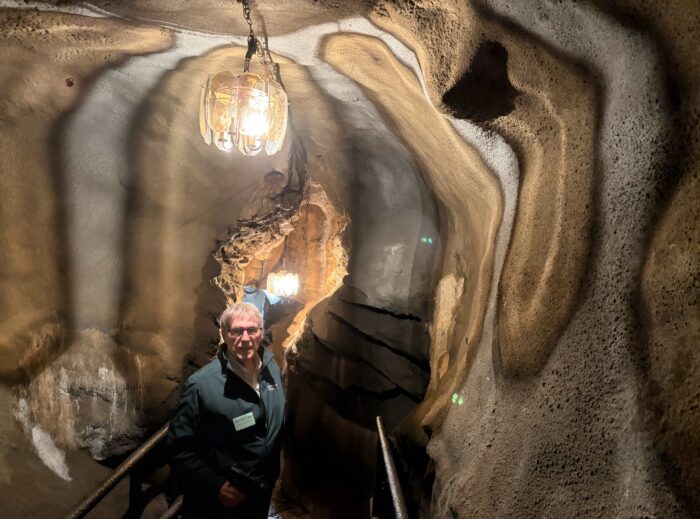
This story originally aired in the Oct. 25, 2026, episode of Inside Appalachia.
Laurel Caverns is a sprawling cave system in Fayette County, Pennsylvania, the largest known in the state, covering about four miles. It’s found under what was once the family farm of David Cale, a spry 81-year-old retired physics professor, married for nearly 50 years to Lillian Cale – a teacher he met when she brought her class on a field trip to the caves. Earlier this year, the Cales donated more than 400 acres of land to Pennsylvania’s Department of Natural Resources, turning Laurel Caverns into a state park.
To enter the caverns, visitors are taken through an unassuming door in a visitor center built partially into the rock. Once underground, the stone ripples above almost like a river, coming together to form a cathedral-like ceiling.
The stone that makes up the caverns is over a hundred million years older than the Appalachian Mountain themselves, according to Cale.
“When the mountains were formed, these flat gray beds of rock were buckled upwards,” he said, pointing at the rock. “Then as the mountain eroded, the groundwater got in here and started to dissolve the rock.”
In another 10 to 40 million years, all this rock will also disappear, he said.
“The mountain is eroding at the rate of about three inches every thousand year,” Cale explained.
Cale has been exploring these passages for a long time. He said his first birthday party was held there in 1946. He started exploring the caverns alone at age 7. By his teens, he was helping expand access to the cave system.
“I worked with my grandfather and my father in 1957,” he said. “We worked on digs in the cave trying to break through into new parts of the cave where no one had ever been before.”
Cale said he had always wanted to share the caverns with the public. In fact, for decades before Laurel Caverns actually became a state park, Cale faked it.
“I made it look like a state park,” he said. “I mimicked their signage. I mimicked everything.”
The signs had white lettering on brown backgrounds – the same style the federal government uses for national parks and other cultural sites. When the state took over the land, they kept most of the signs inside the cave exactly as they were.
Cale isn’t alone in his fascination with vast underground landscapes. Humans have been exploring caves since prehistoric times, but modern economic interests often focus more on mineral rights or on what can be built above a cave.
Cale said, if he wanted to make big bucks, he should have opened up a quarry. But that would have meant short-term profit at the cost of the cavern itself.
“It would take my operation 60 years to match what this place would make as a quarry” he said, noting the cave tours have been in operation for 60 years. “So, we can go for another 60 years with that same economic impact for the community.”
By sharing his cave with others, Cale is helping preserve Laurel Caverns, but he’s also part of a larger underground conservation trend. The push to preserve caves as unique habitats was kick-started by tourism.
“Show caves were the beginning, and they really brought on more of the cave conservation world,” said Emily Davis, a longtime caver who advises the National Speleological Association on cave conservation and education.
Show caves make caving easy.
They usually involve a guided tour along a developed, lit trail that highlights underground wonders. The first show cave in the U.S. opened at Grand Caverns in Grottos, Virginia, in 1806.
Then, as the parks movement gained steam in the early 1900s, the government began to protect some caves from South Dakota, to Kentucky, to New Mexico.
Many caves are now recognized as important natural habitats for hibernating bats and other species, such as cave salamanders, said Davis.
That includes in Appalachia, which is rich in subterranean glory, according to Davis.
“If you drive around Virginia and West Virginia, you will come on to areas that are full of sink holes, full of divots in the fields,” Davis explained. “And when you see rivers that vanish underground or appear above ground suddenly. Those are coming from underground water flow.”
Those are telltale signs of a cave.
Water also played a major part in the creation of this landscape. Long before the tectonic plates collided, there was an ocean here, which is why many Appalachian caverns are limestone, although the rock in Laurel Caverns is a type of sandstone.
“Calcium from the sea life mixed together with the grains of the sand and formed basically what is a natural concrete,” said Cale, pointing to a ripple in the stone.
Though the ocean is long gone, there is still water in Laurel Caverns. It features a towering waterfall, illuminated by spotlights; reflections glimmer across the ceiling; the flow caught in a pool, then flows underneath the trail.
Cale said he used to swim here with friends.
“We would sit on that natural bridge, slide over the back, drop down into the cold muck,” he said.
Cale’s family first bought the land above the caverns as a farmstead in the 1930s. In 1964, his grandfather opened the caverns for tours. There are still passages lit by chandeliers Cale helped string, including the “Discovery Passage,” which was one of the first parts of the caverns uncovered in the late 1700s.
“I wanted to preserve it exactly as it was without any cement on the walls or anything. So, I suspended the lights in midair using these chains,” Cale said, waving at a string of chandeliers suspended along a passage the length of a football field.
Cale said he was heartbroken when his grandfather decided to sell the farmstead in 1969.
The two lawyers who purchased the property hired Cale to keep the cave tours running. A few years later, they were considering selling the land to developers, who wanted to build homes above the caves. This worried Cale.
“The problem is that would put several hundred septic tanks over top of the cave and very much affect the cave hydrology – the polluted water would be entering the cave,” he said.
Development can be especially damaging to underground environments, according to Davis, the cave conservationist.
“The protection of land in the Appalachian region really requires thought – what you’re doing above ground affects what’s going on underground,” she said.
In 1973, Cale found an investor who would help him preserve the caverns. A little over a decade later, Cale bought out that investor. In 1994, he created the conservancy that still offers tours.
Now, the state of Pennsylvania is looking to add more outdoor amenities. It’s already at work on a short trail at the visitor center, according to Mike Mumau, a long-term state parks official who now leads the division that includes Laurel Caverns.
“We wanted folks who were arriving, who may have traveled, a chance to stretch their legs above ground on a nice day,” he said.
Mumau is also thinking about another visitor to the park: Bats.
In the winter, when the caverns are closed to the public, they become what was once one of the largest seasonal bat habitats in the northeast.
“I think they were close to somewhere in the neighborhood of 1,500 to 2,000 bats,” Mumau said.
That was before white nose syndrome, a fungal disease that’s decimated regional bat populations over the past two decades, including at Laurel Caverns.
This past spring, the park observed fewer than fifteen bats wintering on site, according to Mumau. The state has plans to help them return, including by modifying the bat gates, openings that allow bats into caves while keeping humans and other animals out. But these are small changes.
“Many people probably haven’t noticed too much of a change because a lot of what was laid down by David and his family is something that was already in line with how we go about and how we approach things,” Mumau said.
Some of the tour guides at Laurel Caverns worry David Cale will have a hard time when bigger changes come. But when we talk, Cale seems excited about Laurel Caverns’ next chapter.
“You know at my age, a lot of my classmates are dead now,” he told me. “So it’s better that I have lived to see what I wanted it to be.”
For Cale, preserving the caverns for the public was like taking care of a good friend.
“I made a promise to the cave to take care of it. I kept that promise,” Cale said.
And because of that promise, more generations will get to explore Laurel Caverns.
Add WVPB as a preferred source on Google to see more from our team

Two white-feathered birds from a Pendleton County, W.Va. farm have been selected for the traditional White House pardon.
Continue Reading Take Me to More NewsWashington National Cathedral will host the funeral service for West Virginia Governor and Senator Jay Rockefeller who died on Nov. 6.
Continue Reading Take Me to More NewsYou can now submit a proposal to lease three historic structures in the historic town of Thurmond in the New River Gorge National Park and Preserve.
Continue Reading Take Me to More NewsEvery year, NPR's StoryCorps organizes The Great Thanksgiving Listen and encourages people to capture family histories before it is too late.
Continue Reading Take Me to More News